
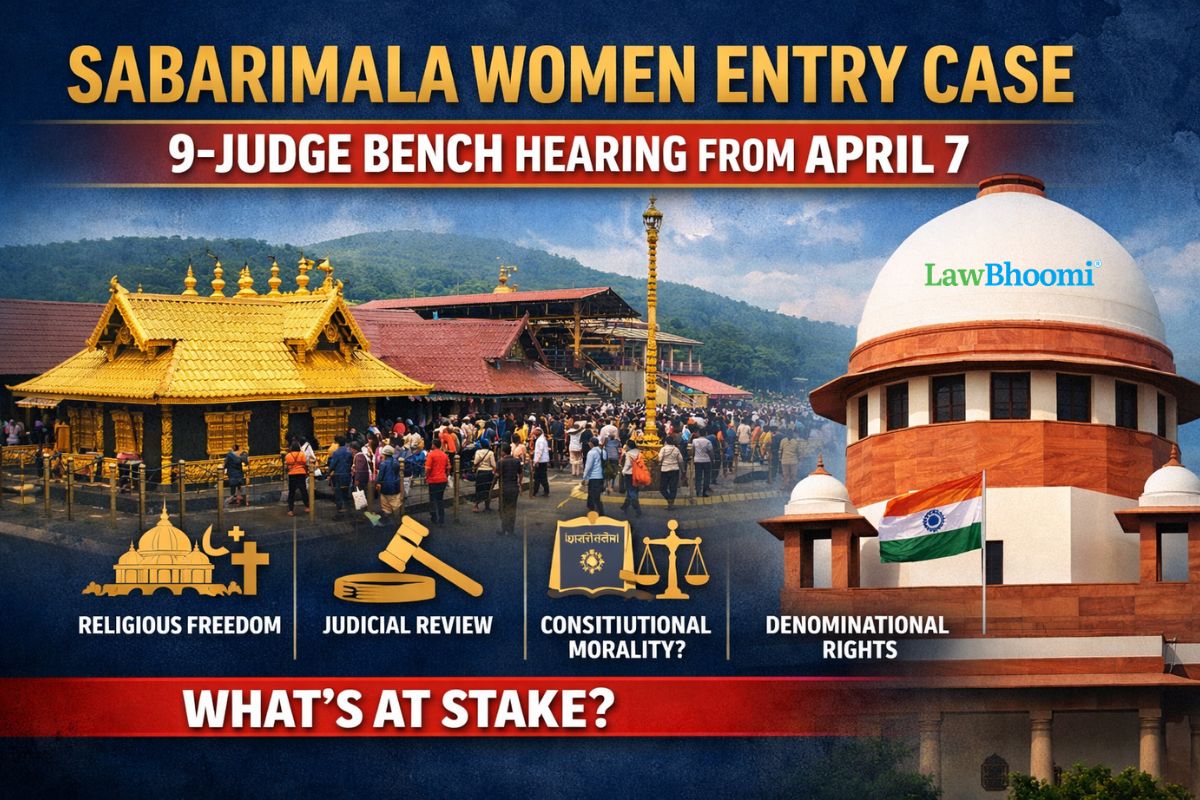
The Supreme Court has fixed April 7 as the date to begin hearing a batch of petitions relating to the Sabarimala women entry case before a nine-judge Constitution Bench. The Court has set aside two weeks, from April 7 to April 22, to complete arguments in the matter.
A Bench led by Chief Justice Surya Kant, along with Justices Joymalya Bagchi and Vipul M Pancholi, announced the schedule and directed all lawyers to strictly adhere to timelines. Written submissions must be filed by March 14.
The hearing will take place in phases.
From April 7 to April 9, the Court will hear arguments from those seeking a review of the 2018 judgment that allowed women of all ages to enter the Sabarimala Temple in Kerala. From April 14 to April 16, the Court will hear parties opposing the review. Rejoinders will be taken up on April 21, followed by final submissions.
The structured schedule suggests that the Court intends to complete hearings within the announced time frame.
The case is no longer only about entry of women into the Sabarimala Temple. It now involves larger constitutional questions.
In 2018, a five-judge Bench of the Supreme Court had ruled that the exclusion of women between 10 and 50 years of age from Sabarimala was unconstitutional. That verdict triggered protests and review petitions.
In 2019, while considering the review pleas, a five-judge Bench observed that certain issues raised in the Sabarimala case were common to other pending matters relating to religious practices. These included issues concerning Muslim women’s entry into mosques, Parsi women’s entry into fire temples after marrying outside the faith, and certain practices in other communities.
The Court decided that before addressing the review petitions, it needed clarity on broader constitutional principles. That is why the matter has now been placed before a nine-judge Bench.
The nine-judge Bench will examine important constitutional questions, including:
These questions go beyond Sabarimala and may affect several religious and constitutional disputes in the future.
The upcoming proceedings are expected to clarify how courts balance religious freedom and equality. The decision may reshape the doctrine of “essential religious practices,” a principle courts have used to determine which religious customs are constitutionally protected.
Whatever the outcome, the nine-judge Bench’s ruling is likely to become a major constitutional precedent. All eyes will now be on April 7, when arguments begin in one of the most closely watched cases concerning religion and fundamental rights in India.