

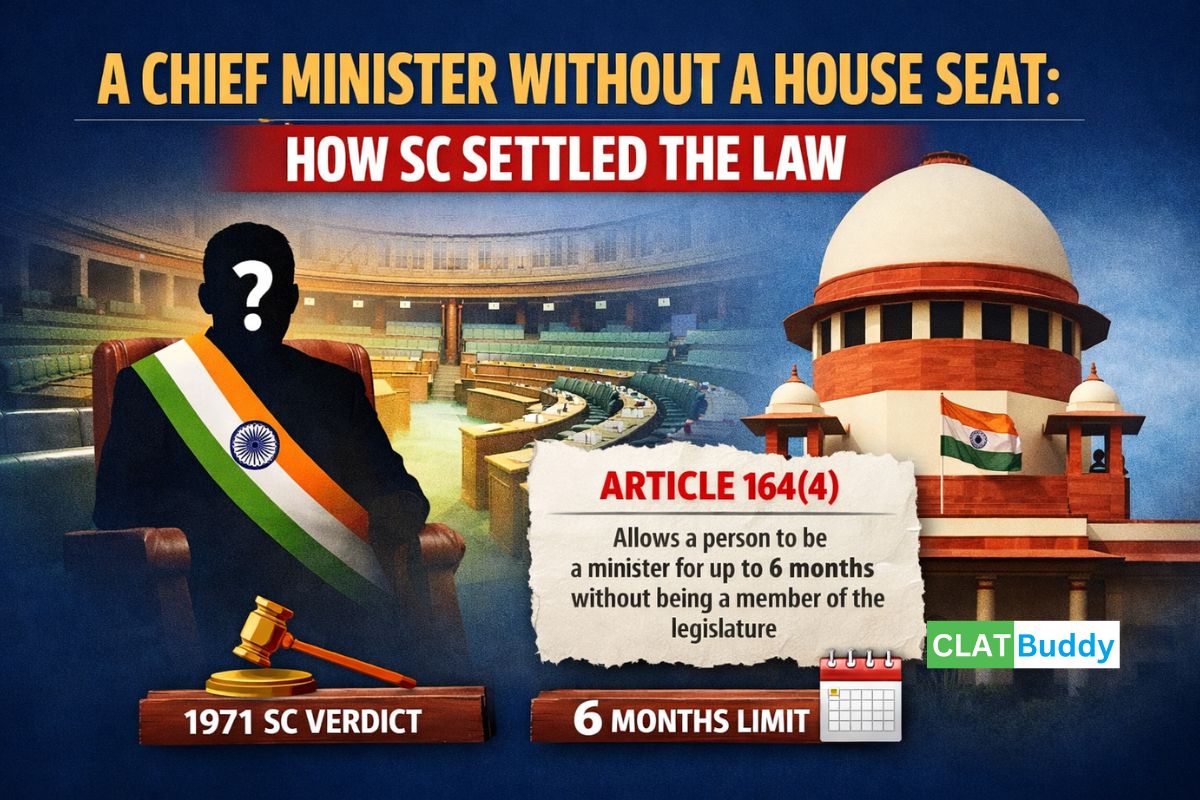
Can a person who is not a member of a State Legislature become Chief Minister? This question has resurfaced in public debate following recent political developments, but constitutionally, the issue was settled decades ago by the Supreme Court of India.
The answer lies in Article 164(4) of the Constitution of India. The provision allows a person to be appointed as a minister, including the Chief Minister, even if they are not a member of the Legislative Assembly or Legislative Council. However, such an appointment is temporary. The individual must secure membership of the legislature within six months, failing which they must resign.
While this clause exists on paper, it gained practical significance only during the politically unstable period of the late 1960s and early 1970s.
After the 1967 Assembly elections, Bihar saw its first non-Congress government. Political instability soon followed, leading to the resignation of Chief Minister Mahamaya Prasad Sinha. Congress support enabled Bindeshwari Prasad Mandal to stake claim to the Chief Minister’s post.
Mandal, however, was not a member of either House of the Bihar Legislature. To overcome this hurdle, Satish Prasad Singh was sworn in as Chief Minister for a brief period of five days, allowing Mandal to be nominated to the Legislative Council. Once Mandal became an MLC, Singh resigned, and Mandal took over.
Although constitutionally permissible, this arrangement had not yet been judicially examined.
The constitutional position was conclusively settled following events in Uttar Pradesh. In October 1970, Tribhuvan Narain Singh, a Rajya Sabha member, was sworn in as Chief Minister despite not being an MLA or MLC.
His appointment was challenged before the Allahabad High Court and subsequently before the Supreme Court. The petitioner argued that a Chief Minister must be a member of the State Legislature at the time of appointment.
In its judgment dated March 16, 1971, the Supreme Court rejected this argument. It held that:
This ruling clarified that legislative membership is not a precondition for assuming the office of Chief Minister, provided the constitutional timeline is respected.
Although the judgment upheld Singh’s appointment, political realities soon caught up. Singh contested a by-election to comply with Article 164(4) but lost. Shortly thereafter, his government lost majority support in the Assembly, and he resigned.
Despite this, the legal principle laid down by the Supreme Court has endured.
The 1971 ruling has since served as the constitutional basis for several Chief Ministers and ministers across states to take oath without immediate legislative membership. It balances democratic accountability with political practicality, allowing continuity of government while imposing a strict time limit for electoral legitimacy.
Under Indian constitutional law, a Chief Minister can be appointed without being a member of the State Legislature. However, the Constitution makes this an exception, not the norm, by requiring the individual to secure a seat within six months. The Supreme Court’s interpretation ensures that executive flexibility does not undermine representative democracy.