
The Allahabad High Court has directed the Consortium of National Law Universities to revise the CLAT UG 2026 merit list after finding flaws in the way a disputed answer was handled.
The case arose from a writ petition filed by a minor candidate, Avneesh Gupta, who challenged the official answer key of CLAT UG 2026. The petition mainly focused on one Logical Reasoning question, where subject experts had accepted two answer options as correct, but this view was later overturned by an Oversight Committee without giving any reasons.
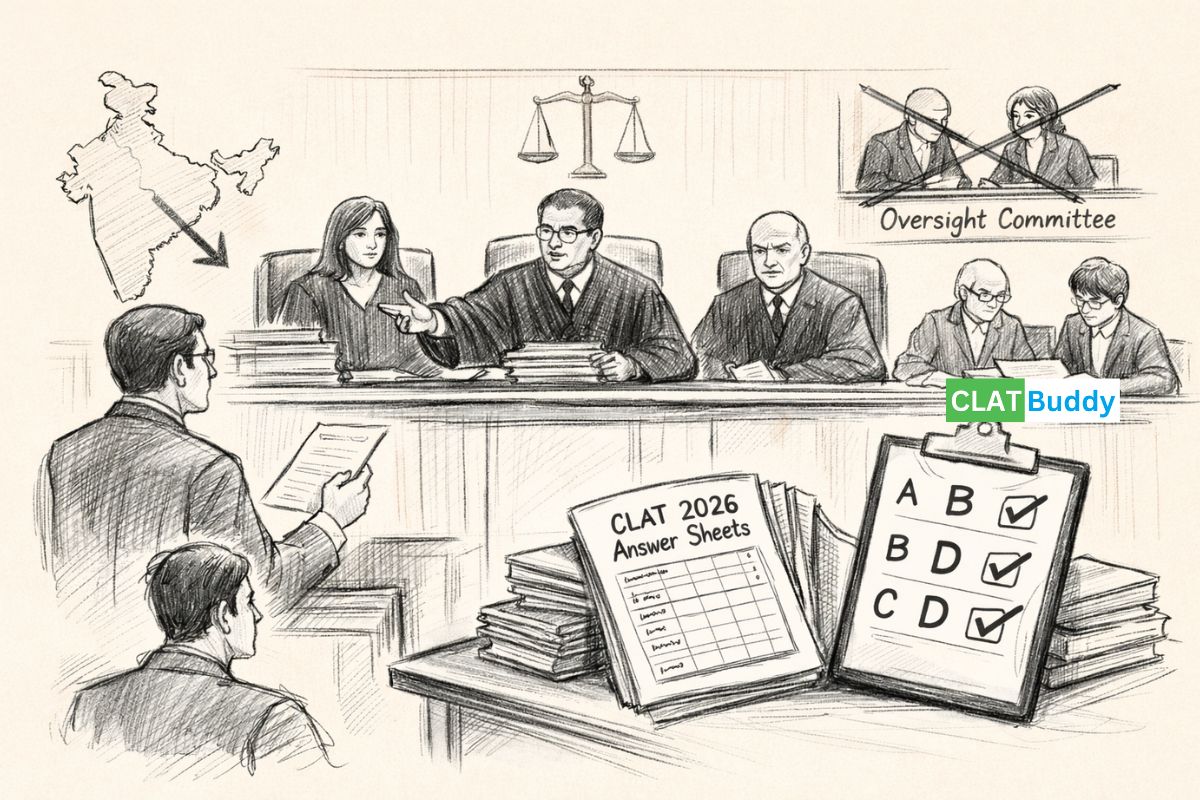
An Expert Committee, which included academics from Logic, Philosophy, and Economics, concluded that both options ‘B’ and ‘D’ were correct for the disputed question. However, the Oversight Committee reversed this decision and retained only one correct answer, without explaining why.
Justice Vivek Saran held that such an approach is legally unsustainable. The Court stressed that any administrative or quasi-judicial decision must record reasons, especially when expert opinions are being overruled.
The High Court relied on Supreme Court judgments to reiterate that:
The Court observed that overruling expert findings without justification is contrary to settled law.
The Consortium argued that the Allahabad High Court lacked jurisdiction since it is registered in Karnataka. The Court rejected this plea, noting that the candidate appeared for the exam in Ghaziabad, Uttar Pradesh, and therefore part of the cause of action arose within its jurisdiction.
In short, the judgment ensures fairness in evaluation while also protecting students who have already secured admission.