

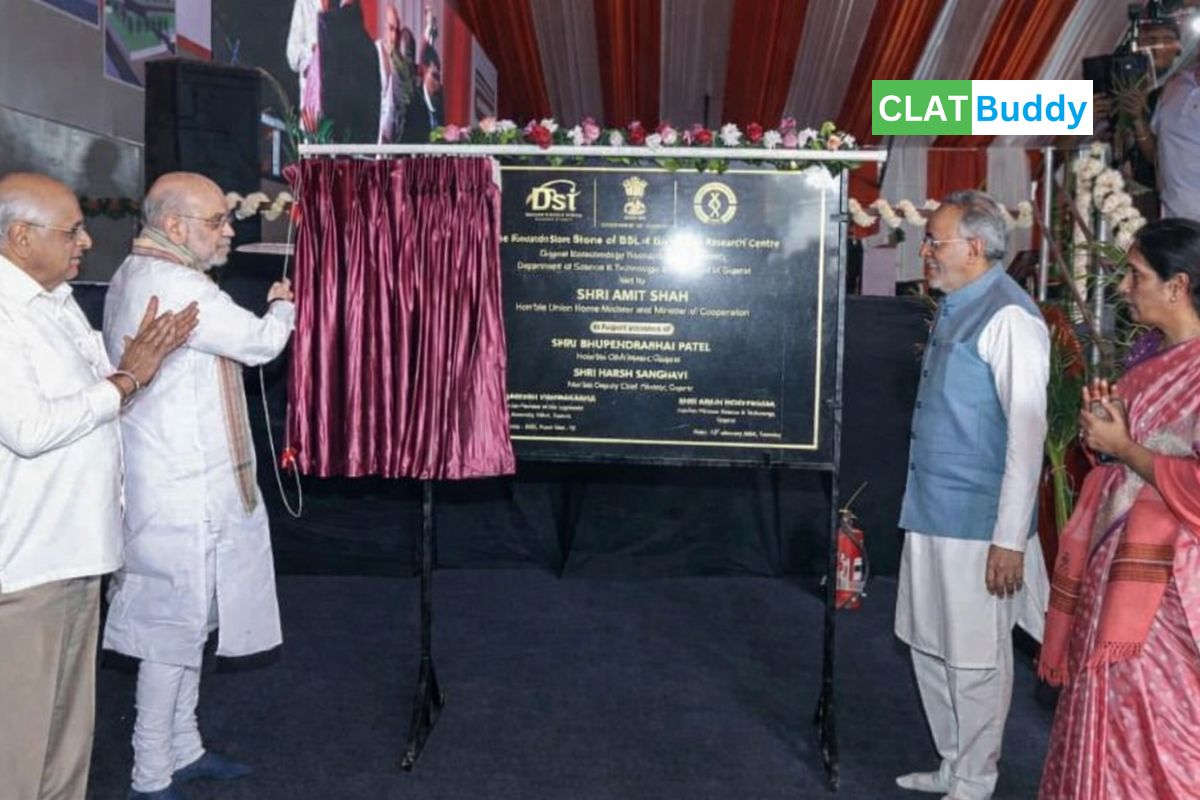
India has taken a significant step towards strengthening its health security and bio-preparedness with the foundation of its first state-funded Bio-Safety Level 4 (BSL-4) laboratory in Gandhinagar, Gujarat. The facility marks a major milestone in India’s ability to research, contain, and respond to the world’s most dangerous infectious diseases.
Union Home Minister Amit Shah, while laying the foundation stone in January 2026, described the laboratory as a “health shield” for the nation. The project signals a shift towards decentralised, state-led investment in advanced biotechnology and biosecurity infrastructure.
A Bio-Safety Level 4 (BSL-4) laboratory represents the highest level of biological containment in the world. Such facilities are designed to safely handle highly infectious and often fatal pathogens for which no proven vaccines or treatments may exist.
BSL-4 labs operate under extremely strict safety protocols. Researchers work in specialised protective suits, air pressure is carefully controlled, and all waste is fully decontaminated. These laboratories are essential for studying viruses and pathogens that pose serious threats to public health, including emerging and re-emerging diseases.
In addition to basic research, BSL-4 facilities play a crucial role in:
The BSL-4 laboratory being constructed in Sector-28, Gandhinagar, is significant for several reasons.
First, it is India’s first fully state-funded and state-controlled BSL-4 facility. Until now, such high-containment labs were either centrally funded or under defence institutions. This project reflects growing state-level capacity in advanced scientific research.
Second, it will be the second civilian BSL-4 laboratory in India, after the National Institute of Virology (NIV) in Pune. Given India’s large population and exposure to zoonotic diseases, the addition of another civilian BSL-4 lab addresses a long-standing infrastructure gap.
The facility will be spread over 11,000 square metres, with an estimated cost of ₹362 crore, and is being developed under the Gujarat State Biotechnology Mission.
The laboratory will function under the Gujarat Biotechnology Research Centre (GBRC). GBRC already houses a BSL-2+ laboratory and played a key role during the Covid-19 pandemic by sequencing the SARS-CoV-2 genome.
Planning for the BSL-4 facility began in mid-2022, highlighting a long-term strategic approach rather than a reactive response. The foundation stone was laid on January 13, 2026, signalling the transition from planning to execution.
The Gujarat complex is designed as a multi-level biosafety facility, not limited to BSL-4 alone. It will include:
The facility is being developed in accordance with international biosafety standards, including guidelines issued by:
Compliance with these standards ensures that the laboratory can collaborate globally and handle pathogens safely.
One of the most important contributions of the Gujarat BSL-4 lab will be its ability to support real-time outbreak response. The facility will enhance both Gujarat’s and India’s capacity to respond quickly to outbreaks of deadly human and zoonotic diseases.
The laboratory will also support:
The inclusion of an ABSL-4 facility is particularly important. It will allow research on animal diseases and vaccine development using antibodies derived from animals. Earlier, such work often required sending samples to the ICAR–National Institute of High Security Animal Diseases, creating delays and logistical challenges.
The Department of Biotechnology has signed a Memorandum of Understanding designating the Gujarat BSL-4 lab as a national facility. This means that it will receive guidance and oversight from expert institutions across India.
Officials have noted that the lack of adequate BSL-4 infrastructure has been a major bottleneck in India’s infectious disease research ecosystem. The new facility is expected to ease this constraint and improve coordination between central and state agencies.
India currently has limited BSL-4 and ABSL-4 infrastructure.
The National Institute of Virology (NIV), Pune is the only fully functional civilian BSL-4 lab in India. It handles research on the most dangerous human pathogens.
In late 2024, the Defence Research and Development Organisation (DRDO) established a BSL-4 laboratory in Gwalior, Madhya Pradesh, under the Defence Ministry.
India also has key institutions studying zoonotic diseases:
Beyond BSL-4 facilities, India has been steadily expanding its biosafety network.
As of March 2025, the Virus Research and Diagnostic Laboratories (VRDL) scheme, under the Ministry of Health and Family Welfare, has approved:
These labs focus on epidemic preparedness and disaster response.
The Indian Council of Medical Research has established:
The Gujarat BSL-4 laboratory reflects a broader national strategy to strengthen India’s health security, scientific self-reliance, and outbreak preparedness. While most of India’s biosafety capacity remains concentrated at BSL-2 and BSL-3 levels, targeted investments in high-containment laboratories like this one are critical for dealing with future pandemics and biosecurity threats.
By combining state leadership with national oversight, the project represents a meaningful step towards a more resilient and responsive public health system.