
If you are preparing for CLAT 2027 and often feel that only toppers or “brilliant” students can crack the exam, this doubt is more common than you think. Many students sitting for CLAT come from average academic backgrounds and still secure seats in top NLUs every year. The idea that CLAT is meant only for extraordinary students is a myth that needs to be broken early in your preparation journey.
CLAT does not test how many marks you scored in school. It tests how well you understand passages, think logically, manage time, and stay consistent. With the right approach, an average student can definitely crack CLAT 2027.
Before judging your chances, it is important to understand what “average” actually means in the context of CLAT.
Most students who call themselves average usually fall into one or more of these categories:
None of these issues disqualify you from cracking CLAT. CLAT is not about memorising facts or writing long answers. It is about understanding, practice, and strategy. Many rankers started exactly where you are today.
This is one of the biggest misconceptions about CLAT.
CLAT is a skill-based exam, not a knowledge-heavy exam. It tests:
School toppers often struggle in CLAT because they rely heavily on rote learning. On the other hand, students with average marks but good reading habits and discipline often perform better.
CLAT rewards:
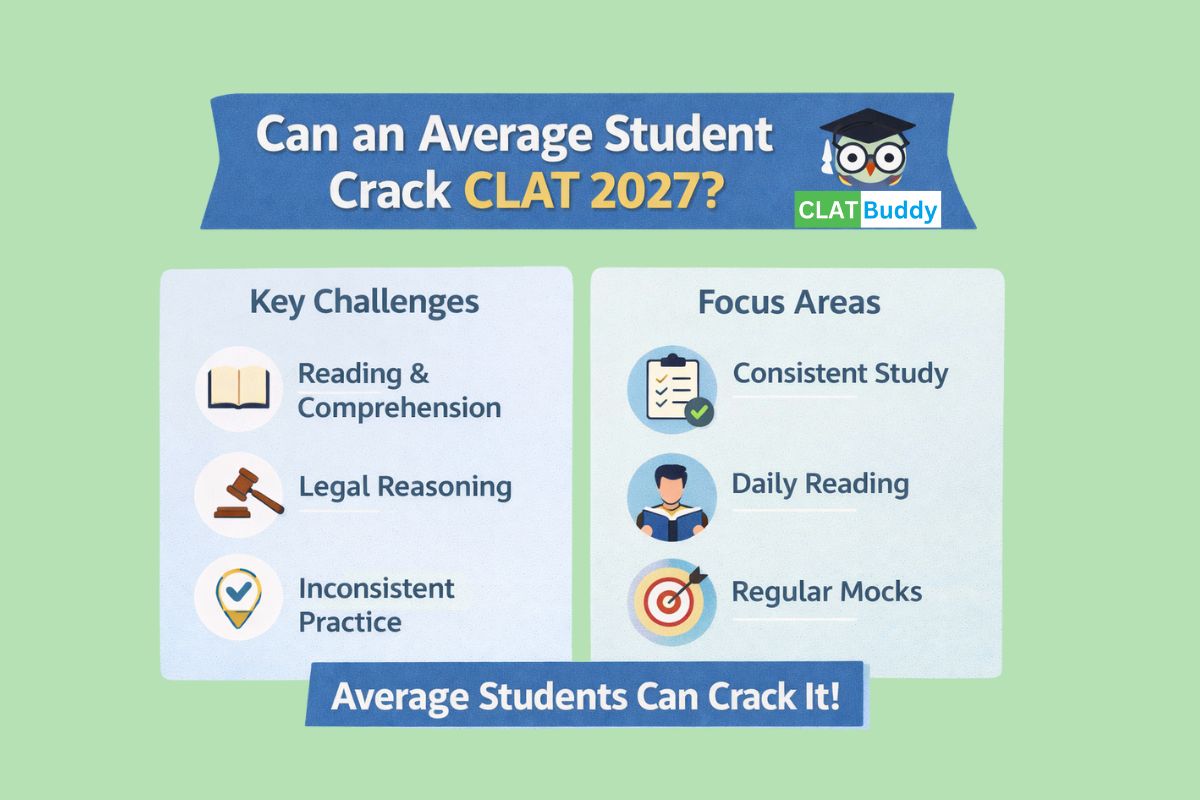
Understanding the challenges helps you plan better.
Many students feel overwhelmed by long passages in English, Legal Reasoning, and Current Affairs. Initially, it may take too much time to read and understand questions.
Legal reasoning feels unfamiliar because it is not taught in schools. Concepts like principles, facts, and application may seem confusing at first.
Average students often start with motivation but struggle to maintain daily consistency. Skipping practice for a few days quickly turns into weeks.
Low scores in early mock tests can affect confidence. Many students give up too early without realising that improvement takes time.
These challenges are normal and solvable.
Yes, without any doubt.
CLAT is a marathon, not a sprint. Intelligence helps, but consistency beats intelligence every single time.
If you:
You will outperform students who rely only on talent and study irregularly.
Many CLAT toppers improved their mock scores gradually over 8–12 months. They were not scoring well from day one.
Preparation needs to be realistic, structured, and stress-free.
Starting early gives you a massive advantage. Even if you study less initially, building daily habits is more important than studying long hours.
Focus on:
Since most sections are passage-based, reading becomes your biggest weapon.
Read:
Do not rush reading. Focus on understanding tone, argument, and conclusion.
Legal reasoning is not about law knowledge. It is about applying rules to facts.
Start by:
With practice, this section often becomes a scoring area.
Coaching is helpful, but not compulsory.
Coaching helps by:
However, many average students crack CLAT through self-study by using:
What matters is not where you study, but how seriously and consistently you study.
Mock tests are non-negotiable.
Mocks help you:
Initially, scores may be low. That is normal.
The real improvement happens during:
An average student who analyses mocks properly often improves faster than a topper who ignores analysis.
Yes, if preparation is strategic.
Remember:
CLAT is not about defeating thousands of students. It is about being better prepared than yesterday.
If you improve a little every week, your rank improves naturally.
Mental strength is just as important as academics.
You will face:
Successful students are not stress-free. They simply learn how to manage pressure.
Ways to stay mentally strong:
Confidence grows with preparation, not motivation videos.
Improvement is gradual.
Most students see:
Do not expect instant results. CLAT rewards patience and discipline.
Yes, provided preparation is focused.
If you are starting late:
Many students start late and still crack CLAT because they study smartly.
Avoiding mistakes is as important as studying.
Stay away from:
Simple plans executed consistently work best.
Yes, absolutely.
Every year, students from small towns, average schools, and non-English backgrounds enter top NLUs. Their common strengths are:
CLAT does not ask where you started. It only cares about how well you perform on one day.
If you are willing to:
Then yes, an average student can crack CLAT 2027.
Your background, school marks, or initial mock scores do not define your future. Your daily effort does.
Start small, stay consistent, and trust the process. CLAT rewards those who prepare smartly, not those who label themselves early.