

If you are an Arts student preparing for CLAT, this question has probably crossed your mind more than once. You may have heard people say that CLAT is meant for students from science or commerce backgrounds, or that Arts students have an unfair advantage. With so many opinions around, it is easy to feel confused or even underconfident.
The truth is far more balanced and reassuring. Arts students can crack CLAT, but not because it is easy. They succeed because their subject background aligns well with some parts of the exam, and with the right strategy, they can turn this alignment into real scores. Let us break this down clearly so you know where you stand and how you can move forward.
CLAT is not designed to favour any one stream. The exam tests skills, not school subjects. What often creates the perception that Arts students find CLAT easier is the overlap between Arts subjects and certain sections of the exam.
As an Arts student, you may already be familiar with reading newspapers, understanding social issues, interpreting passages, and forming logical opinions. These abilities are extremely useful in CLAT. However, they do not automatically guarantee success. Without focused practice and exam awareness, even Arts students can struggle.
So no, CLAT is not easy just because you are from Arts. But yes, your background can help if you use it the right way.
To understand your advantage clearly, you need to look at how CLAT is structured and where Arts students usually feel more comfortable.
CLAT is a passage-based exam. Almost every section requires you to read long texts, understand arguments, and answer questions based on interpretation rather than memory.
As an Arts student, you are likely used to:
This habit of reading and thinking deeply helps you manage CLAT passages better, especially under time pressure.
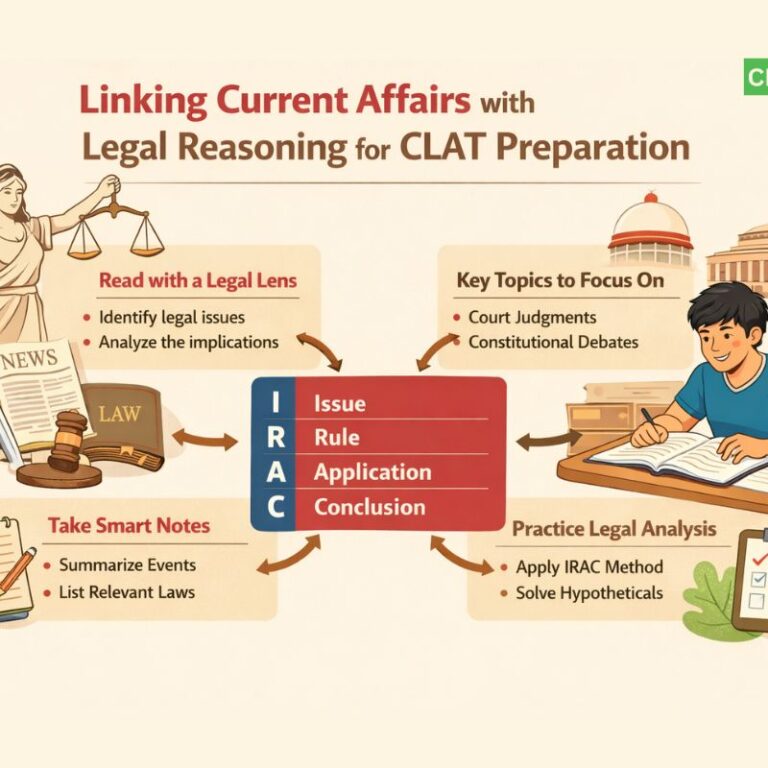
Current Affairs and General Knowledge is one section where Arts students often feel more confident, especially those studying subjects like Political Science, History, Sociology, or Economics.
Arts subjects often discuss:
When CLAT asks questions on topics like Parliament, Supreme Court decisions, global summits, or social justice issues, you are not seeing these ideas for the first time. This familiarity helps you understand news better and remember information more effectively.
However, CLAT Current Affairs is very specific and exam-oriented. Relying only on school textbooks or casual reading is not enough. You still need structured monthly preparation and revision.
Legal Reasoning is often considered the heart of CLAT, and this is where Arts students can truly shine if they prepare smartly.
Legal Reasoning is not about knowing laws. It is about:
Arts students are trained to read carefully, identify assumptions, and analyse situations from different perspectives. These skills are extremely helpful when you solve legal passages.
If you enjoy debating, analysing case studies, or discussing ethical and social questions, Legal Reasoning can become one of your strongest sections.
While Arts students have certain natural strengths, there are also areas where extra effort is needed. Being aware of these early can save you from losing easy marks.
Quantitative Techniques is the section where many Arts students feel anxious. This section involves basic mathematics, including percentages, ratios, averages, graphs, and data interpretation.
The level of maths in CLAT is not advanced. It is mostly Class 10 standard. The real challenge is speed, accuracy, and confidence.
If you have avoided maths for a long time, this section can feel uncomfortable at first. But with regular practice, it becomes manageable. Many Arts students score well here once they stop fearing numbers and start practising step by step.
This is a very common doubt, and it is important to address it honestly.
Science and commerce students may feel more comfortable with numbers, charts, and calculations. This helps them in Quantitative Techniques. However, they may struggle with long reading passages or opinion-based questions if they are not habitual readers.
CLAT is a balanced exam. Every student has strengths and weaknesses depending on their background. Success depends on how well you balance all sections, not on which stream you come from.
In the final merit list, what matters is your score, not your subject combination in school.
Not every Arts student automatically performs well in CLAT. Certain habits and attitudes make a big difference.
Arts students who do well in CLAT usually:
If you recognise yourself in these points, you are already on the right path.
Preparation strategy matters more than background. Here is how you can make the most of your Arts stream while covering your weak areas.
You should treat reading as your biggest weapon. Regularly read:
While reading, focus on understanding arguments, assumptions, and conclusions. This habit directly improves Legal Reasoning, English, and even Logical Reasoning.
Instead of trying to master everything at once, start small.
With consistent practice, Quantitative Techniques can become a scoring section even for Arts students.
Mocks tell you where you stand, but analysis tells you how to improve. As an Arts student, analysis helps you understand:
Proper mock analysis can improve your score faster than solving more questions blindly.
If you enjoy reading, thinking critically, and understanding society, law can be a very fulfilling career. Many successful lawyers, judges, policymakers, and legal scholars come from Arts backgrounds.
Law is not about science formulas or commerce calculations. It is about people, rules, rights, and responsibilities. Arts students often connect naturally with these ideas.
If your interest in law is genuine and you are willing to work consistently, your stream will never hold you back.
Arts students can crack CLAT, not because it is easy, but because their skills align well with what the exam tests. Your background gives you a strong foundation in reading, reasoning, and awareness, but success depends on discipline, practice, and smart strategy.
If you stop doubting yourself and start preparing with clarity, CLAT becomes achievable. Your stream does not decide your rank. Your preparation does.
If you stay consistent, believe in your strengths, and work on your weak areas, cracking CLAT as an Arts student is not just possible, it is realistic.