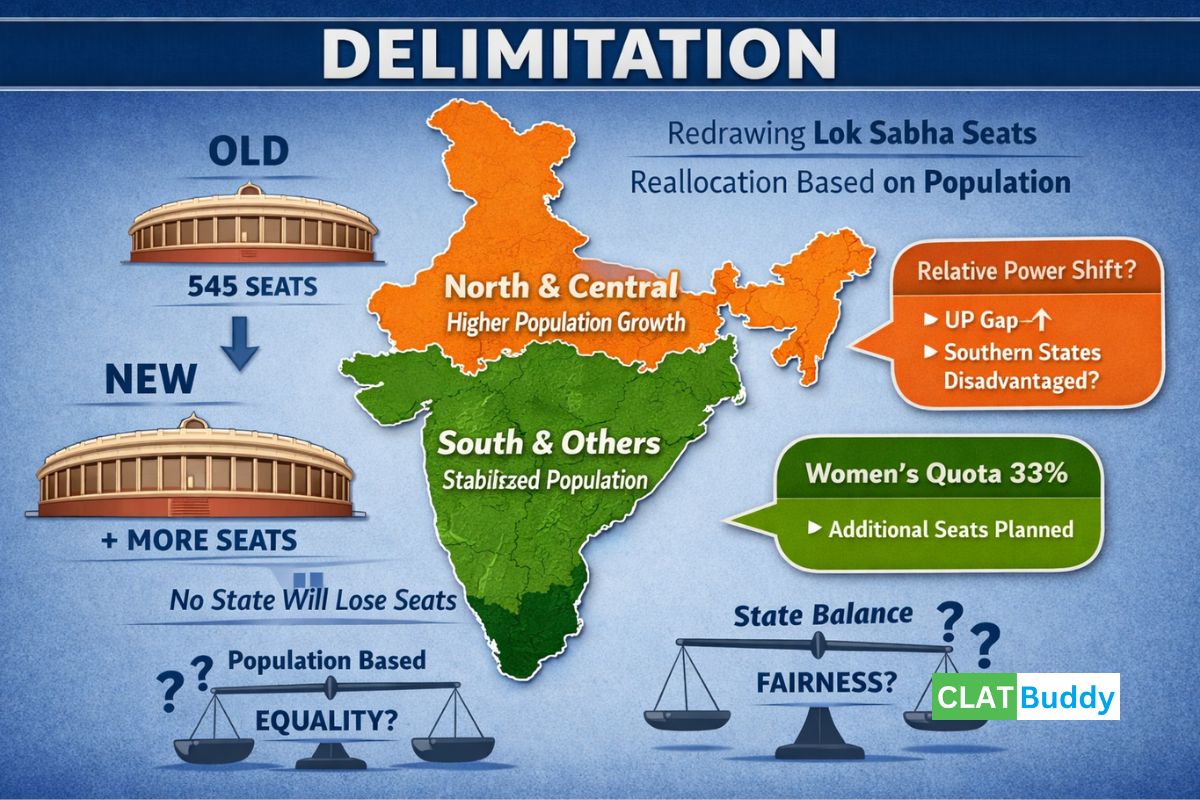
Delimitation is one of the most important constitutional processes in a democratic system like India. It directly affects how people are represented in Parliament and State Assemblies. While elections determine who represents the people, delimitation determines how many representatives a state gets and from which areas.
In recent times, delimitation has once again come into public discussion due to concerns raised by several states regarding fair representation and population-based seat allocation. Understanding delimitation is therefore essential to understand the functioning of India’s representative democracy.
What is Delimitation?
Delimitation refers to the process of fixing the boundaries of electoral constituencies and allocating seats in legislative bodies based on population.
In simple terms, it involves:
- Dividing a country or state into constituencies
- Determining how many seats each state or region gets
- Ensuring equal representation based on population
The objective is to maintain the principle of:
“One person, one vote, one value”
Constitutional Framework of Delimitation
Delimitation in India is governed by constitutional provisions that ensure it is carried out periodically and fairly.
Article 82
This provision states that:
- After every Census, Parliament must enact a law
- Based on this law, the allocation of Lok Sabha seats is readjusted
Article 170
- Provides for readjustment of seats in State Legislative Assemblies
Delimitation Commission
- A Delimitation Commission is set up by the government
- It is an independent body
- Its decisions have the force of law and cannot be challenged in court
Delimitation Commission: Composition and Powers
The Delimitation Commission generally consists of:
- A retired Supreme Court judge (Chairperson)
- The Chief Election Commissioner
- State Election Commissioners
Key Powers
- Determine constituency boundaries
- Allocate seats to states
- Reserve constituencies for SC/ST communities
Once the Commission finalises its orders:
They are final and binding
History of Delimitation in India
Delimitation has been carried out several times since independence:
- 1952 – First delimitation based on 1951 Census
- 1963 – Based on 1961 Census
- 1973 – Based on 1971 Census
- 2002 – Based on 2001 Census (but with limitations)
Why Was Delimitation Frozen?
A major turning point came with the 42nd Constitutional Amendment (1976).
Reason for Freeze
At that time:
- The government wanted to promote population control
- States that controlled population growth should not be penalised
What Was Done
- Seat allocation was frozen based on the 1971 Census
Later, the 84th Amendment (2001) extended this freeze:
Until the first Census after 2026
Current Delimitation Scenario
India is now approaching a crucial phase:
- The next Census is expected to conclude by 2027
- A fresh delimitation exercise is expected thereafter
This will be the first major delimitation in decades affecting seat allocation
Key Issues in Delimitation Debate
1. Population-Based Representation vs Federal Balance
Delimitation is based on population. However, this creates a challenge:
- States with higher population growth may gain more seats
- States with controlled population growth may lose relative influence
This raises concerns about:
Fairness in a federal structure
2. North-South Divide
A major concern is the difference between:
- Northern and central states → Higher population growth
- Southern states → Lower population growth
Southern states argue that:
- They should not be penalised for effective governance and population control
3. Political Representation and Power Shift
Even if no seats are reduced:
- Increasing total seats may still change relative power balance
Larger states may:
- Gain more seats in absolute numbers
- Increase their influence in Parliament
Reservation and Delimitation
Delimitation also affects:
- Reservation of seats for Scheduled Castes (SCs)
- Reservation for Scheduled Tribes (STs)
The proportion of reserved constituencies:
- Depends on population data
The Women’s Reservation Act, 2023 further adds complexity:
- 33% reservation is to be implemented after delimitation
Conclusion
Delimitation is not merely a technical process of drawing boundaries. It is a core democratic exercise that shapes political representation in India.
The upcoming delimitation will be particularly significant because:
- It comes after decades of freeze
- It involves major demographic changes
- It raises questions about fairness, federalism and representation
Balancing population-based representation with regional equity will be the biggest challenge. The way this process is handled will have long-term implications for India’s political structure and democratic functioning.
Calling all law aspirants!
Are you
exhausted from constantly searching for study materials and question banks?
Worry not!
With over
15,000 students already engaged, you definitely don't want to be left out.
Become a member of the most vibrant law aspirants community out there!
It’s
FREE! Hurry!
Join our
WhatsApp Groups (
Click Here) and
Telegram Channel (Click Here) today, and receive instant notifications.