
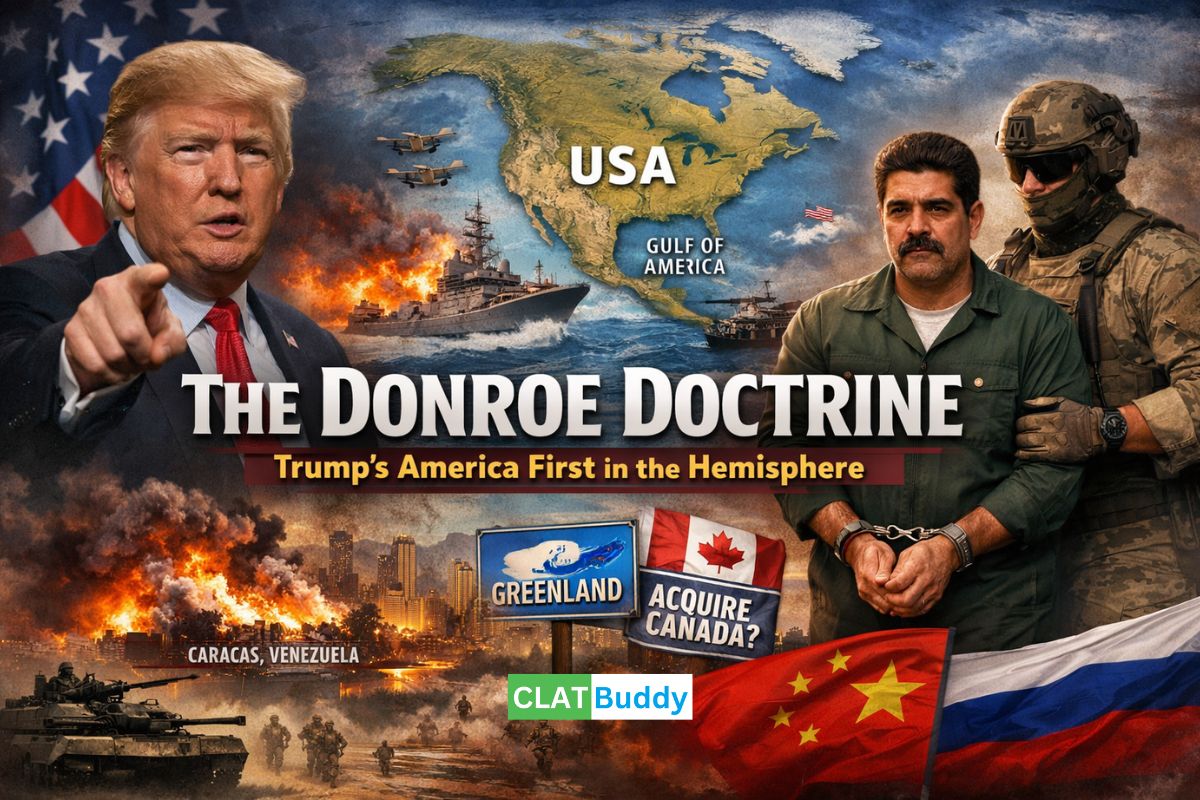
The Donroe Doctrine, also referred to as the Trump Corollary to the Monroe Doctrine, is a term used to describe the foreign policy approach adopted by U.S. President Donald Trump toward the Western Hemisphere during his second term. The doctrine reflects a renewed effort to assert American dominance across the Americas, drawing inspiration from the historic Monroe Doctrine while adapting it to modern geopolitical realities.
The name “Donroe” blends Donald Trump and Monroe, symbolising a modern reinterpretation of the 19th-century policy that warned external powers against interference in the Western Hemisphere.
The original Monroe Doctrine, announced in 1823, declared that European powers should not interfere in the affairs of the Americas. While initially defensive in nature, it later became a foundation for U.S. influence and intervention in Latin America.
The Donroe Doctrine represents a more assertive and unilateral version of this idea. Instead of merely opposing foreign interference, it reflects a willingness to actively shape political and strategic outcomes within the hemisphere through economic pressure, territorial ambition, and military action.
Several policy decisions and statements by President Trump have been cited as evidence of this doctrine in practice:
Following the Venezuela operation, Trump explicitly referred to the Donroe Doctrine, stating that American dominance in the Western Hemisphere would no longer be questioned.
Hemispheric Priority
The doctrine places the Western Hemisphere at the centre of U.S. foreign policy, treating it as a zone of primary American interest and influence.
Unilateral Action
Rather than relying on international institutions or multilateral consensus, the approach emphasises direct U.S. decision-making and enforcement.
Military Readiness
The doctrine accepts the use of military force as a legitimate tool to secure political and strategic objectives within the region.
Countering External Powers
China and Russia are viewed as rival influences in Latin America, and limiting their presence is a key justification for U.S. intervention.
Trump’s skepticism toward multilateral institutions, including NATO and international legal frameworks, has reinforced the perception that the United States is turning inward geographically—focusing more on its own hemisphere than on global leadership.
Supporters argue that this strategy restores American primacy and deters rival powers from gaining influence close to U.S. borders. Critics, however, warn that it undermines international law, weakens democratic norms, and sets a dangerous precedent by legitimising territorial ambition and regime change through force.