
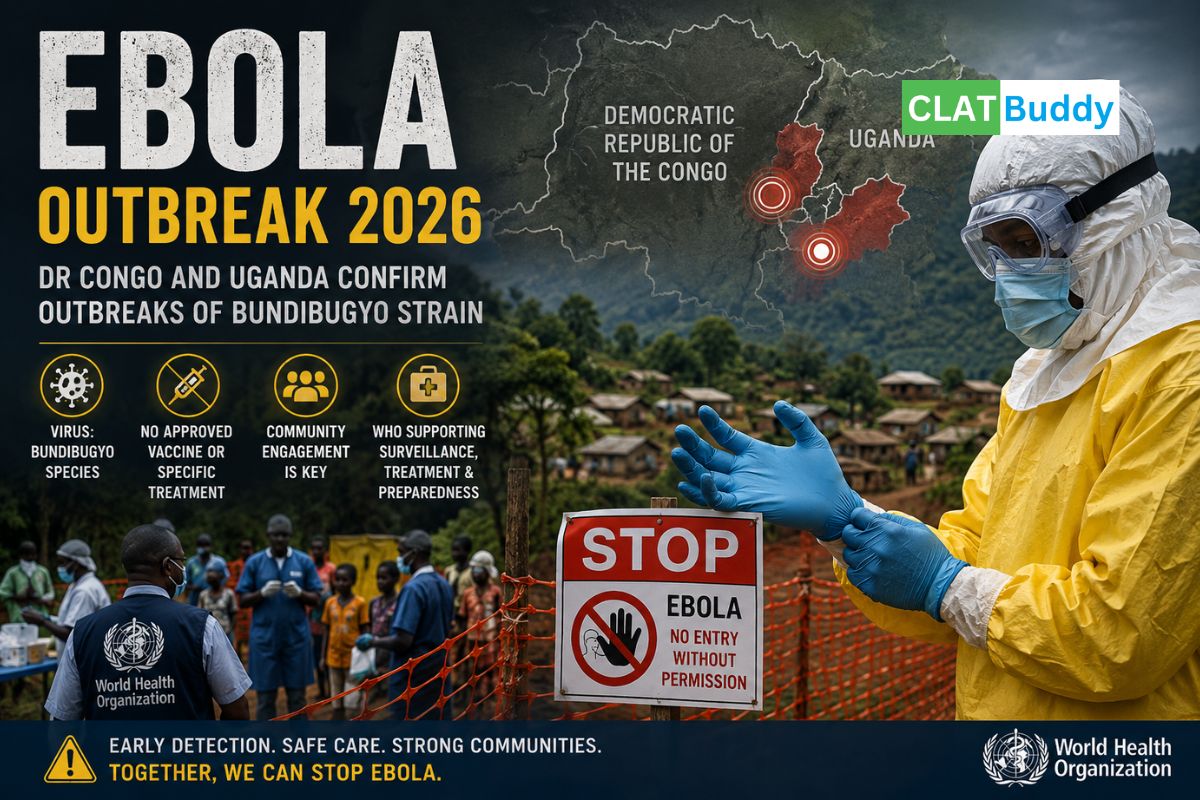
Health authorities in the Democratic Republic of the Congo and Uganda confirmed fresh outbreaks of Ebola in May 2026, triggering renewed concerns among international health agencies and neighbouring countries. The outbreaks involve the Bundibugyo strain of the Ebola virus, a species for which no approved vaccine or specific treatment is currently available. The development has placed regional healthcare systems on high alert, particularly because the affected areas are facing humanitarian challenges, insecurity, and high cross-border movement.
The World Health Organization (WHO) has stepped up its emergency response by supporting both governments in surveillance, contact tracing, clinical preparedness, and community outreach. Medical supplies and trained personnel are also being deployed to strengthen local healthcare systems and prevent wider transmission of the virus.
What Is Ebola?
Ebola virus disease is a severe and often fatal illness caused by viruses belonging to the Ebola family. It spreads through direct contact with the blood, bodily fluids, or tissues of infected individuals or contaminated materials. Symptoms commonly include fever, weakness, muscle pain, vomiting, diarrhoea, and in severe cases, internal and external bleeding.
The disease was first identified in 1976 near the Ebola River in present-day Democratic Republic of the Congo. Since then, several outbreaks have occurred across parts of Africa, with some becoming major public health emergencies. The 2014–2016 West Africa Ebola outbreak remains one of the deadliest in history, causing thousands of deaths across Guinea, Liberia, and Sierra Leone.
Why The Current Outbreak Is Concerning
Health experts have expressed concern because the current outbreak is unfolding in densely populated and remote regions where access to healthcare is limited. Insecurity and displacement of people have further complicated efforts to monitor infections and isolate patients. Frequent trade and population movement between affected areas also increase the risk of cross-border transmission.
Another major concern is the absence of an approved vaccine for the Bundibugyo strain. While vaccines exist for some other Ebola species, researchers are still studying possible candidates for this particular strain. This makes early detection, isolation, and public cooperation especially important.
Done Reading? Now Put It into Practice.
Continue your CLAT preparation with practice questions, question banks and exam-focused learning resources.
Explore Practice Resources →WHO’s Response Measures
The WHO and local health authorities are focusing on several key measures to contain the outbreak:
- Strengthening disease surveillance systems
- Identifying and monitoring contacts of infected persons
- Training healthcare workers for safe treatment practices
- Improving laboratory testing facilities
- Distributing protective equipment and medical supplies
- Conducting awareness campaigns in local communities
- Enhancing border screening and preparedness
Officials have repeatedly stressed that community engagement is one of the most important tools in controlling Ebola outbreaks. Public cooperation helps authorities identify cases early, reduce misinformation, and encourage safe healthcare practices.
Global Monitoring Continues
International health agencies are closely monitoring the situation to prevent the outbreak from spreading further. Neighbouring countries have also begun increasing preparedness measures at border points and healthcare facilities. Although no widespread international transmission has been reported so far, experts warn that rapid action remains essential.
Public health specialists believe that lessons learned from previous Ebola outbreaks, as well as recent experiences during the COVID-19 pandemic, may help authorities respond more effectively. However, they also caution that outbreaks in conflict-affected and underserved regions remain difficult to manage without strong local participation and sustained international support.
The coming weeks are expected to be critical in determining whether containment efforts succeed in limiting the spread of the disease.
Calling all law aspirants!
Are you exhausted from constantly searching for study materials and question banks? Worry not!
With over 15,000 students already engaged, you definitely don't want to be left out.
Become a member of the most vibrant law aspirants community out there!
It’s FREE! Hurry!
Join our WhatsApp Groups (Click Here) and Telegram Channel (Click Here) today, and receive instant notifications.
Done Reading? Now Put It into Practice.
Continue your CLAT preparation with practice questions, question banks and exam-focused learning resources.
Explore Practice Resources →