
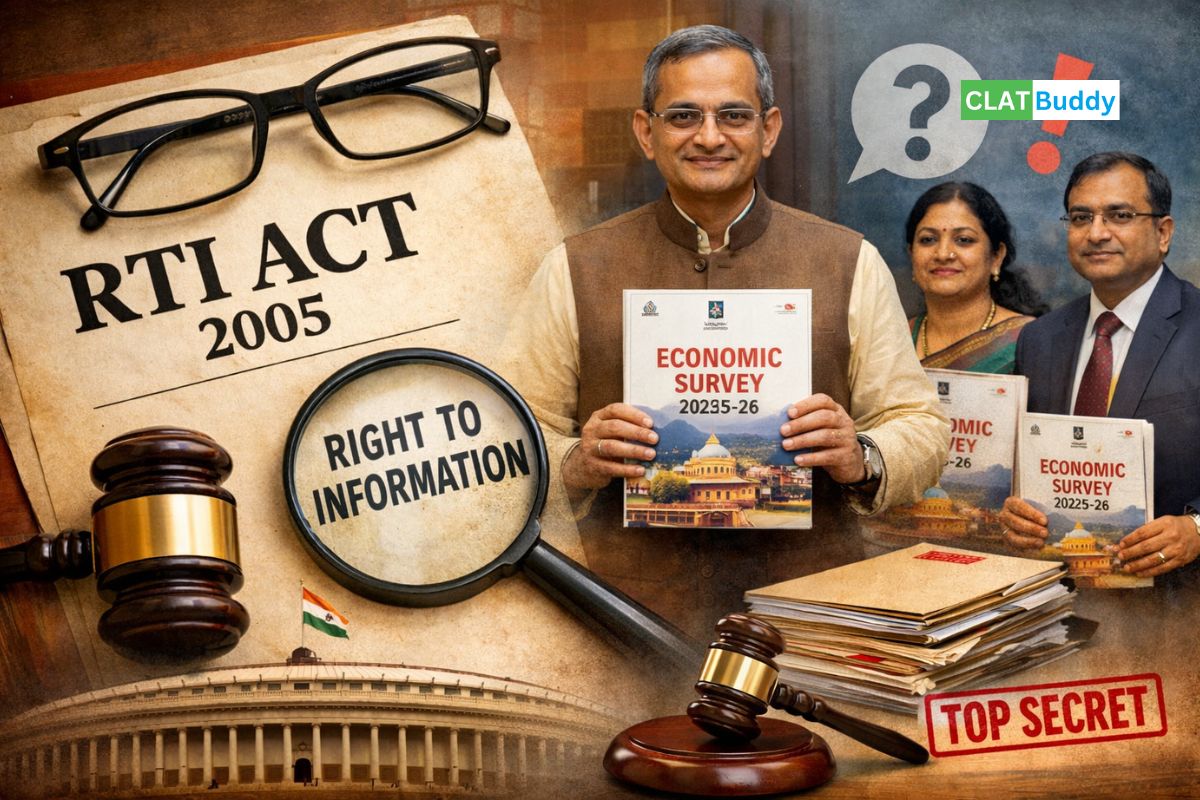
The Economic Survey 2025–26, tabled in Parliament on Thursday ahead of the Union Budget, has called for a re-examination of the Right to Information (RTI) Act, 2005. While recognising the RTI as one of India’s most significant democratic reforms, the Survey argues that certain aspects of the law may be constraining effective governance and policy making.
The Survey, prepared under the supervision of Chief Economic Advisor V Anantha Nageswaran, suggests that the RTI Act was never intended to function as a tool for “idle curiosity” or to allow external micromanagement of government decision-making. Instead, it cautions that excessive disclosures may discourage candid deliberation within government.
The Survey acknowledges that the RTI Act has played a vital role in improving transparency, strengthening accountability, and combating corruption. However, it warns that the law risks becoming an “end in itself”, where disclosures are celebrated irrespective of whether they contribute to better governance or policy outcomes.
According to the Survey, the absence of adequate safeguards for internal policy deliberations has led to situations where draft notes, internal correspondence, and preliminary opinions of officials enter the public domain, often without a clear public interest justification.
The Economic Survey does not propose repealing the RTI Act but calls for “adjustments” to strike a balance between transparency and effective governance. Its key suggestions include:
The Survey stresses that such measures should not lead to secrecy by default but should enable officials to deliberate freely before being held accountable for final decisions.
To support its case, the Survey draws comparisons with transparency laws in countries such as the United States, the United Kingdom, and Sweden. It notes that many jurisdictions explicitly exempt internal personnel records, inter-agency communications, and policy deliberations from disclosure.
In contrast, India does not recognise a general “deliberative process” exemption. File notings, draft documents, and internal opinions are considered “information” under the RTI Act, with Cabinet papers receiving only temporary protection until a decision is taken. The Survey argues that this leaves far less room for confidential internal discussion than in comparable democracies.
The Survey flags concerns that constant exposure of tentative remarks and draft ideas may encourage officials to adopt overly cautious language and avoid proposing bold or innovative solutions. It argues that democracy functions best when officials can deliberate freely and are then held accountable for the decisions they ultimately endorse, rather than for every half-formed thought expressed during the process.
The Survey also highlights the strain on the RTI system. As of June 30, 2025, over 4.13 lakh appeals and complaints were pending before 29 Information Commissions, according to an October 2025 appraisal by Satark Nagrik Sangathan.
Transparency campaigners have pushed back strongly against the Survey’s observations.
Anjali Bharadwaj, co-convenor of the National Campaign for People’s Right to Information (NCPRI), said there is no evidence to show that the RTI Act has harmed governance. She pointed out that the Act already contains exemptions to protect sensitive information and decision-making processes.
Bharadwaj also highlighted that nearly 70% of RTI applications seek information that should already be publicly available under Section 4 of the Act, which mandates proactive disclosure. She criticised the Survey for being silent on the poor implementation of this provision.
Former Chief Information Commissioner Shailesh Gandhi argued that recent legal changes, particularly the Digital Personal Data Protection Act, 2023, have already weakened the RTI framework by expanding grounds for denial of information. He described the Survey’s criticism as flawed and questioned whether any concrete evidence exists showing that governance has suffered due to RTI disclosures.
The Economic Survey’s recommendations do not have immediate legal effect, but they are likely to shape policy discussions during the Budget session and beyond. Any amendment to the RTI Act would require parliamentary approval and is expected to face strong scrutiny from civil society groups and opposition parties.
At its core, the debate reflects a long-standing tension between transparency and administrative efficiency. The challenge for policymakers will be to ensure that reforms, if any, preserve the RTI Act’s role as a tool for democratic accountability while addressing concerns about governance and policy effectiveness.