
If you are preparing for CLAT, one question comes up again and again: How should you read editorials?
Many aspirants spend hours reading newspapers but still struggle in English and Legal Reasoning sections. The problem is not effort. The problem is approach.
This guide will help you understand exactly how to read editorials in a way that actually improves your CLAT score.
Editorials are not just newspaper articles. They are structured arguments written by experts on important issues.
For CLAT, they help in three major areas:
When you look at CLAT passages, especially in English and Legal sections, they are very similar to editorials. They present an issue, give arguments, and lead to a conclusion.
So when you read editorials properly, you are indirectly practising CLAT passages every day.
You do not need to read multiple newspapers. One good source is enough if used properly.
The most recommended options are:
Both provide high-quality editorials with balanced viewpoints and relevant topics like law, governance, international relations, and social issues.
Focus only on:
Avoid getting distracted by political gossip, regional news, or advertisements.
The goal is quality reading, not quantity.
Reading editorial for CLAT is not passive reading. It is an active process.
You need to train your mind to think while reading.
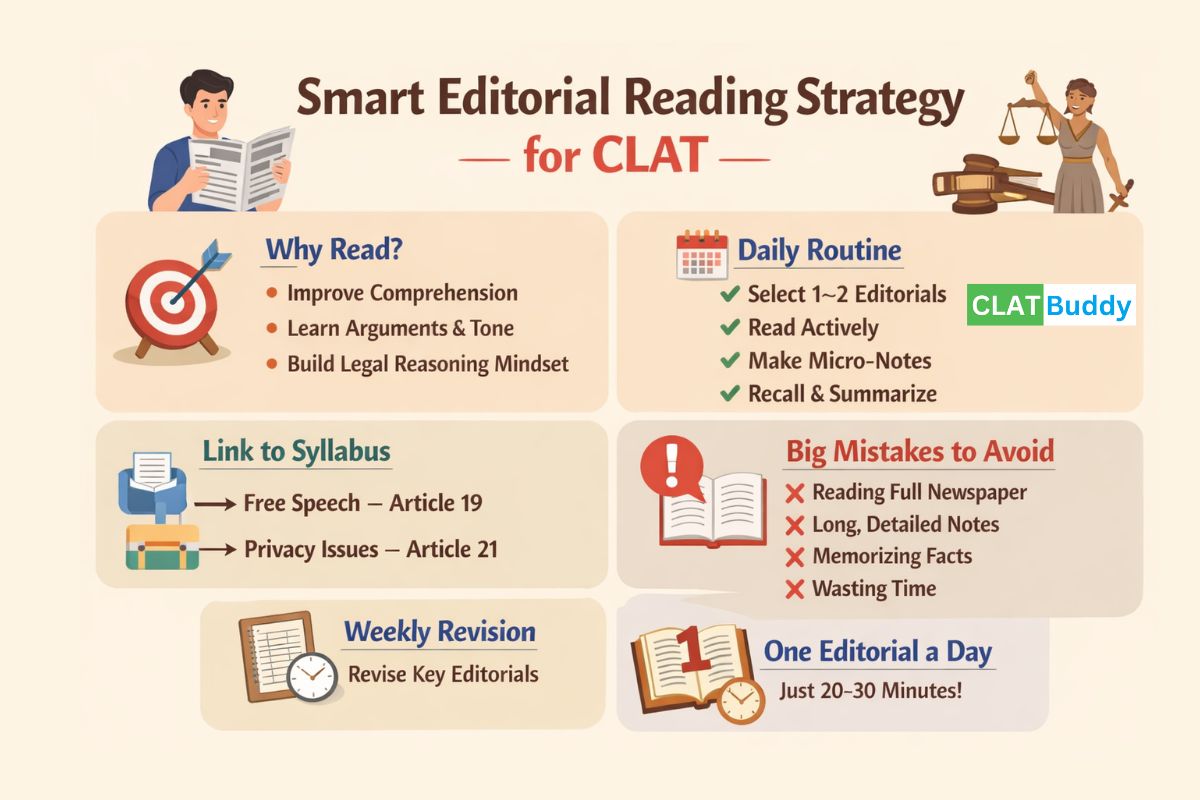
Spend 2 to 3 minutes quickly scanning the editorial page.
Pick 1 or at most 2 editorials that are:
Avoid very technical topics like deep economics unless you are comfortable.
While reading, keep asking yourself questions:
This habit directly improves your CLAT accuracy because most questions test these exact skills.
Every editorial follows a structure:
Try to mentally divide the article into these parts while reading.
This helps in identifying the main idea quickly, which is crucial for CLAT passages.
Many students make long notes and waste time. That is not needed.
You need short and effective notes.
For example:
This format takes only 5 minutes and is extremely useful.
This is where most aspirants miss out.
CLAT is not testing how much news you know. It is testing how well you can apply concepts.
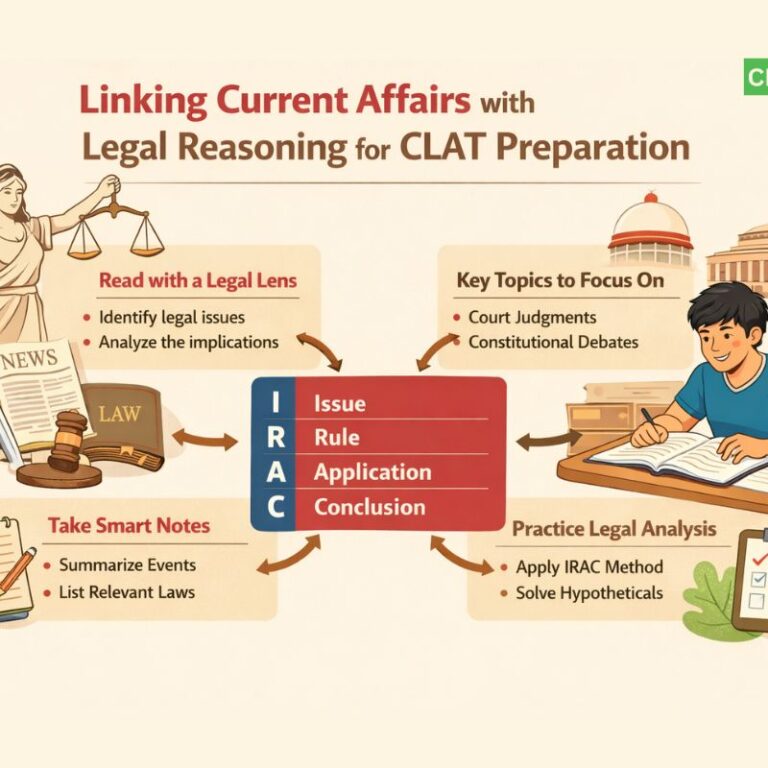
Whenever you read an editorial, try to connect it with legal concepts.
This habit builds a strong foundation for Legal Reasoning without extra effort.
Time management is very important.
You do not need to spend hours reading newspapers.
Total time: 25 to 30 minutes per day
Consistency matters more than duration.
Even one well-read editorial daily can make a big difference over time.
Most students read and forget.
That is why recall is important.
After reading an editorial:
This improves retention and strengthens understanding.
It also helps in tackling inference-based questions in CLAT.
Avoiding mistakes is as important as following the right strategy.
CLAT is not about information overload. It is about clarity of thought.
Editorials are one of the best tools to improve English naturally.
Instead of memorising word lists, try to understand how words are used in sentences.
This improves comprehension much faster.
Yes, significantly.
Legal Reasoning is not about knowing law beforehand. It is about applying logic to given principles.
Editorials train your brain to:
This directly reflects in better performance in Legal Reasoning passages.
Daily reading is important, but weekly revision is what builds retention.
For example, if multiple editorials discuss privacy or judiciary, that topic becomes important.
This helps in both comprehension and current affairs.
Once you are comfortable with basic reading, you can level up.
Ask yourself:
This converts reading into a scoring skill.
Yes, if done properly.
One editorial read with focus is far better than reading five articles without understanding.
If you are just starting:
CLAT preparation is a marathon, not a sprint.
Editorial reading is not about collecting information.
It is about building thinking ability.
Every time you read an editorial, focus on:
That is exactly what CLAT tests.
If this habit is built consistently, improvement in English and Legal Reasoning becomes automatic.