
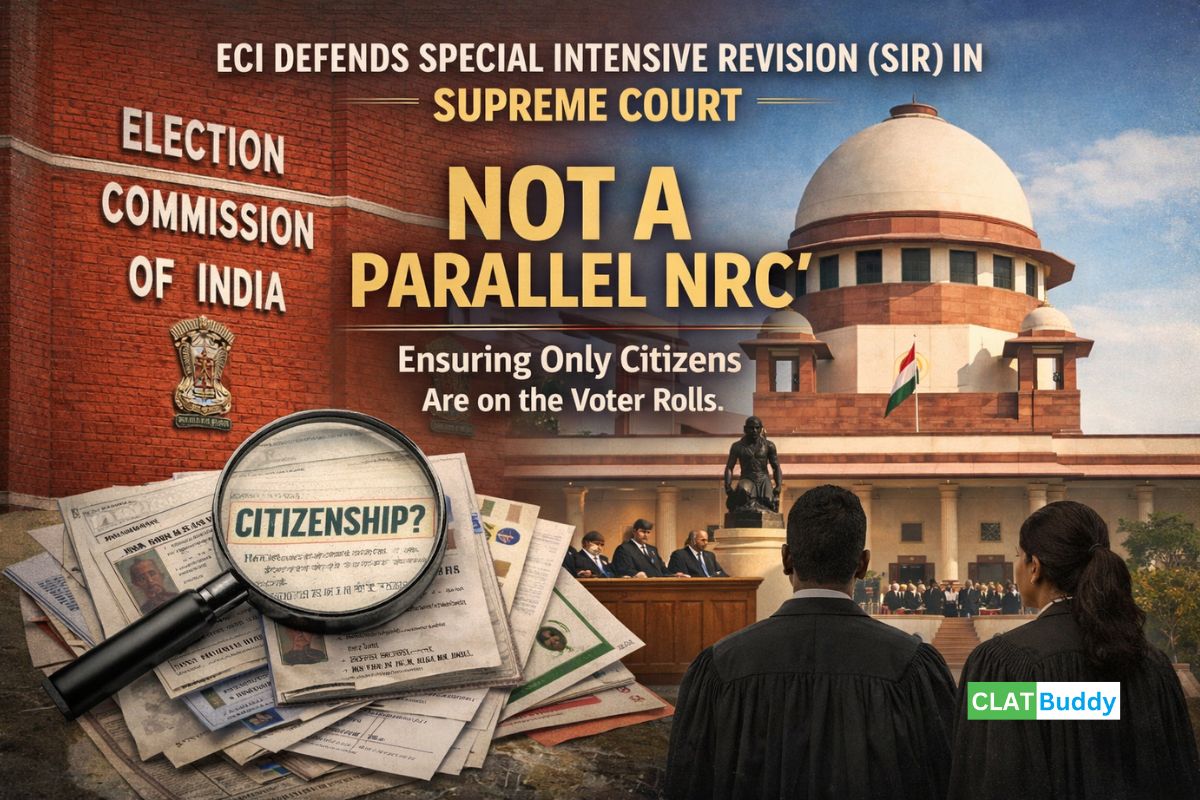
The Election Commission of India (ECI) has defended the ongoing Special Intensive Revision (SIR) of electoral rolls before the Supreme Court of India, rejecting allegations that the exercise is a “parallel NRC”. According to the ECI, SIR is part of its constitutional duty to ensure that only eligible Indian citizens are included in voter lists.
At the core of the dispute is whether verifying citizenship during voter roll revision amounts to conducting a citizenship determination exercise like the NRC. The ECI has clarified that this comparison is misleading. The NRC deals with identifying all citizens, irrespective of age or voting eligibility. In contrast, electoral rolls only include citizens above 18 years who are otherwise qualified to vote. Therefore, the scope and purpose of both processes are fundamentally different.
A major concern raised by petitioners is the large-scale deletion of names, especially in States like Uttar Pradesh, where nearly three crore names were reportedly removed from draft rolls. Critics argue that such deletions could lead to exclusion of genuine voters. The ECI, however, maintains that even if a single foreign national is found on the rolls, it is constitutionally obligated to remove that name to preserve the “purity” of elections.
The ECI has relied heavily on Article 324 of the Constitution, which grants it plenary powers to supervise and control elections, read with Article 326, which limits voting rights to citizens. It also distinguished its role from that of the Union government under the Citizenship Act, 1955, stating that while the Centre handles formal citizenship determinations, the ECI can verify citizenship only for electoral purposes.
From a constitutional perspective, the argument highlights a key principle: citizenship is central to democratic participation. Only citizens can vote, contest elections, or hold constitutional offices. The ECI argues that allowing non-citizens on electoral rolls would undermine the legitimacy of the electoral process.
For CLAT aspirants, this issue is important because it brings together constitutional law, electoral law, and federal balance. The Supreme Court’s eventual decision will likely clarify the limits of the ECI’s powers and set standards for how voter verification exercises must be conducted without violating democratic rights.
In short, the case is not just about voter lists—it is about balancing electoral integrity with inclusion and fairness, a theme that frequently appears in constitutional law questions.