

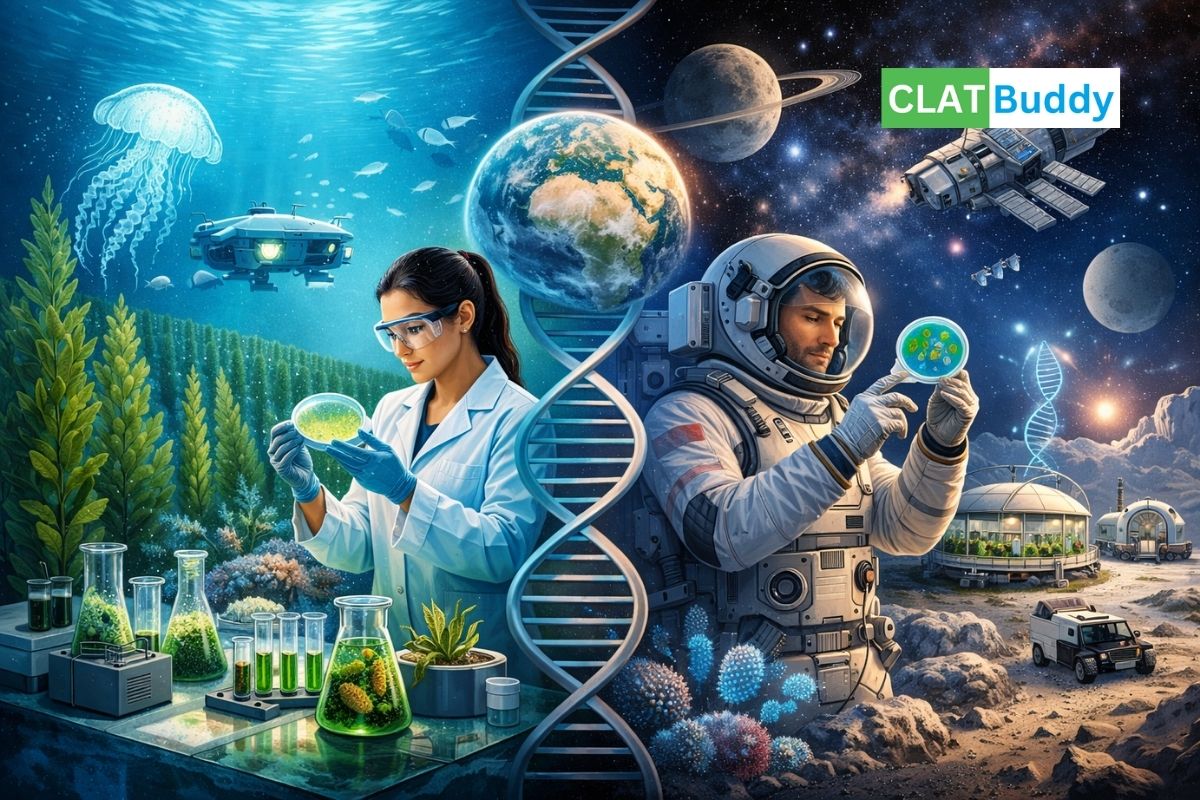
Futuristic marine and space biotechnology is an emerging area of scientific research that looks at using extreme and underexplored environments (such as deep oceans and outer space) to develop new biological knowledge, materials, and manufacturing systems.
Policymakers and scientists increasingly view these fields as critical for addressing long-term challenges related to food security, healthcare, climate change, and sustainable industrial growth. For India, these technologies are closely linked to its ambitions under the Blue Economy framework and its expanding space programme.
Marine biotechnology involves studying marine organisms such as microorganisms, algae, and invertebrates to extract useful biological compounds and processes. These organisms survive in harsh conditions (high pressure, salinity, low light, and nutrient scarcity) which makes their enzymes and biomolecules particularly valuable for industrial use. Applications include pharmaceuticals, nutraceuticals, food ingredients, cosmetics, biofuels, and biodegradable materials.
Marine biomanufacturing is also seen as a way to reduce pressure on land-based agriculture and freshwater resources. Seaweed cultivation, for example, does not require fertile land or freshwater and can absorb carbon dioxide, making it attractive for climate-resilient production systems.
Space biotechnology studies how biological systems behave in microgravity and high-radiation environments. This includes research on microbes, plants, and human biology in space. Such research is essential for long-duration human space missions, where astronauts must rely on closed-loop systems for food, oxygen, waste recycling, and healthcare.
Experiments on microbial behaviour and astronaut microbiomes help develop probiotic interventions, disease management strategies, and life-support technologies. Many findings from space biotechnology also have terrestrial applications, particularly in medicine, nutrition, and advanced manufacturing.
India has significant untapped potential in marine biotechnology. With a coastline of over 11,000 kilometres and a large Exclusive Economic Zone, the country has access to rich marine biodiversity. Despite this, India’s marine biomanufacturing output remains limited. Seaweed cultivation, for instance, is modest, leading to dependence on imports for seaweed-derived products used in food and pharmaceuticals.
In space biotechnology, India’s ambitions are tied to its human spaceflight programme. As missions become longer and more complex, biological systems tailored to Indian genetic, nutritional, and health profiles will become increasingly important. Relying solely on foreign-developed technologies may limit strategic autonomy.
Government initiatives such as the Deep Ocean Mission, the Blue Economy policy framework, and the BioE3 programme aim to strengthen marine biomanufacturing. Research institutions and a few private firms are working on scaling seaweed-based products and marine bioresources, though the sector remains fragmented.
In space biotechnology, the Indian Space Research Organisation is conducting microgravity experiments involving microbes, algae, and biological systems. However, private-sector participation is limited, as these technologies are still in early stages and require long-term investment.
The European Union, China, and the United States have invested heavily in marine and space biotechnology. China leads in seaweed aquaculture, while the U.S. conducts extensive space biology research through NASA and the International Space Station. These countries illustrate how early investment can translate into technological leadership.
Marine and space biotechnology remain frontier domains where early movers gain lasting advantages. For India, the key challenge is ensuring coordinated and timely progress. A clear national roadmap aligning research institutions, industry, and funding could help India emerge as a significant player in next-generation biomanufacturing.