
How Does CLAT Ask Current Affairs Questions?

If you are preparing for CLAT or any other law entrance exam, one thing you have probably realised already is that current affairs is not what it used to be.

You cannot clear CLAT by mugging up one-liners anymore. You are expected to read, think, connect, and analyse.

In this article, you will understand how CLAT actually asks current affairs questions, what the examiners expect from you, and how you should prepare smartly instead of blindly memorising facts.

This guide is written to help you approach current affairs like a future law student, not like a quiz contestant.

Why Is Current Affairs Important in CLAT?

Current affairs and general knowledge together form one of the highest-scoring sections in CLAT. At the same time, it is also the section where many students lose confidence.

The reason is simple. CLAT does not reward rote learning. It rewards awareness with understanding.

You are being tested on whether you can:

  • Understand what is happening around you
  • Read and interpret news like a law student
  • Connect events with their legal, political, or social impact

That is exactly what you will be doing in law school.

How Is the Current Affairs Section Structured in CLAT?

Before understanding the question types, you need to be clear about the structure of the section.

In CLAT, current affairs questions are:

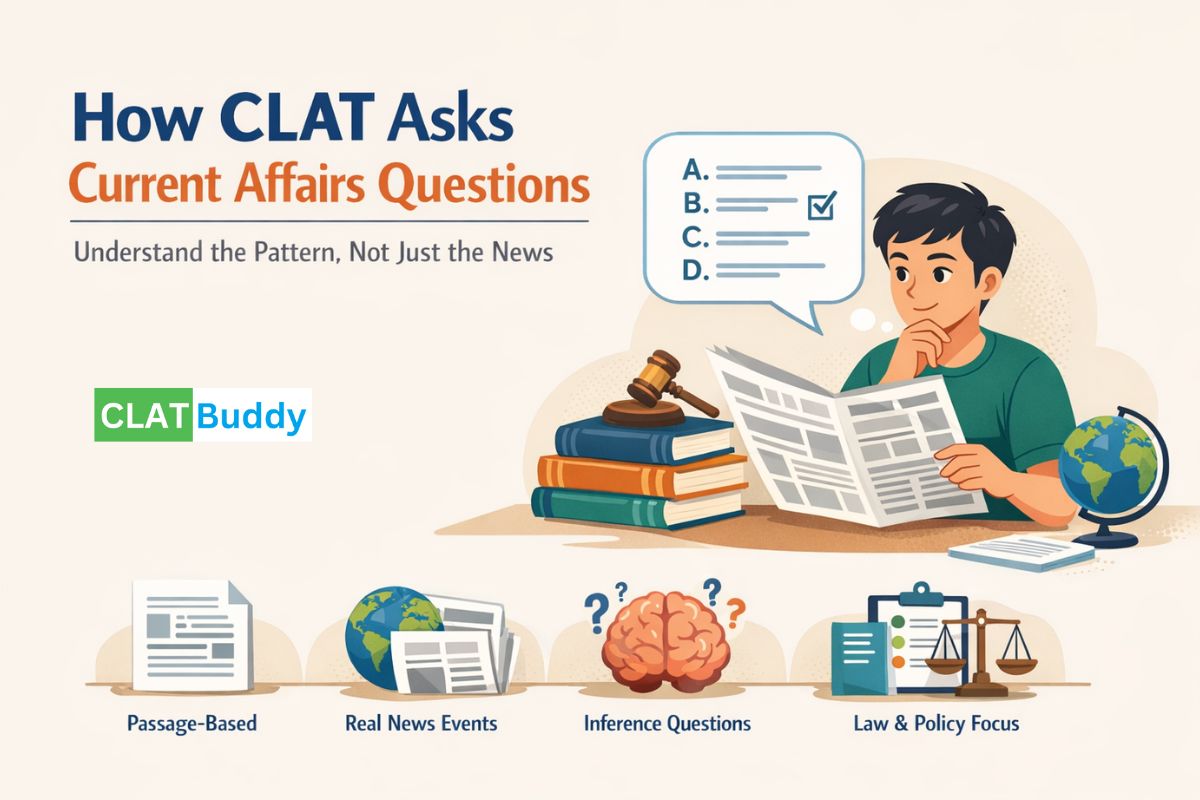
  • Passage based
  • Inspired by real news articles
  • Followed by 4 to 6 MCQs per passage

Each passage is usually 350 to 450 words long and is written in a journalistic or explanatory tone.

You are not expected to know everything beforehand. You are expected to read carefully and think logically.

Does CLAT Ask Direct Current Affairs Questions?

No. CLAT almost never asks direct questions like:

  • Who won this award?
  • When was this summit held?

Instead, CLAT asks contextual questions.

You will first read a passage about a current event. Then the questions will test whether you understood:

  • What the issue is about
  • Why it is important
  • What impact it has
  • What background information is relevant

This is why reading skills matter as much as knowledge.

What Kind of Passages Are Asked in CLAT Current Affairs?

The passages in the current affairs section are usually based on real-world issues that are relevant to law, governance, and society.

Common passage sources include:

  • Newspaper editorials
  • Explainer articles
  • Policy analysis pieces
  • Reports on international events

The language is simple but the ideas require attention.

What Topics Does CLAT Focus on in Current Affairs?

CLAT focuses on relevant and meaningful issues, not random news.

Here are the most important topic areas you should focus on.

National Current Affairs

  • New laws and bills
  • Government schemes and policies
  • Constitutional developments
  • Supreme Court and High Court related issues

International Current Affairs

  • Global conflicts
  • International treaties and agreements
  • International organisations and their roles
  • India’s relations with other countries

Legal and Political Issues

  • Changes in criminal or civil laws
  • Election related developments
  • Human rights issues
  • Federalism and constitutional debates

Economic and Social Issues

  • Budget related topics
  • Inflation, GDP, unemployment
  • Social justice issues
  • Education and health policies

Environment and Science

  • Climate change
  • Environmental laws
  • Space missions
  • Technology regulation

You should always ask yourself one question while studying. Why does this matter for society or law?

What Type of Questions Are Asked After the Passage?

Once you finish reading the passage, the real test begins.

The questions are designed to check different skills.

Factual Understanding Questions

These questions test whether you noticed important facts mentioned in the passage.

You will not need outside knowledge. The answer will be clearly stated or implied in the passage.

Inference Based Questions

These questions ask you to read between the lines.

You may be asked:

  • What can be inferred from the passage?
  • What is the likely impact of this development?

This is where careful reading matters.

Contextual Knowledge Questions

Some questions test whether you know the basic background of the issue.

For example:

  • The role of an international organisation
  • The objective of a government scheme
  • The purpose of a law or policy

This is why static GK linked with current affairs is important.

Opinion or Tone Based Questions

These questions check whether you understood the author’s viewpoint.

You may be asked:

  • What is the author critical of?
  • What is the main concern raised?

Does CLAT Test Static GK Through Current Affairs?

Yes, but indirectly.

CLAT often mixes static general knowledge with current events.

For example:

  • A passage on a Supreme Court judgment may require basic knowledge of the Constitution
  • A passage on climate change may need awareness of environmental agreements
  • A passage on Parliament may require understanding of its structure

You are not tested on memorisation. You are tested on application of basic knowledge.

How Many Months of Current Affairs Should You Prepare?

Ideally, you should prepare 10 to 12 months of current affairs before the exam.

However, do not panic. Quality matters more than quantity.

You should focus on:

  • Major national issues
  • Important international events
  • Legal and policy related developments

Avoid spending too much time on celebrity news or sports unless it has national importance.

How Should You Read Current Affairs for CLAT?

Reading current affairs for CLAT is very different from reading news casually.

You should read with a purpose.

While reading, focus on:

  • What is the issue?
  • Why did it happen?
  • Who is involved?
  • What are the legal or social implications?

Do not highlight everything. Highlight only what helps you understand the issue.

Should You Memorise Facts for CLAT Current Affairs?

You should understand first, memorise later.

Facts make sense only when you know the context.

For example:

  • Memorising the name of a treaty is useless unless you know what it is about
  • Knowing a scheme’s name matters only if you understand its objective

CLAT rewards clarity, not cramming.

How Does CLAT Expect a Law Aspirant to Think?

CLAT wants to see whether you can think like a future law student.

That means:

  • You can analyse issues objectively
  • You can understand multiple perspectives
  • You can connect news with law and governance

If you read current affairs with curiosity instead of fear, you are already on the right path.

Common Mistakes Students Make in CLAT Current Affairs

Many students lose marks not because they do not study, but because they study the wrong way.

Avoid these mistakes:

  • Relying only on monthly PDFs without understanding
  • Ignoring passages and jumping to options
  • Memorising one-liners without context
  • Skipping current affairs thinking it is unpredictable

CLAT current affairs is predictable if your preparation is structured.

How Can You Practise Current Affairs Questions for CLAT?

Practice is essential.

You should regularly:

  • Solve passage based GK questions
  • Analyse why an option is correct or incorrect
  • Practice reading long passages without panic

The more you practise, the more comfortable you become.

Final Advice 

Current affairs is not a section to be feared. It is a section to be understood.

If you:

  • Read regularly
  • Focus on understanding issues
  • Practise passage based questions

You will slowly realise that current affairs becomes one of your strengths.

Remember, CLAT is not testing how much you know. It is testing how well you think.

And that is something you can definitely master with the right approach.


Calling all law aspirants!

Are you exhausted from constantly searching for study materials and question banks? Worry not!

With over 15,000 students already engaged, you definitely don't want to be left out.

Become a member of the most vibrant law aspirants community out there!

It’s FREE! Hurry!

Join our WhatsApp Groups (Click Here) and Telegram Channel (Click Here) today, and receive instant notifications.

CLAT Buddy
CLAT Buddy

Leave a Reply

Your email address will not be published. Required fields are marked *

CLATBuddy Popup Banner New