
If you think the English section in CLAT is only about grammar rules or difficult words, you are already looking at it the wrong way. CLAT tests how well you understand what you read, how clearly you think, and how accurately you interpret meaning. English comprehension is not about fancy vocabulary. It is about focus, logic, and clarity.
This article will help you understand exactly how CLAT tests English comprehension, what skills are actually being judged, and how you should prepare smartly instead of blindly memorising rules.
The English section in CLAT is designed to check whether you can handle the kind of reading you will face in law school. As a law student, you will constantly read judgments, case laws, articles, and opinions. CLAT wants to see if you are ready for that.
The focus is not on textbook English. Instead, it tests whether you can read unfamiliar content, understand arguments, and make sense of ideas under time pressure.
When you understand this purpose, your preparation automatically becomes more strategic.
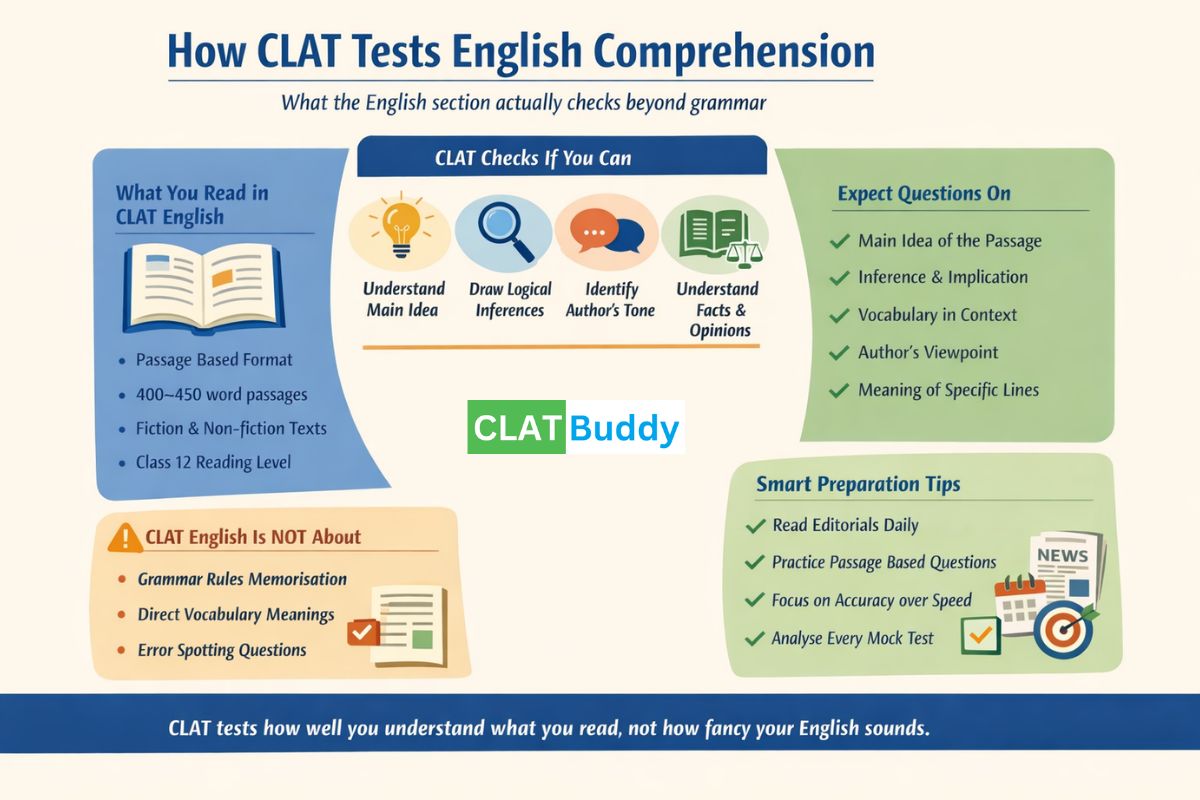
CLAT follows a passage-based format for English comprehension. You are not asked isolated questions. Everything revolves around a passage.
Each passage is usually around 400 to 450 words and is followed by 4 to 6 multiple choice questions. These passages can come from various sources such as essays, editorials, short stories, or opinion pieces.
The language level is close to Class 12, but the ideas may be slightly abstract or argumentative.
Before you prepare, you need to know what you are reading.
These passages are taken from novels, short stories, or narrative writing. They test your ability to understand emotions, characters, and situations.
You may be asked about:
These are more common and usually come from essays, newspaper editorials, or opinion articles.
They test your ability to:
Most CLAT aspirants struggle more with non fiction passages, so you should spend extra time practicing them.
CLAT does not test speed reading alone. It tests intelligent reading.
You are judged on how well you can:
These skills matter much more than knowing difficult words.
One of the most common question types in English comprehension is identifying the main idea of the passage.
You may be asked what the passage is primarily about or what best summarises the author’s argument.
To answer these questions correctly, you must avoid extreme options. CLAT usually hides the correct answer in balanced and neutral language.
A mentor tip for you is this:
If an option feels too dramatic or too narrow, it is probably wrong.
Inference based questions test whether you can understand what is implied but not directly stated.
You are not expected to use outside knowledge. The answer must come only from the passage.
Such questions may ask:
To handle inference questions, always ask yourself:
If I remove the passage, does this option still make sense?
If yes, reject it.
CLAT does not ask direct meanings of words like traditional exams. Vocabulary is always tested in context.
You may be asked:
This means memorising word lists alone will not help. You need to understand how words behave inside sentences.
A smart way to improve this skill is regular reading of editorials and articles.
Many students lose marks in tone based questions because they guess emotionally.
CLAT may ask you:
To answer correctly, focus on:
Avoid choosing extreme tones unless the passage clearly supports it.
This is a common doubt.
In recent CLAT papers, grammar is not tested as a separate section. However, grammar still plays an indirect role.
You need grammatical awareness to:
So do not ignore grammar completely, but do not overfocus on traditional error spotting exercises either.
Speed matters, but comprehension matters more.
You are expected to read quickly without missing meaning. Reading too fast leads to careless mistakes. Reading too slowly wastes time.
The balance comes with practice.
You should aim to:
With regular practice, speed improves naturally.
The English section usually has 22 to 26 questions. Each question carries one mark, and there is negative marking for wrong answers.
This means accuracy is extremely important. Random guessing can seriously affect your score.
Most students lose marks not because English is difficult, but because their approach is wrong.
Some common mistakes include:
Once you become aware of these mistakes, avoiding them becomes easier.
Preparation for English comprehension is a long term process.
You should focus on:
Consistency matters more than intensity.
Choose quality over quantity.
Some useful sources include:
The goal is to become comfortable with different writing styles.
Mocks are useful only if you analyse them properly.
After every mock, ask yourself:
Write down recurring mistakes and work consciously on them.
Yes, absolutely.
English is one of the most scoring sections if prepared correctly. It does not require formulas or calculations. It rewards clarity of thought.
Once you build strong comprehension skills, they help you not only in English but also in legal reasoning and current affairs.
English comprehension in CLAT is not about perfect English. It is about clear thinking.
If you learn to read attentively, question logically, and answer objectively, this section can become your strength.
Remember, CLAT is not testing whether you know English. It is testing whether you understand English.
Prepare smartly, stay consistent, and trust the process.