

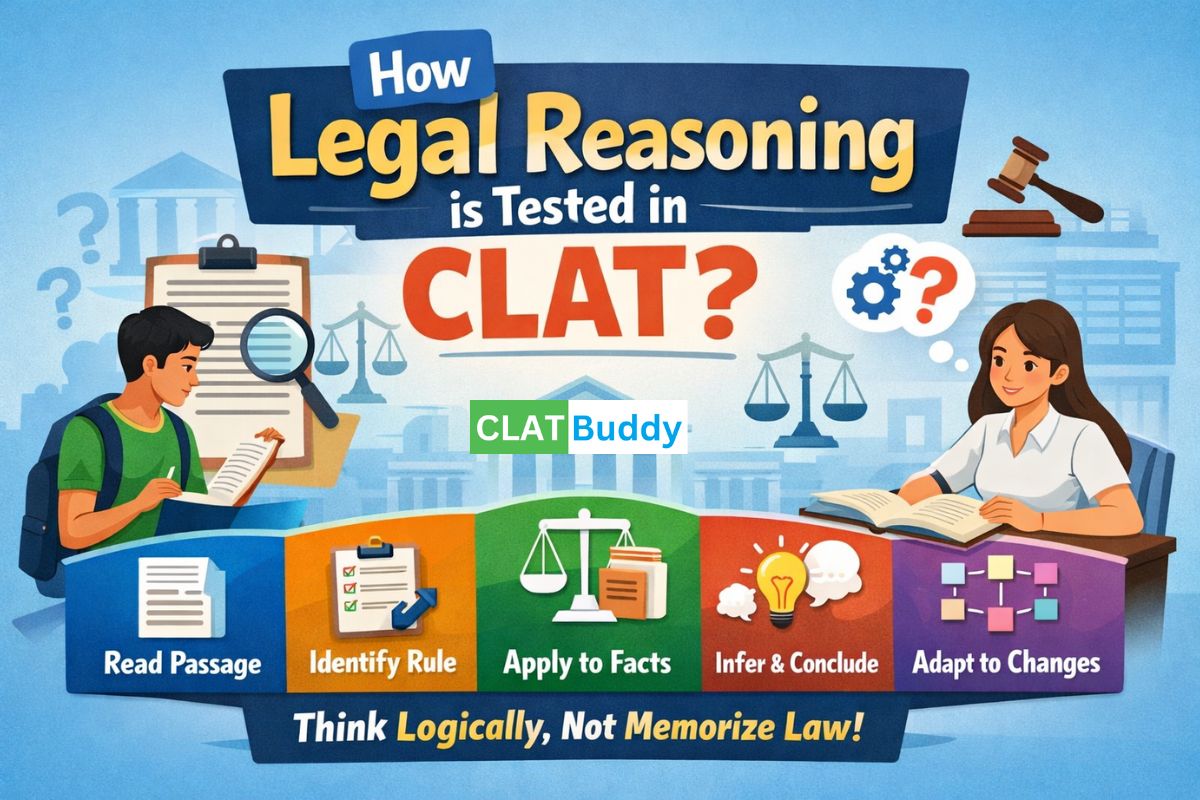
If you are preparing for CLAT, one section you will hear about again and again is Legal Reasoning. Many students feel nervous about it because they think law means heavy books, sections, and case names. The good news is that CLAT does not test you on memorising law. It tests how well you can read, think, and apply logic.
This article will help you clearly understand how legal reasoning is tested in CLAT, what examiners expect from you, and how you should approach this section to score better.
Legal Reasoning in CLAT is designed to check whether you can think like a future law student. It tests your ability to read a legal passage, understand the rule or principle given, and apply it to a set of facts.
You are not expected to know the Constitution, criminal law, or any specific law beforehand. Everything you need to answer the questions is provided inside the passage itself.
In simple words, CLAT wants to see how well you can understand rules and use them logically.
Legal reasoning questions in CLAT are always passage based. Each passage usually talks about a legal issue, moral dilemma, or public policy matter.
The passage generally contains:
After the passage, you will be asked multiple choice questions based on it. These questions do not ask you to recall facts. They ask you to apply what you just read.
Legal reasoning passages in CLAT are not random stories. They are carefully designed to test your thinking ability.
Common themes include:
The language is usually formal but not too technical. You just need good reading skills and patience.
This is the most important skill you need to develop.
A legal principle is the rule or idea on which the entire passage is based. It often sounds like a general statement.
For example, the passage may say that a person is responsible for an act only if it was done voluntarily and with intention.
Your first job while reading is to slow down and clearly understand:
If you miss the principle, you will struggle with every question that follows.
Once you understand the principle, CLAT tests whether you can apply it correctly to different situations.
Each question usually gives you a new set of facts. Your task is to match those facts with the rule given in the passage.
You are not supposed to use real life opinions or emotions. You must strictly stick to what the passage says.
Even if the answer feels morally wrong, you must choose what is legally correct according to the passage.
This is one of the biggest myths among CLAT aspirants.
You do not need any prior legal knowledge to solve legal reasoning questions. In fact, using outside knowledge can sometimes confuse you.
CLAT clearly mentions that all required information will be provided in the passage. The exam checks reasoning ability, not memory.
If you are from a non law background or studying in school, you are not at any disadvantage.
Not all questions will be direct application questions. Some questions test your ability to draw logical conclusions.
These questions may ask:
Here, you need to think carefully and avoid extreme options. The correct answer usually sticks closely to the language of the passage.
Another common question type involves changing a fact or condition.
For example, the question may slightly alter a fact and ask whether the legal outcome will change.
This tests whether you truly understood the structure of the rule and not just memorised it.
To solve such questions:
This skill is very important for law school and CLAT tests it early.
Many students lose marks not because legal reasoning is tough, but because of avoidable mistakes.
Common mistakes include:
Legal reasoning rewards calm and careful reading, not speed alone.
Legal reasoning is one of the most important sections in CLAT.
It usually carries a significant portion of the paper and can strongly affect your rank. Since this section is skill based, consistent practice can lead to steady improvement.
If you master legal reasoning, it also helps you in:
Having the right exam strategy is crucial.
A good approach includes:
You do not need to rush. Accuracy matters more than attempting all questions.
Improving legal reasoning is a gradual process. It improves with practice and reflection.
Practical tips for you:
The more you practice, the more comfortable you become with legal language and logic.
Legal reasoning is not just for clearing an entrance exam. It prepares you for life in law school.
In law school, you will constantly read cases, identify principles, and apply them to new situations. CLAT introduces you to this way of thinking early.
If you build this skill now, you will feel more confident not just during CLAT, but also after entering a law college.
Legal reasoning in CLAT is not about being perfect. It is about being logical, patient, and consistent.
If you treat each passage like a small puzzle and focus on understanding before answering, you will naturally improve.
Remember, every strong lawyer once struggled with legal reasoning too. What matters is that you keep practising and learning from mistakes.
CLATBuddy is here to guide you at every step. Keep trusting the process and keep moving forward.