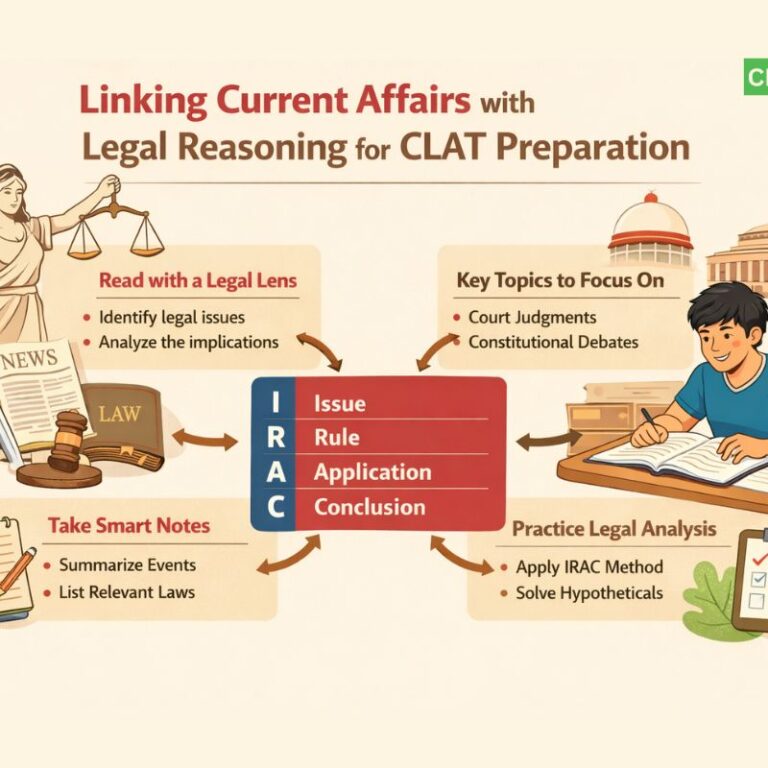


Practicing for the Legal Reasoning section of CLAT is critical because it accounts for a significant portion of the exam. This section tests your ability to apply legal principles to various factual situations, even if you don’t have a law background. Here are some effective tips to help you prepare:
Legal Reasoning involves reading comprehension, where you need to apply a legal principle to the facts of the case. It’s not about knowing the law in-depth but about reasoning logically.
Focus on the principle-facts-application approach. You’ll be given a principle (like a law or legal rule), and your task is to apply it correctly to the factual scenario presented.
Although prior legal knowledge isn’t necessary, having a basic understanding of common legal concepts helps. Focus on:
Read up on these topics through CLAT prep books or online resources to get a good foundation.
Legal reasoning passages contain legal principles that you need to apply to specific facts. Practice reading these principles carefully and understanding their implications.
Read legal articles, case summaries, and newspapers (especially sections related to law and justice) to improve your comprehension of legal matters.
Go through previous CLAT legal reasoning questions. This will give you a clear idea of the types of principles and factual scenarios CLAT uses.
Notice patterns in the questions, especially how legal principles are framed and how you should approach them.
Regular mock tests simulate the exam environment and help you gauge your performance under timed conditions.
Analyse each test carefully. Review not only the questions you got wrong but also those you took too much time on, and find out why.
Check out CLAT mocks here and question banks here.
Create or download practice sets containing 4-5 passages on legal reasoning. Set a timer (20-25 minutes for 4-5 passages) and work on solving them. This helps with both speed and accuracy.
After completing a set, spend time reviewing how well you applied the principle to the facts and where you might have misunderstood.
CLAT’s legal reasoning section tests how logically you can apply a principle to a given fact, not your memory of legal facts. Avoid using any external knowledge while solving the questions; stick to the principle provided in the question.
If a principle sounds incorrect based on your general knowledge, still apply it as if it were true, because that’s what the question demands.
Since the legal reasoning section involves reading lengthy passages, improving your reading speed without compromising comprehension is essential.
Practice reading legal articles, judgments, or editorials from newspapers like The Hindu or The Indian Express, which often feature legal topics.
In legal reasoning, sometimes multiple answers seem correct, but only one fits the principle entirely. Practice eliminating answers that don’t fully apply to the legal rule.
Carefully dissect each option and eliminate those that either stretch the principle too much or don’t apply it at all.
When you make mistakes in practice, analyse why. Did you misinterpret the principle? Did you apply external knowledge? Were you too quick in reading the facts? This self-analysis will help you avoid similar mistakes in the actual exam.
Manage time well: Don’t spend too long on any one passage. If it’s taking too much time, move on and come back later if needed.