
Preparing for CLAT can feel overwhelming when you face passages that are not clearly easy or clearly difficult. In most CLAT papers, passages are deliberately designed with mixed difficulty, where some questions feel straightforward while others demand deeper thinking. Learning how to approach such passages smartly can significantly improve your accuracy, speed, and confidence in the exam.
This guide will help you understand how to deal with mixed-difficulty CLAT passages in a calm, structured, and exam-oriented way.
In CLAT, a mixed-difficulty passage is one where not all questions are of the same level. You may find a passage that looks lengthy or complex at first glance but contains some direct questions, along with a few that require logical reasoning or interpretation.
These passages are common across sections such as Legal Reasoning, Reading Comprehension, Logical Reasoning, and even Current Affairs.
The challenge is not the passage itself, but deciding how much time and effort to invest in each question without losing marks elsewhere.
Mixed-difficulty passages create confusion because they test multiple skills at once. You may understand the passage but struggle with the options, or you may find one question easy and the next extremely time-consuming.
This often leads to panic, second-guessing, or spending too much time on a single question. Understanding this pattern is the first step towards handling it effectively.
When you start reading a mixed-difficulty passage, your goal is not to memorise every detail. Instead, focus on understanding:
Read actively but calmly. Avoid rereading sentences unless absolutely necessary. Trust that you can always refer back to the passage if needed.
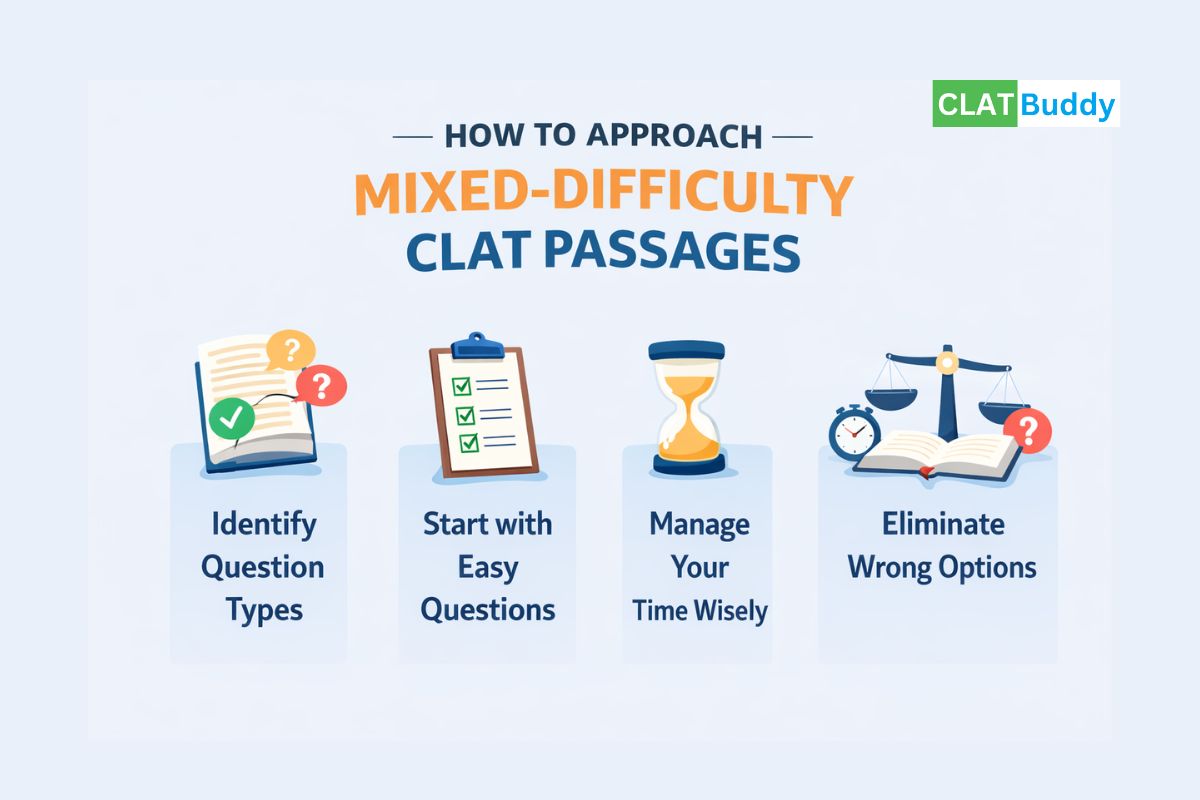
After reading the passage once, quickly glance through all the questions. This helps you mentally categorise them into:
You do not need to label them consciously during the exam, but with practice, your brain will automatically sense which questions are quicker to attempt.
In mixed-difficulty passages, it is always wise to attempt the easier questions first. These usually:
Answering these first boosts confidence and ensures that you secure marks early without wasting time.
Time management is crucial when dealing with mixed-difficulty passages. Ideally, you should:
CLAT rewards accuracy, but not at the cost of missing easier scoring opportunities elsewhere in the paper.
If a question feels confusing after a reasonable attempt, it is better to skip it temporarily rather than force an answer. Mark it mentally and move ahead.
Often, answering other questions gives you clarity or confidence to revisit the tougher ones later with a fresh perspective.
In mixed-difficulty questions, especially in Legal and Logical Reasoning, eliminating wrong options is more effective than searching for the correct one.
Focus on:
Even if two options seem close, one will usually align better with the passage’s reasoning.
Context plays a critical role in CLAT passages. Many aspirants make the mistake of answering based on prior knowledge or assumptions.
Always ask yourself:
CLAT is not testing what you know, but how well you apply information given in the passage.
Overthinking usually happens when you start doubting simple answers. In CLAT, the correct option is often the one that is:
Avoid reading too deeply into questions unless the passage clearly demands it.
Regular practice trains your brain to recognise patterns. Over time, you will start noticing that:
The more mixed-difficulty passages you practise, the better your judgment becomes during the actual exam.
Instead of solving many passages blindly, focus on:
After each practice session, reflect on your time management and decision-making rather than just your score.
Many aspirants struggle with mixed-difficulty passages because of avoidable mistakes such as:
Being aware of these mistakes helps you stay composed and focused.
Confidence comes from familiarity. The more exposure you have to different passage styles, the less intimidating they feel.
Build confidence by:
A calm approach often leads to better performance than aggressive guessing.
Speed matters in CLAT, but strategy matters more. A slow but structured approach can outperform a fast but careless one, especially in mixed-difficulty passages.
Knowing when to move on, when to attempt, and when to skip is what separates top scorers from average attempts.
On exam day, remind yourself that:
Approach each passage as an opportunity to score smartly rather than a hurdle to overcome.
Mixed-difficulty CLAT passages are not your enemy. They are designed to reward students who can think clearly under pressure, manage time effectively, and make smart choices.
If you read strategically, prioritise questions wisely, and trust the passage over assumptions, you will find that these passages become manageable and even scoring.
With consistent practice and the right mindset, mixed-difficulty passages can turn into one of your strongest areas in CLAT preparation.