Preparing for CLAT 2027 can feel overwhelming, especially when you hear about toppers studying for years or coaching schedules packed with endless classes. But the truth is simple. If you have a clear 11-month CLAT 2027 study plan and follow it with discipline, you can prepare effectively without panic. What matters is not studying all the time, but studying with direction.
This guide will help you create a realistic, balanced, and exam-focused 11-month CLAT preparation plan that suits a student between 16 and 18 years of age. You will understand what to study, when to study, and how to adjust your preparation as the exam approaches.
Why Do You Need a 11-Month Study Plan for CLAT 2027?
A structured study plan gives your preparation clarity and confidence. CLAT is not about memorising facts. It tests comprehension, reasoning, consistency, and time management. Without a plan, it is easy to either study randomly or burn out early.
A 11-month plan helps you:
- Cover the entire syllabus in a calm and organised way
- Build strong reading and reasoning habits
- Practise mock tests at the right time
- Revise properly without last-minute stress
Most importantly, it ensures you stay consistent even on days when motivation is low.
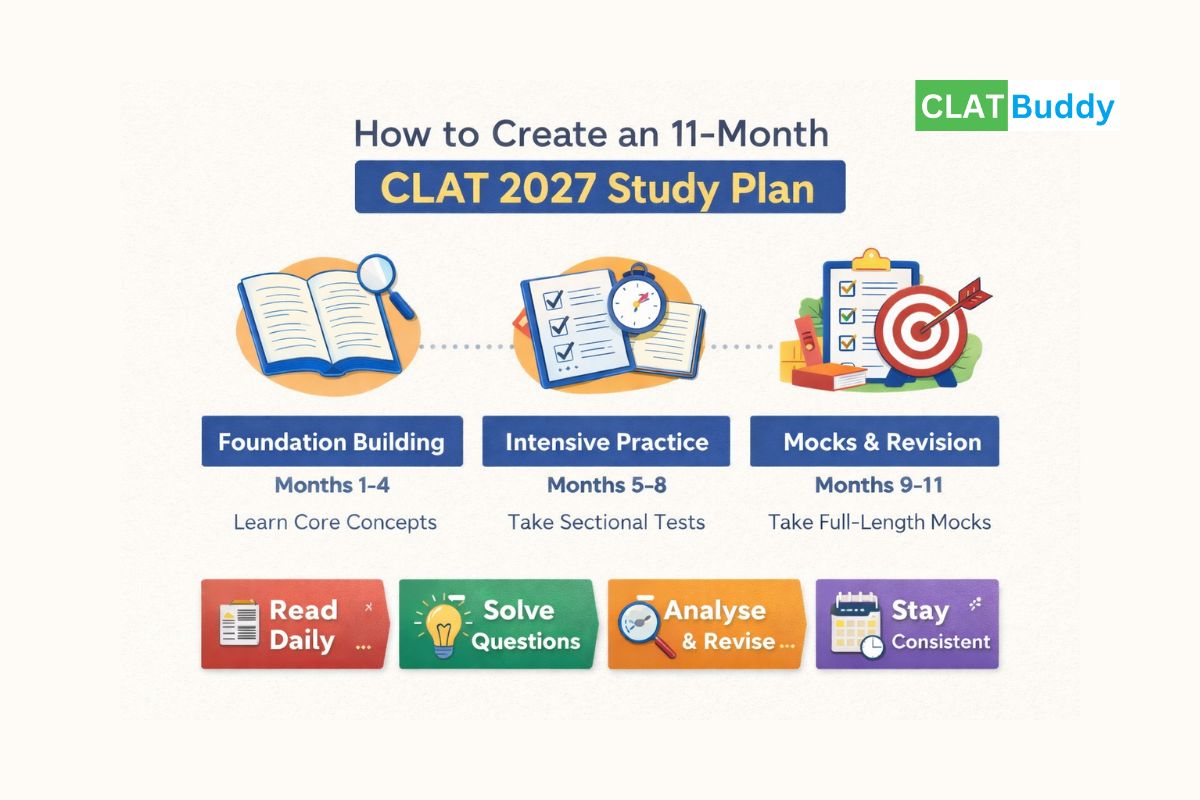
What Is the Ideal Structure of a 11-Month CLAT 2027 Study Plan?
Before dividing months and subjects, you need to understand the phases of preparation. A good CLAT study plan has three broad stages.
- Phase 1: Foundation Building (Months 1 to 4)
- Phase 2: Skill Strengthening and Practice (Months 5 to 8)
- Phase 3: Testing, Revision, and Strategy (Months 9 to 11)
Each phase has a different purpose, and skipping any one of them can weaken your preparation.
How Should You Plan the First 4 Months for CLAT 2027 Preparation?
The first four months are about building your base. This is where most students make mistakes by rushing into mocks too early.
What Should Be Your Focus in Months 1 to 4?
Your focus should be on understanding concepts, improving reading ability, and becoming comfortable with all five sections of CLAT.
English Language
Start reading every single day. This is non-negotiable.
- Read editorials from reputed newspapers
- Focus on comprehension, tone, and vocabulary in context
- Practise one reading comprehension passage daily
Do not try to memorise word lists. Instead, understand how words are used.
Current Affairs and General Knowledge
This section requires consistency from day one.
- Read daily news from reliable sources
- Maintain a monthly current affairs notebook
- Focus on national issues, legal news, international relations, and government schemes
Avoid random GK books at this stage. Understanding news is more important than memorising facts.
Legal Reasoning
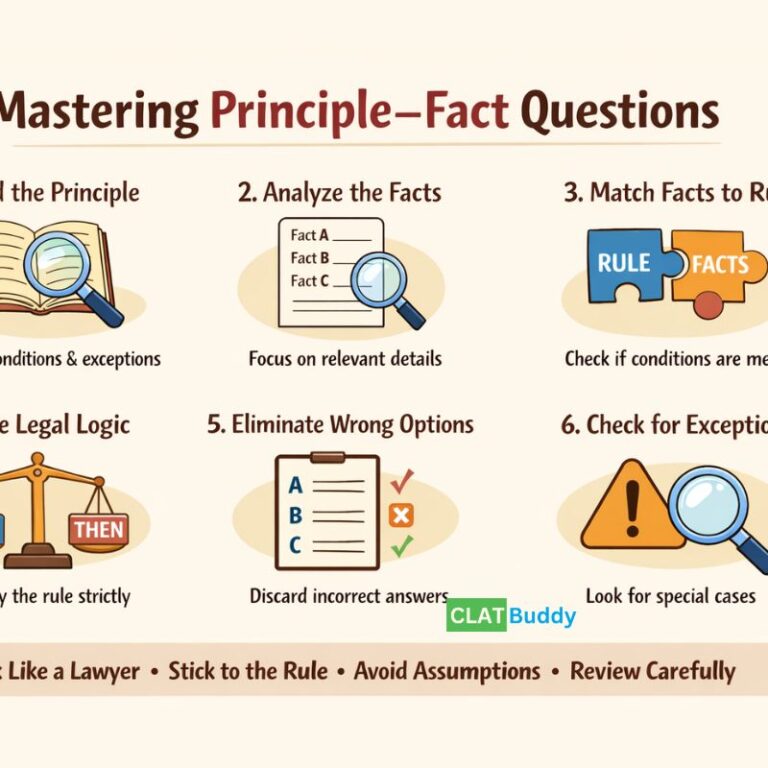
Legal reasoning is about principle-based thinking.
- Learn how legal principles work
- Practise simple legal passages
- Focus on understanding facts and applying rules logically
Do not worry about legal terms initially. CLAT does not test prior legal knowledge.
Logical Reasoning
Logical reasoning needs patience.
- Practise basic argument-based questions
- Focus on assumptions, conclusions, and strengthening or weakening arguments
- Solve a small set of quality questions daily
Accuracy matters more than speed at this stage.
Quantitative Techniques
Many students fear maths, but CLAT maths is manageable.
- Revise basic concepts like percentages, ratios, averages, and profit and loss
- Practise calculation-based questions slowly
- Focus on understanding tables, graphs, and charts
The goal is comfort, not speed.
How Should You Study in Months 5 to 8 for CLAT 2027?
This phase is where your preparation starts becoming exam-oriented. You should now be comfortable with all sections.
What Changes in This Phase?
- Increased practice
- Sectional tests
- Time-bound solving
- Deeper current affairs analysis
English and Reading Practice
Increase reading difficulty.
- Practise longer comprehension passages
- Work on inference-based questions
- Analyse mistakes to understand why an option is wrong
Reading speed and understanding should improve naturally.
Current Affairs Strategy
Now you should start linking news with context.
- Focus on issues rather than isolated events
- Revise monthly current affairs regularly
- Start solving current affairs-based questions
Make sure older months are revised along with new ones.
Legal and Logical Reasoning Practice
This is the time to push yourself.
- Practise full-length legal and logical sections
- Start solving questions under time limits
- Analyse reasoning behind every answer
Understanding why you made a mistake is more important than solving more questions.
Quantitative Techniques Practice
Gradually introduce time pressure.
- Solve data interpretation sets regularly
- Improve calculation speed with practice
- Focus on question selection
You do not need to attempt all maths questions in CLAT. Smart selection matters.
When Should You Start Taking Mock Tests for CLAT 2027?
Mock tests should not be started randomly.
Ideal Mock Test Timeline
- First mock: Around month 5 or 6
- One mock every 10 to 15 days initially
- Weekly mocks from month 9 onwards
Mocks are tools for improvement, not score checking.
How Should You Analyse CLAT Mock Tests Properly?
Many students waste mocks by not analysing them correctly.
After every mock:
- Check which section took the most time
- Identify weak areas and repeated mistakes
- Analyse why correct options are correct
- Note patterns in errors
Mock analysis is where real improvement happens.
How Should You Plan the Last 3 Months Before CLAT 2027?
The final phase is crucial and should be calm, not stressful.
What Should Be Your Focus in Months 9 to 11?
- Regular full-length mocks
- Intensive revision
- Strengthening strong areas
- Managing exam temperament
Revision Strategy
Revision should be structured.
- Revise current affairs month-wise
- Revisit legal and logical concepts
- Practise English passages daily
- Solve selected maths sets regularly
Avoid learning anything completely new in the last two months.
Mock Test Frequency
- One mock per week initially
- Two mocks per week in the final two months
- Full analysis after each mock
Quality matters more than quantity.
How Many Hours Should You Study Daily for CLAT 2027?
There is no perfect number, but consistency matters.
- School-going students: 3 to 4 hours daily
- Weekends: 5 to 6 hours with breaks
- Focus on focused study, not long sitting hours
Studying smart for fewer hours is better than studying distracted for long hours.
How Can You Stay Consistent for 11 Months of CLAT Preparation?
Consistency is the biggest challenge in long-term preparation.
Some practical tips:
- Follow a fixed daily routine
- Set weekly goals instead of daily pressure
- Track progress monthly
- Take short breaks to avoid burnout
Remember, missing one day does not ruin preparation. Giving up does.
What Are Common Mistakes to Avoid While Making a CLAT Study Plan?
Be aware of these mistakes early.
- Starting mocks too early
- Ignoring current affairs initially
- Studying only favourite sections
- Comparing preparation with others
- Changing strategy too frequently
A stable plan works better than constant changes.
Final Advice for CLAT 2027 Aspirants
A 11-month CLAT 2027 study plan works only when you trust the process. You do not need to study everything or solve every question. What you need is consistency, clarity, and confidence.
Focus on understanding, not rote learning. Read daily, practise regularly, analyse deeply, and revise smartly. If you follow a structured plan and stay disciplined, CLAT 2027 becomes achievable, not intimidating.
If you want, the next step can be breaking this 11-month plan into a monthly timetable or a daily routine that fits your school schedule. Just say the word.
Calling all law aspirants!
Are you
exhausted from constantly searching for study materials and question banks?
Worry not!
With over
15,000 students already engaged, you definitely don't want to be left out.
Become a member of the most vibrant law aspirants community out there!
It’s
FREE! Hurry!
Join our
WhatsApp Groups (
Click Here) and
Telegram Channel (Click Here) today, and receive instant notifications.