

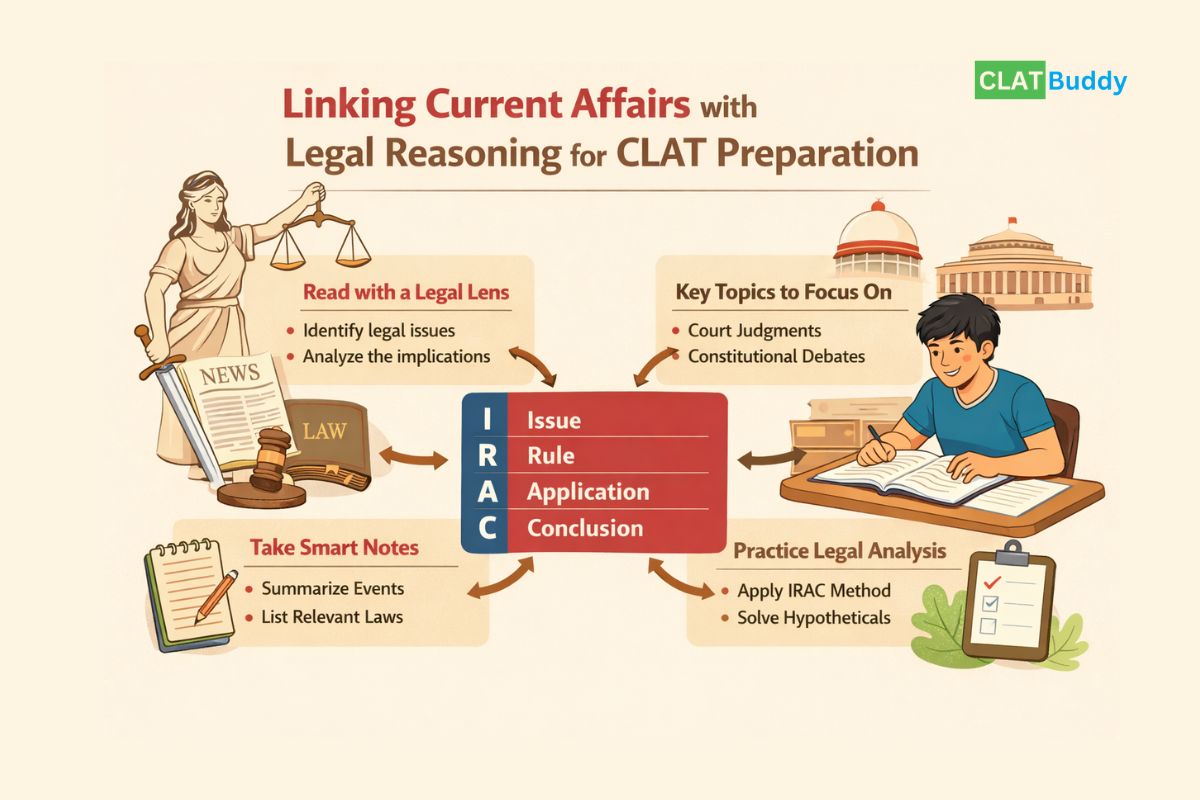
If you are preparing for CLAT or any other law entrance exam, you already know that legal reasoning and current affairs are two major pillars of your preparation. But here is the real question. Are you studying them separately, or are you learning how to connect them?
Many students read newspapers daily and practise legal reasoning questions from mock tests. Yet, they fail to combine the two. In CLAT, that combination is exactly what gives you an edge.
In this article, I will guide you step by step on how to link current affairs with legal reasoning for CLAT 2026 and beyond. If you master this skill now, you will not just score better, you will start thinking like a law student.
CLAT has changed over the years. It is no longer a memory-based exam. It is a comprehension and application-based exam.
In the CLAT Legal Reasoning section, you are given passages related to:
Now think about it. Where do these topics come from?
They come directly from current legal developments in India.
If you read about:
You are already reading potential legal reasoning material.
That is why understanding current affairs for CLAT is not just about GK. It is about improving your legal aptitude.
Before linking current affairs to legal reasoning, you must clearly understand what legal reasoning means.
In simple terms, legal reasoning is:
In CLAT, you are not expected to know every law. You are expected to read a passage, understand the principle given, and apply it logically.
So when you read current affairs, your focus should not be on memorising dates and names. Instead, you should ask:
This is how you train your brain for CLAT legal reasoning questions.
Most students make one common mistake. They read newspapers like a general reader.
As a CLAT aspirant, you must read like a future law student.
Whenever you read a news article, ask yourself:
For example, if you read about internet shutdowns in a state, the legal angle could be:
Now you are no longer just reading news. You are analysing it through a legal lens.
Even though CLAT does not directly test IRAC, the logic behind it is very useful.
IRAC stands for:
Let us see how you can use this method while reading current affairs.
What is the main legal question?
Example:
Is banning a social media platform a violation of freedom of speech?
Which legal principle applies?
Example:
Article 19(1)(a) of the Constitution guarantees freedom of speech, subject to reasonable restrictions.
Would the restriction fall under public order, security of the state, or another valid ground?
Would the action likely be considered constitutional or unconstitutional?
By practising this mentally, you are building strong legal reasoning skills for CLAT.
Not every news story is equally important for law entrance exams in India. You must prioritise wisely.
Focus on:
These topics often appear in CLAT legal reasoning passages.
When you see such news, do not skip it. Read it carefully and think about the legal principles involved.
If you want to improve your CLAT preparation, your notes must be analytical, not bulky.
Here is a simple structure you can follow:
Write 3 to 4 lines explaining what happened.
Mention:
Briefly note:
Think like a judge. What might be the reasoning?
This method improves:
Over time, you will notice that legal reasoning questions feel more familiar.
Editorials are gold for CLAT aspirants.
When you read an editorial on:
You will see structured arguments.
You learn:
This directly improves your ability to handle passage-based legal reasoning questions.
Instead of memorising facts, you start understanding perspectives.
That is exactly what CLAT tests.
You do not need 3 extra hours. You need smart practice.
Here is a simple daily routine for CLAT 2026 aspirants.
Pick one important legal development from a reliable newspaper.
Try changing the facts slightly and apply the same legal principle.
This is exactly how CLAT frames legal reasoning questions.
By doing this daily, you strengthen both current affairs and legal aptitude.
When you link current affairs with legal reasoning, you gain multiple advantages.
You:
Many students panic in the legal reasoning section because they feel unfamiliar with the topic.
But if you regularly analyse current legal issues, most passages will feel like something you have already thought about.
Confidence is a huge scoring factor in CLAT.
Let me guide you as a mentor here.
Do not:
Also, do not treat current affairs for CLAT and legal reasoning for CLAT as separate subjects. They are deeply interconnected.
If you separate them, you are doing double work. If you combine them, you are studying smarter.
If you are in Class 11 or 12, this is the perfect time.
The earlier you start:
Remember, CLAT preparation is not about mugging up. It is about training your brain.
And linking current affairs with legal reasoning is one of the best ways to train it.
You are preparing not just for an exam, but for a career in law.
Law is not studied in isolation. It interacts with society, politics, economy, and technology.
When you read about:
You are witnessing law in action.
If you learn to connect these developments with legal principles, you will not only score well in CLAT legal reasoning, but you will also think like a true law student.
Start today.
Read one legal news article. Analyse it. Question it. Apply legal principles to it.
Over the next few months, you will notice a transformation in your legal aptitude, critical reasoning skills, and overall CLAT performance.
And remember, smart preparation always beats long preparation.