
How to Make Concise GK Notes for CLAT 

Preparing for CLAT is not just about reading newspapers or monthly magazines. It is about how effectively you convert information into revision-ready notes. Many aspirants read daily but still struggle in GK because their notes are either too bulky or not structured.

If you are serious about cracking CLAT 2027, you need to learn one skill early: making concise GK notes that you can revise multiple times.

This guide will help you understand exactly how to do that in a simple and practical way.

What Are Concise GK Notes and Why Do You Need Them?

Concise GK notes are short, structured, and exam-focused summaries of current affairs and static GK. They are not detailed explanations. They are quick revision tools.

When you prepare for CLAT, you deal with one year of current affairs. If you rely only on reading, revision becomes difficult. This is where notes help.

Good GK notes help you:

  • Revise faster before mocks and the exam
  • Retain information for a longer time
  • Identify important topics quickly
  • Build clarity on issues, not just facts

If your notes are too long, you will avoid revising them. If you avoid revision, you lose marks. So the goal is simple: short notes that you will actually revise.

What Is the Ideal Format for GK Notes for CLAT?

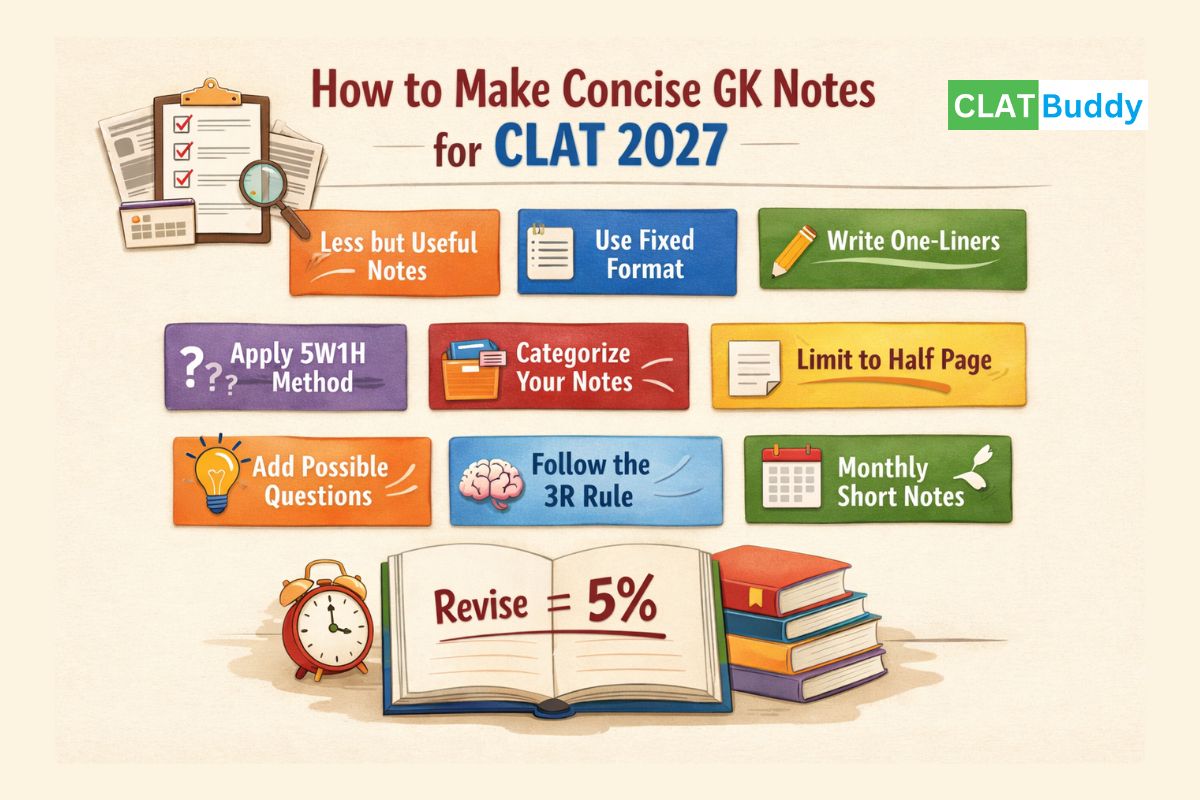
A fixed format saves time and keeps your notes organised. Instead of writing randomly, follow a structure for every topic.

Start with this format:

Topic:
Why in News: One line explaining relevance
Background: Two to three lines
Key Points: Four to five bullets
Static Link: Related concept or article
Possible Questions: One or two expected questions

This format ensures that you cover everything important without overloading your notes.

Why This Format Works

  • It forces you to think about relevance
  • It avoids unnecessary details
  • It prepares you for passage based questions

Once you follow this consistently, your notes will automatically become concise and effective.

How Should You Write GK Notes in One Line Format?

One of the biggest mistakes aspirants make is writing full paragraphs. That is not needed.

You should train yourself to write in one line or keyword format.

Example

Instead of writing:
“The scheme was launched by the government to promote renewable energy and reduce carbon emissions.”

Write:

  • Scheme name
  • Ministry
  • Objective
  • Target group

Why One Line Notes Work

  • They improve revision speed
  • They reduce mental load
  • They help in quick recall during exams

Remember this rule: If a sentence can be shortened, shorten it.

How Can You Use the 5W1H Method While Making GK Notes?

The 5W1H method helps you filter only important information.

For every news topic, ask:

  • What happened
  • Why it is important
  • Who is involved
  • Where it happened
  • When it happened if relevant
  • How it impacts

You do not need to write all six every time. Use only what is relevant.

Example

For a Supreme Court judgment:

  • What: Judgment delivered
  • Why: Constitutional issue
  • Who: Bench or parties
  • Impact: Legal significance

This method ensures that your notes are focused and exam-oriented.

How Should You Categorise Your GK Notes for Better Revision?

If all your notes are in one place, revision becomes confusing. You should divide them into clear categories.

Recommended Categories for CLAT

  • Polity and Judiciary
  • International Relations
  • Economy and Government Schemes
  • Environment and Science
  • Awards and Sports

Why Categorisation Matters

  • It helps in topic-wise revision
  • It improves memory association
  • It makes last-minute revision easier

You can maintain separate sections in a notebook or use digital tools like Notion or Google Docs.

How Long Should Each GK Note Be?

This is where most students go wrong.

A single topic should not exceed:

  • Half page in a notebook
  • Five to six bullet points

If your notes are longer than this, you are writing too much.

How to Reduce Length

  • Remove repeated points
  • Avoid detailed explanations
  • Focus only on exam-relevant facts

Your goal is not to create study material. Your goal is to create revision material.

Why Should You Add Possible Questions in Your GK Notes?

This is one of the most powerful techniques that many aspirants ignore.

After writing your notes, add one or two possible questions.

Example

  • Which article is related to this issue?
  • Why is this topic in controversy?

Benefits of This Approach

  • It improves analytical thinking
  • It prepares you for passage based questions
  • It helps in retention

CLAT is not about direct facts anymore. It tests understanding. Writing possible questions bridges that gap.

How Should You Revise GK Notes Effectively?

Making notes is only half the work. Revision is what actually improves your score.

Follow the 3R Rule:

  • Read the notes
  • Recall without looking
  • Revise after two to three days

Weekly Revision Strategy

  • Revise daily notes at the end of the week
  • Revise weekly notes at the end of the month
  • Keep revising important topics repeatedly

Why Revision Matters

Without revision, even the best notes are useless. GK is memory based. The more you revise, the more confident you become.

How Can You Create Monthly Concise GK Notes?

Daily notes are detailed. But before the exam, you need ultra-short notes.

At the end of every month:

  • Convert your notes into six to ten pages
  • Keep only the most important topics
  • Remove less relevant news

What to Include in Monthly Notes

  • Major national and international issues
  • Important judgments
  • Key government schemes
  • Repeated topics

These monthly notes will become your final revision material before CLAT.

What Are the Common Mistakes to Avoid While Making GK Notes?

Avoiding mistakes is as important as following the right strategy.

Common Errors

  • Writing full newspaper paragraphs
  • Adding too many facts and numbers
  • Not following a fixed format
  • Making notes but not revising

What You Should Do Instead

  • Keep notes short and structured
  • Focus on clarity, not quantity
  • Revise regularly

Remember, quality of notes matters more than quantity.

What Is an Example of a Perfect Concise GK Note?

Let us look at a simple example to understand how your notes should look.

Topic: Uniform Civil Code
Why in News: Debate in Uttarakhand
Background: Common civil laws for all citizens
Key Points:

  • Article 44 of DPSP
  • Covers marriage, divorce, inheritance
  • State level implementation
    Static Link: DPSP vs Fundamental Rights
    Possible Questions:
  • Which article mentions UCC?
  • Why is it controversial?

This is short, clear, and easy to revise.

How Can You Stay Consistent with GK Note Making?

Consistency is the real challenge in CLAT preparation.

Simple Daily Routine

  • Read newspaper or GK source for 30 to 45 minutes
  • Make notes for 20 to 30 minutes
  • Revise previous notes for 10 minutes

Tips to Stay Consistent

  • Do not try to cover everything
  • Focus on important topics only
  • Keep your notes simple

Even if you study less on some days, try not to skip note making completely.

Final Thoughts: Focus on Smart Work, Not Just Hard Work

GK preparation can feel overwhelming. There is too much information and limited time.

But once you learn how to make concise notes, everything becomes manageable.

Remember:

  • Notes should be short
  • Notes should be structured
  • Notes should be revised regularly

If you follow this consistently, you will notice a clear improvement in your GK section.

CLAT is not about who reads the most. It is about who revises the best.


Calling all law aspirants!

Are you exhausted from constantly searching for study materials and question banks? Worry not!

With over 15,000 students already engaged, you definitely don't want to be left out.

Become a member of the most vibrant law aspirants community out there!

It’s FREE! Hurry!

Join our WhatsApp Groups (Click Here) and Telegram Channel (Click Here) today, and receive instant notifications.

CLAT Buddy
CLAT Buddy

Leave a Reply

Your email address will not be published. Required fields are marked *

CLATBuddy Popup Banner New