
If you are in Class 11 or 12 and thinking, “I have never studied law before. How will I solve Legal Reasoning in CLAT?” take a deep breath.
You do not need prior law knowledge to score well in CLAT Legal Reasoning. In fact, the exam is designed in a way that tests your ability to read, understand, and apply legal principles logically. As someone guiding CLAT aspirants every year through CLATBuddy, I can confidently tell you that students from science, commerce, and humanities backgrounds crack this section with the right approach.
In this article, you will learn how to prepare Legal Reasoning for CLAT from scratch, what skills actually matter, and how to build them step by step.
Before you start preparation, you must understand what the Legal Reasoning section of CLAT actually tests.
In CLAT, you are given passages based on legal principles. These can be about contracts, torts, constitutional law, or current legal issues. After the passage, you are asked multiple choice questions where you must apply the principle given in the passage to new fact situations.
CLAT does not expect you to know bare acts or complex legal provisions. Instead, it tests:
If you focus only on memorising legal definitions, you will struggle. But if you train your mind to think logically and analytically, you will start enjoying this section.
This is one of the most searched questions by students in India.
The simple answer is no.
The Consortium of NLUs has clearly mentioned that the Legal Reasoning section does not require prior legal knowledge. The principles required to answer the questions are provided in the passage itself.
However, having basic familiarity with commonly tested areas can help you feel more comfortable. These areas include:
You do not need to study them in depth. You just need to understand basic ideas such as what is negligence, what makes a contract valid, or what is a fundamental right. This builds confidence and reduces fear.
If you are in Class 11 or early Class 12, this is the perfect time to start building your foundation.
Legal passages in CLAT are usually 400 to 500 words long. If you struggle with reading speed or comprehension, this section will feel overwhelming.
Start by:
This improves your vocabulary, concentration, and ability to understand arguments.
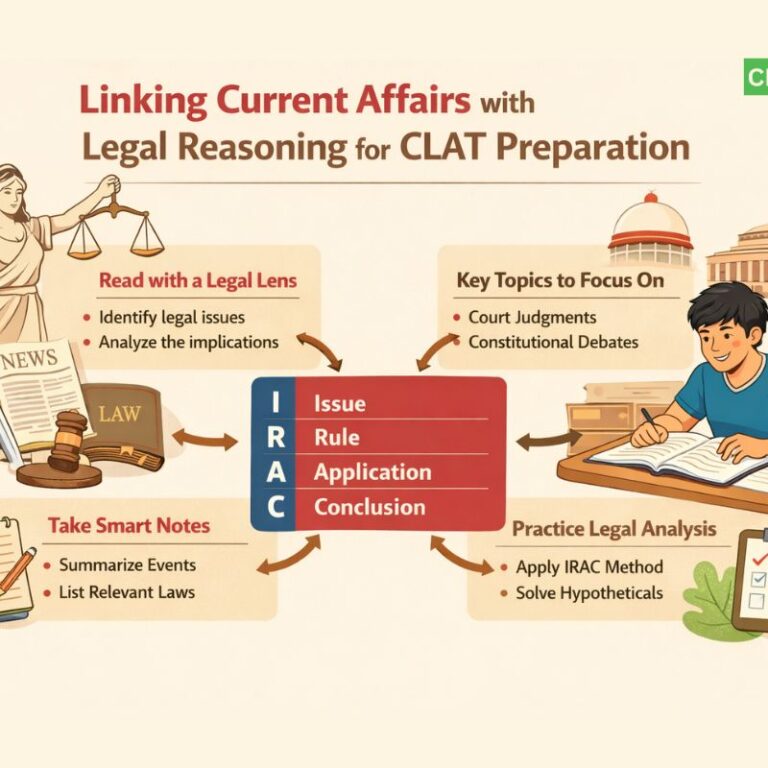
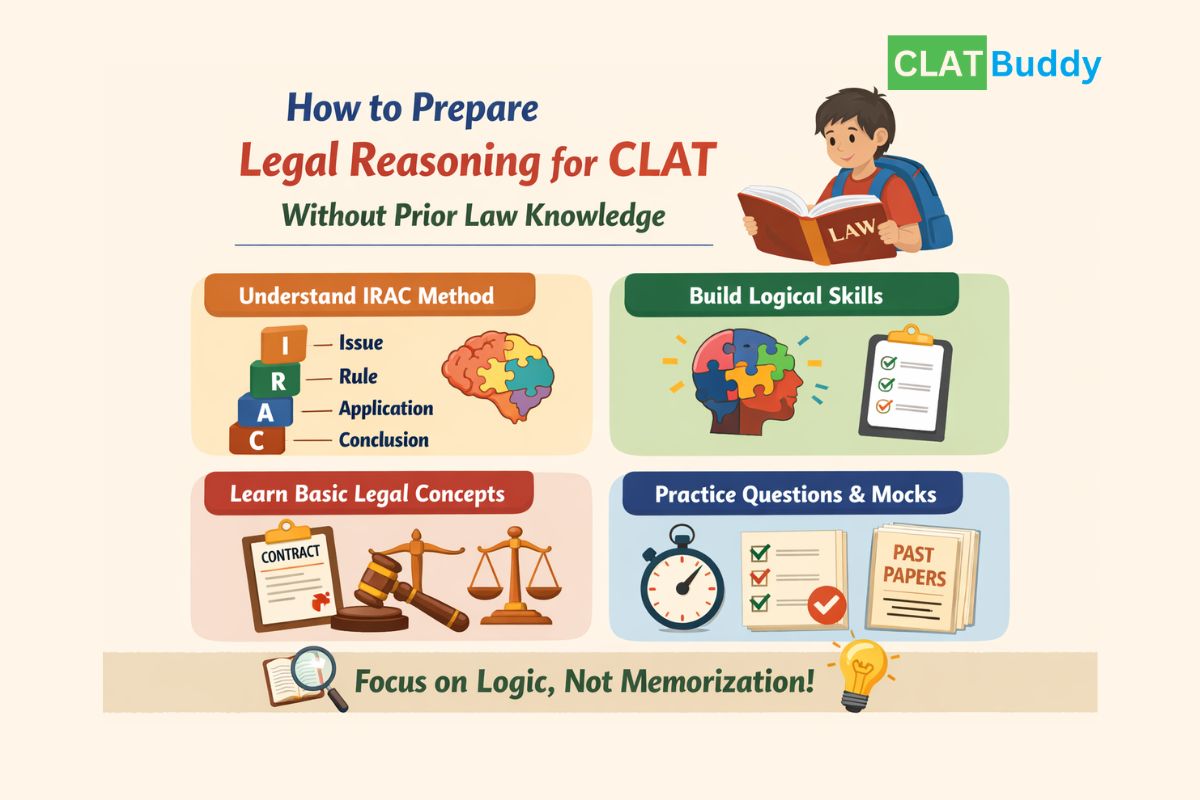
Even if you are not in law school yet, you should learn a simple method used by lawyers called IRAC.
IRAC stands for:
When you solve a CLAT Legal Reasoning question, mentally follow this process:
If you train yourself to think in this structured way, you will avoid confusion and eliminate wrong options more easily.
Many students search for “how to improve legal reasoning for CLAT” or “how to solve legal reasoning questions in CLAT.”
The real answer lies in improving your logical thinking.
Legal reasoning is very similar to logical reasoning. You are given:
Your task is to check whether the situation fits within the rule.
To improve this skill:
When you review your mock tests, do not just check the correct answer. Ask yourself why the other options were incorrect. This habit sharpens your analytical ability.
If you want to score 30 plus marks in Legal Reasoning, you must avoid common mistakes.
Many students try to use their general knowledge or moral opinion while answering.
In CLAT, this is dangerous.
You must strictly stick to the principle given in the passage, even if it feels unrealistic or unfair. Your job is not to judge the law. Your job is to apply it.
Words like:
These words can completely change the meaning of a principle. Train yourself to underline or mentally note such words while reading.
Some students jump directly to the questions without fully understanding the passage. This leads to confusion and repeated reading, which wastes time.
Instead, read the passage carefully once. Understand the principle clearly. Then move to the questions.
This is another common doubt among CLAT aspirants.
The best strategy is balance.
Spend some time understanding basic legal concepts in simple language. For example:
You can use beginner friendly CLAT preparation books or reliable online resources. Avoid complicated law textbooks meant for law school students.
After building basic understanding, shift your focus to practice.
Solve:
Practice under timed conditions. This improves your speed and accuracy.
If you are preparing seriously for CLAT, dedicate at least 45 minutes to 1 hour daily to Legal Reasoning.
A simple daily routine can look like this:
Consistency matters more than intensity. Even one hour daily over 8 to 10 months can create massive improvement.
Mock tests are extremely important for CLAT preparation.
They help you:
After every mock test, spend at least 2 to 3 hours analysing it. Check:
This reflective practice is what separates average scorers from top rankers.
Let me tell you something important.
Every year, thousands of students from science and commerce backgrounds crack CLAT and secure seats in top NLUs. They also started without legal knowledge.
What makes the difference is mindset.
You should:
Legal Reasoning is a skill. And like any skill, it improves with training.
If I had to summarise the smart strategy for you, it would be this:
Search terms like “how to prepare legal reasoning for CLAT,” “legal reasoning preparation tips,” and “CLAT legal aptitude strategy” all lead to the same conclusion. Focus on logic, not memorisation.
But once you start solving passages, you will realise something. It is just structured thinking. It is about reading carefully, thinking logically, and choosing the most reasonable answer.
Do not wait to feel confident before you start. Start first. Confidence will follow.
At CLATBuddy, we believe that with the right guidance and disciplined practice, you can master Legal Reasoning even without prior law knowledge.
If you stay consistent, trust your preparation, and practice smartly, you will walk into the CLAT exam hall ready and calm.
And that is exactly where you want to be.