
If the thought of revising one year of GK feels overwhelming, that is completely normal. Most CLAT aspirants struggle with current affairs because it looks endless and unpredictable. The real problem is not lack of time, but lack of strategy.
Many students try to read everything from January to December, spend hours making notes, and still forget most of it. This leads to frustration and burnout.
The truth is simple. GK is not about how much you read. It is about how well you revise and recall.
This guide will help you revise one year of GK in a structured and stress-free way, so that you stay consistent and confident till the exam.
Before fixing the problem, it is important to understand why it happens.
Most students:
GK becomes exhausting when it feels like an endless syllabus. But once you simplify it, the pressure reduces automatically.
Instead of treating GK like a memory test, treat it like a pattern-based subject.
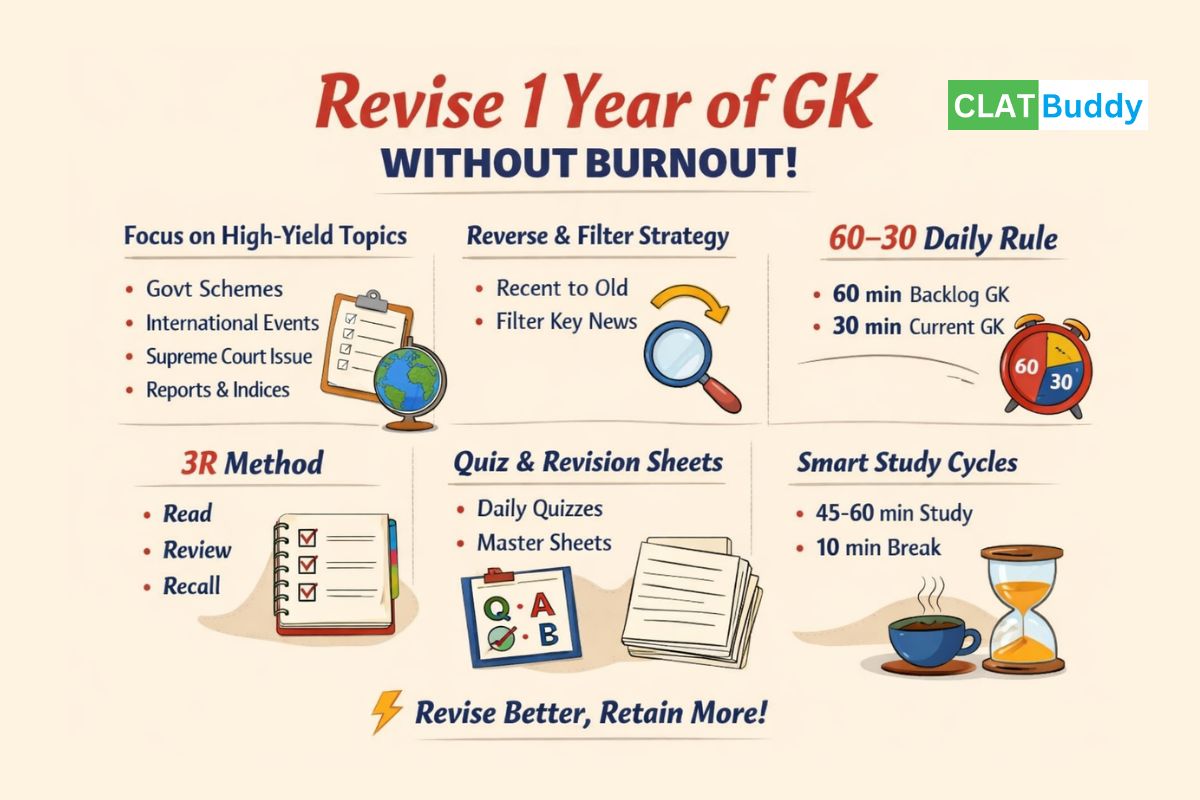
Not everything in current affairs is important. You should prioritise:
This filtering reduces your workload and helps you focus on what actually matters for CLAT.
This is one of the biggest mistakes students make.
Start from the most recent 3 to 4 months and then move backwards.
Recent events:
Once you gain momentum, covering older months becomes much easier.
You do not need to study GK for hours.
This ensures that:
Consistency matters more than long study hours.
Simply reading notes again and again will not work. You need an active revision method.
Go through short and concise notes. Avoid reading full articles repeatedly.
Revise the same content within a few days to strengthen memory.
Close your notes and try to remember what you studied.
Recall is the most powerful step. If you cannot recall, it means you need to revise again.
Yes, but only if done smartly.
Instead of writing everything, compress your GK into:
Focus only on:
This helps you revise quickly before the exam without feeling overloaded.
Quizzes are one of the most underrated tools.
Spend 10 to 15 minutes daily solving GK questions.
This helps in:
GK is not about passive reading. It is about active testing.
Long study hours are not the solution. Smart study patterns are.
This keeps your mind fresh and improves retention.
GK should not feel like a burden. Treat it as a daily habit rather than a heavy subject.
Avoiding mistakes is just as important as following the right strategy.
These mistakes lead to burnout and low retention.
If you are short on time, you can follow a structured plan.
This plan helps you cover maximum GK in minimum time without stress.
One-time reading is never enough.
The more you revise, the stronger your memory becomes.
GK can feel boring if not approached correctly.
Keep a checklist of completed months. Seeing progress boosts motivation.
Do not aim for perfection. Aim for consistency.
This is where most students go wrong.
GK is not about covering everything. It is about:
Even if you remember 60 to 70 percent of important GK, you are in a strong position.
Revising one year of GK does not have to be stressful. With the right strategy, it becomes manageable and even enjoyable.
Start with recent months, focus on important topics, revise regularly, and test yourself through quizzes.
Most importantly, stay consistent. Even one hour of focused GK daily can make a huge difference over time.
CLAT is not about doing everything. It is about doing the right things consistently.