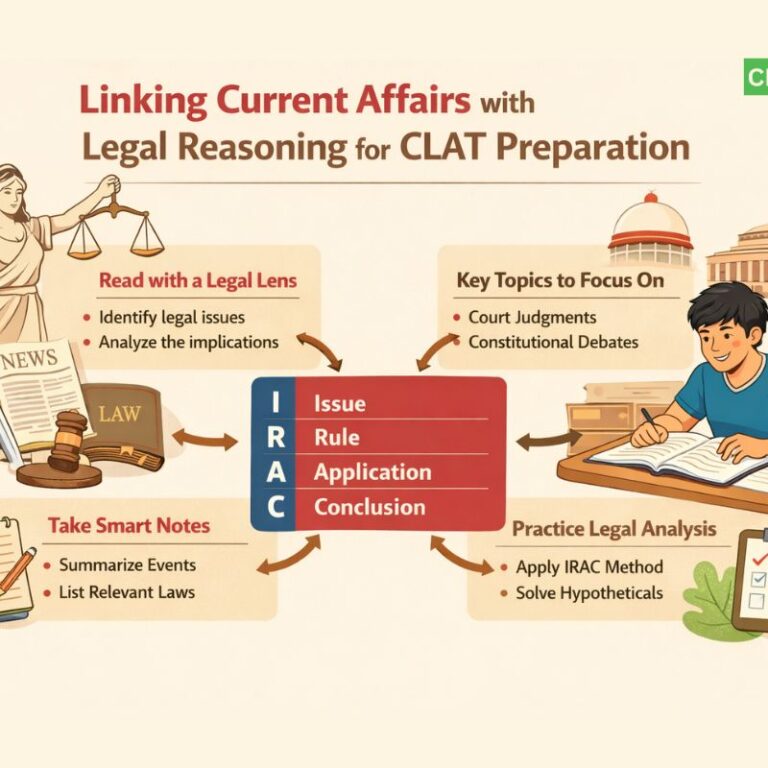


If you are preparing for CLAT 2027, current affairs can feel confusing and overwhelming. You may often wonder what to read, how much to read, and how to remember so many events. The truth is that current affairs is not about reading everything. It is about reading smartly, understanding context, and linking news with law, governance, and society. With the right approach, current affairs can become one of your strongest sections.
This guide will help you understand exactly how to study current affairs for CLAT 2027 in a structured and stress-free way.
Current affairs in CLAT is not a memory-based section anymore. The exam tests whether you understand what is happening around you and whether you can analyse it logically. Most questions are passage-based and linked to real-world events.
Current affairs questions usually test:
If you prepare current affairs properly, it also helps you in legal reasoning passages because many legal topics are inspired by real events.
Before you start studying, you must know what to focus on. CLAT does not follow a fixed syllabus, but the pattern is predictable.
You should focus on:
Sports and entertainment news should be studied only if they have national or international importance.
For CLAT 2027, current affairs preparation should ideally cover May 2026 to October 2027. This roughly means 15 to 18 months of news.
You should not try to cover more than this, as older news usually does not appear unless it is linked to an ongoing issue.
Choosing the right sources is more important than reading multiple sources. Too many sources will only confuse you.
Reading one good newspaper daily is enough. The most preferred options are:
Focus on the editorial and explained sections rather than political gossip.
Monthly compilations help you revise and consolidate news. Choose one reliable source and stick to it.
Websites that explain issues in simple language are extremely helpful for CLAT-level understanding.
Avoid social media reels or random current affairs PDFs without explanations.
Many students read newspapers like a storybook, which does not help in CLAT.
When you read the newspaper, ask yourself:
Focus on:
Skip local crime news, celebrity interviews, and political speeches without substance.
Good notes save revision time before the exam.
Your notes should answer these questions:
Keep your notes short and structured:
You can maintain digital notes or a notebook, but consistency matters more than the format.
This is where most students lose marks.
Whenever you read a current affair, try to link it with static concepts. For example:
This approach helps you answer application-based questions easily.
You do not need hours every day.
A practical daily plan looks like this:
Consistency matters more than long study hours.
Revision is the key to retention.
You should follow a simple revision cycle:
Without revision, current affairs preparation becomes useless.
Reading alone is not enough. You must practice.
You should regularly:
While analysing, focus on understanding the logic behind the question rather than memorising facts.
Many CLAT aspirants make common mistakes that cost them marks.
Avoid:
Current affairs is not about mugging up. It is about awareness and clarity.
Motivation fades, but systems work.
You can stay consistent by:
Treat current affairs like a habit, not a subject.
Studying current affairs does not help only in CLAT.
It improves:
These skills will stay with you even after you enter law school.
To crack current affairs for CLAT 2027, remember three things:
If you start early and stay disciplined, current affairs can become a scoring and confidence-boosting section for you.
Start building your current affairs habit today. A few focused minutes daily can make a massive difference in your CLAT 2027 rank. Stay consistent, stay curious, and trust the process.