

How to Use Previous Year Questions Effectively for CLAT Preparation
If you ask toppers what genuinely helped them improve in CLAT preparation, many will mention one thing repeatedly: previous year questions.
Not because PYQs magically increase marks, but because they help you understand the exam better than any random practice material. They show you how questions are framed, how passages are structured, what topics repeat, and how the examiners think.
Still, many students use PYQs incorrectly. Some solve them casually without analysis. Others save them only for the last month. Some simply check scores and move on.
If you want to use previous year questions effectively for CLAT, you need a proper strategy.
In this article, you will learn:
- How to solve PYQs properly
- When to start using them
- How to analyse mistakes
- How to improve speed and accuracy using PYQs
- Common mistakes students make while practising
Why Are Previous Year Questions So Important for CLAT?
CLAT is not an exam where mugging up theory works.
The exam tests:
- Reading ability
- Application of concepts
- Time management
- Logical thinking
- Decision making under pressure
Previous year papers help you understand all these things together.
They help you:
- Understand the actual difficulty level
- Learn important topics
- Improve question selection
- Develop exam temperament
- Reduce fear of the unknown
Most importantly, PYQs help you move from “studying” to “exam-oriented preparation.”
When Should You Start Solving Previous Year Questions?
Many students think they should start PYQs only after completing the syllabus.
That is not necessary.
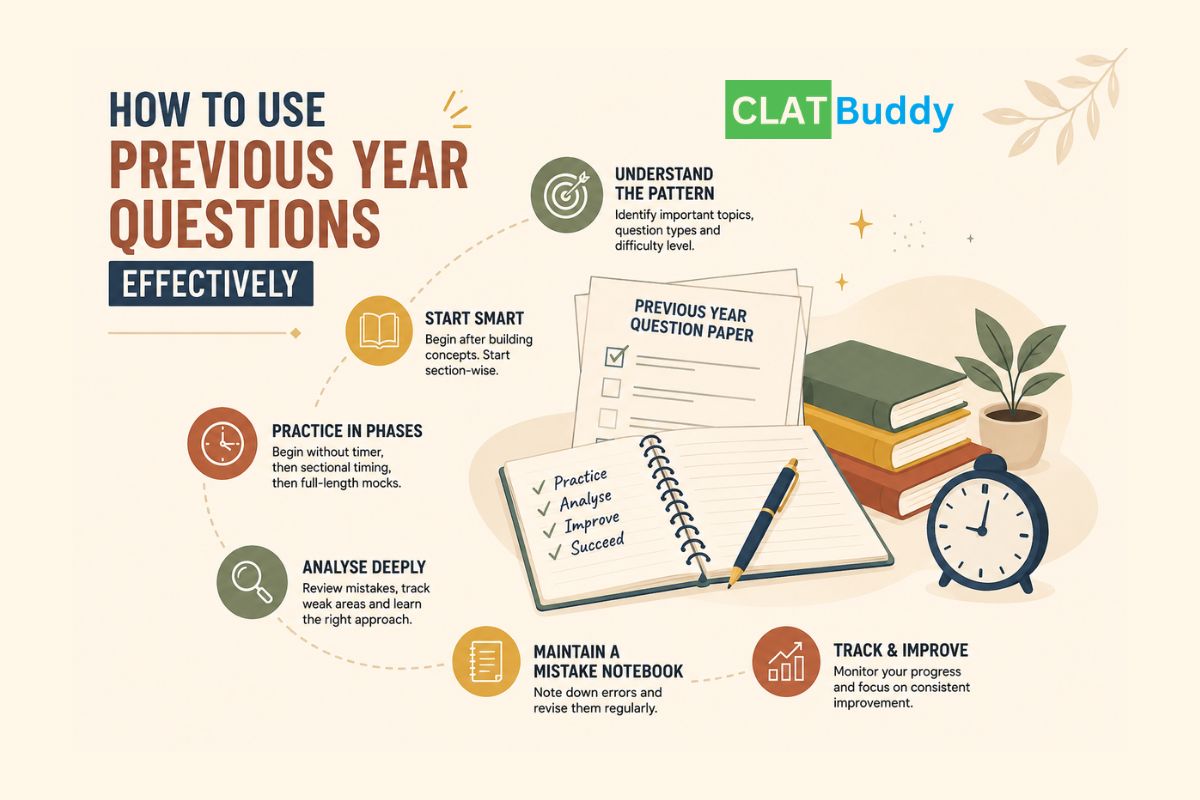
You should begin using PYQs early, but in a smart way.
During the Initial Preparation Stage
At the beginning:
- Solve section-wise PYQs
- Focus on understanding question patterns
- Do not worry too much about speed
For example:
- After learning basic legal reasoning, solve legal reasoning PYQs
- After practising reading comprehension, attempt previous English passages
This helps you connect concepts with actual exam questions.
During the Intermediate Stage
Once your basics become stronger:
- Start timed sectional practice
- Improve speed and accuracy together
- Learn time allocation
At this stage, PYQs become training tools.
During the Final Months
In the last 2 to 3 months:
- Solve full-length previous year papers
- Attempt them like actual mocks
- Analyse deeply after every paper
This stage is where real exam preparation happens.
How Should You Solve PYQs in the Beginning?
One of the biggest mistakes students make is solving full papers immediately.
That often creates frustration.
Instead, start slowly and strategically.
Should You Solve Topic-wise or Full-Length Papers First?
You should begin with topic-wise practice.
This allows you to:
- Build confidence
- Understand question styles
- Improve specific weak areas
For example:
Legal Reasoning
Solve:
- Principle-fact questions
- Constitutional law based passages
- Tort and contract related application questions
English Language
Practise:
- Reading comprehension
- Inference-based questions
- Vocabulary in context
Logical Reasoning
Focus on:
- Critical reasoning
- Assumptions
- Conclusions
- Strengthen and weaken questions
Once comfortable, gradually move to full-length papers.
How Can PYQs Improve Your Time Management?
Many CLAT aspirants know concepts but struggle to complete the paper.
This usually happens because they never trained under time pressure.
PYQs help you improve speed naturally.
How Should You Use Timers While Solving PYQs?
Start in phases.
Phase 1
No strict timer.
Focus only on accuracy and understanding.
Phase 2
Use sectional timers.
For example:
- English: 30 minutes
- Legal Reasoning: 35 minutes
- Logical Reasoning: 25 minutes
Phase 3
Attempt complete papers in exam conditions.
No distractions.
No phone.
No extra breaks.
This builds:
- Stamina
- Focus
- Mental endurance
These things matter a lot in CLAT.
Why Is Analysis More Important Than Solving?
This is where most students lose marks.
Simply solving papers is not enough.
The real improvement happens during analysis.
A student who solves 10 papers properly can improve more than someone who solves 50 papers casually.
What Should You Analyse After Every PYQ?
After every paper, ask yourself:
Which Questions Were Wrong?
Find out:
- Was it a conceptual mistake?
- A silly mistake?
- A reading error?
- A guess?
Which Questions Took Too Much Time?
Sometimes the issue is not accuracy but time wastage.
You need to identify:
- Slow passages
- Confusing question types
- Difficult sections
Which Topics Keep Repeating?
Certain themes appear again and again in CLAT.
For example:
- Constitutional principles
- International events
- Reading comprehension inference questions
- Logical reasoning assumptions
Tracking repeated patterns helps you prioritise smarter.
Why Should You Maintain a PYQ Mistake Notebook?
A mistake notebook can completely change your preparation.
Every time you make a mistake, write:
- The question type
- Why the mistake happened
- What should have been the correct approach
Over time, you will notice patterns.
Maybe:
- You misread “except” questions
- You rush through legal passages
- You make calculation mistakes in Quant
This notebook becomes your personalised improvement guide.
How Many Previous Year Papers Should You Solve?
Students often become obsessed with quantity.
They collect hundreds of papers but analyse very few.
Quality matters much more.
For CLAT, properly analysing:
- 10 to 15 previous year papers
can help more than casually solving 50.
The goal is not just exposure.
The goal is learning patterns.
Should You Re-solve Previous Year Questions?
Yes. Absolutely.
Re-solving papers is highly underrated.
When you solve the same paper again after a few weeks:
- Your speed improves
- Your pattern recognition improves
- Your confidence increases
- Your mistakes reduce
This also helps in long-term retention.
Can PYQs Help in Improving Accuracy?
Yes, and this is one of their biggest benefits.
Accuracy improves when your brain becomes familiar with:
- Exam language
- Passage structure
- Question traps
- Option elimination techniques
The more quality PYQs you solve, the more naturally your brain starts recognising patterns.
Eventually, you stop overthinking simple questions.
How Can You Use PYQs for Legal Reasoning?
Legal Reasoning is one of the most important sections in CLAT.
PYQs can help you understand:
- Principle-based questions
- Fact application
- Legal language
- Reading speed under pressure
What Should You Focus on While Analysing Legal PYQs?
Focus on:
- Why the correct option is correct
- Why the wrong options are wrong
- Whether you missed facts from the passage
- Whether you assumed outside knowledge
CLAT legal reasoning mostly tests application, not legal expertise.
The better your passage reading becomes, the better your score improves.
How Can PYQs Help in Current Affairs Preparation?
Many students misunderstand current affairs preparation.
CLAT does not usually ask direct factual GK questions only.
It focuses heavily on:
- Reading comprehension
- Context understanding
- Issue awareness
PYQs help you understand:
- How current affairs passages are framed
- What depth of knowledge is required
- Which topics become important
This helps you study current affairs more strategically.
What Are the Common Mistakes Students Make While Using PYQs?
Avoid these mistakes:
- Solving Without Analysis: This is the biggest mistake.
- Ignoring Weak Areas: Many students repeatedly practise favourite sections while avoiding weak ones.
- Focusing Only on Scores: Your score matters less than your learning initially.
- Not Simulating Exam Conditions: You must eventually practise under pressure.
- Random Guessing Without Review: Blind guessing teaches nothing unless analysed properly.
How Should You Balance PYQs and Mock Tests?
Both are important, but they serve different purposes.
Previous Year Questions Help You:
- Understand actual CLAT patterns
- Learn examiner behaviour
- Improve fundamentals
Mock Tests Help You:
- Handle unpredictability
- Improve adaptability
- Build exam temperament
A balanced preparation strategy uses both together.
What Is the Best PYQ Strategy for the Last Few Months Before CLAT?
If your exam is close, your preparation should become highly exam-oriented.
3 to 4 Months Before CLAT
- Solve sectional PYQs regularly
- Start full-length timed papers
- Improve weak sections
2 Months Before CLAT
- Increase mock frequency
- Re-solve important PYQs
- Focus heavily on analysis
Final Month
- Avoid excessive new material
- Revise mistakes
- Improve consistency
- Focus on accuracy and calmness
Final Thoughts
Previous year questions are not just practice papers. They are one of the best learning tools available for CLAT preparation.
If used properly, PYQs can help you:
- Improve accuracy
- Increase speed
- Understand the exam deeply
- Build confidence
- Reduce exam anxiety
Do not treat them like ordinary worksheets.
Treat them like a map that shows you how the exam actually works.
And remember one important thing.
Low scores in PYQs are not failures. They are feedback.
Every mistake you discover now is one mistake less in the actual CLAT exam.
Calling all law aspirants!
Are you exhausted from constantly searching for study materials and question banks? Worry not!
With over 15,000 students already engaged, you definitely don't want to be left out.
Become a member of the most vibrant law aspirants community out there!
It’s FREE! Hurry!
Join our WhatsApp Groups (Click Here) and Telegram Channel (Click Here) today, and receive instant notifications.