
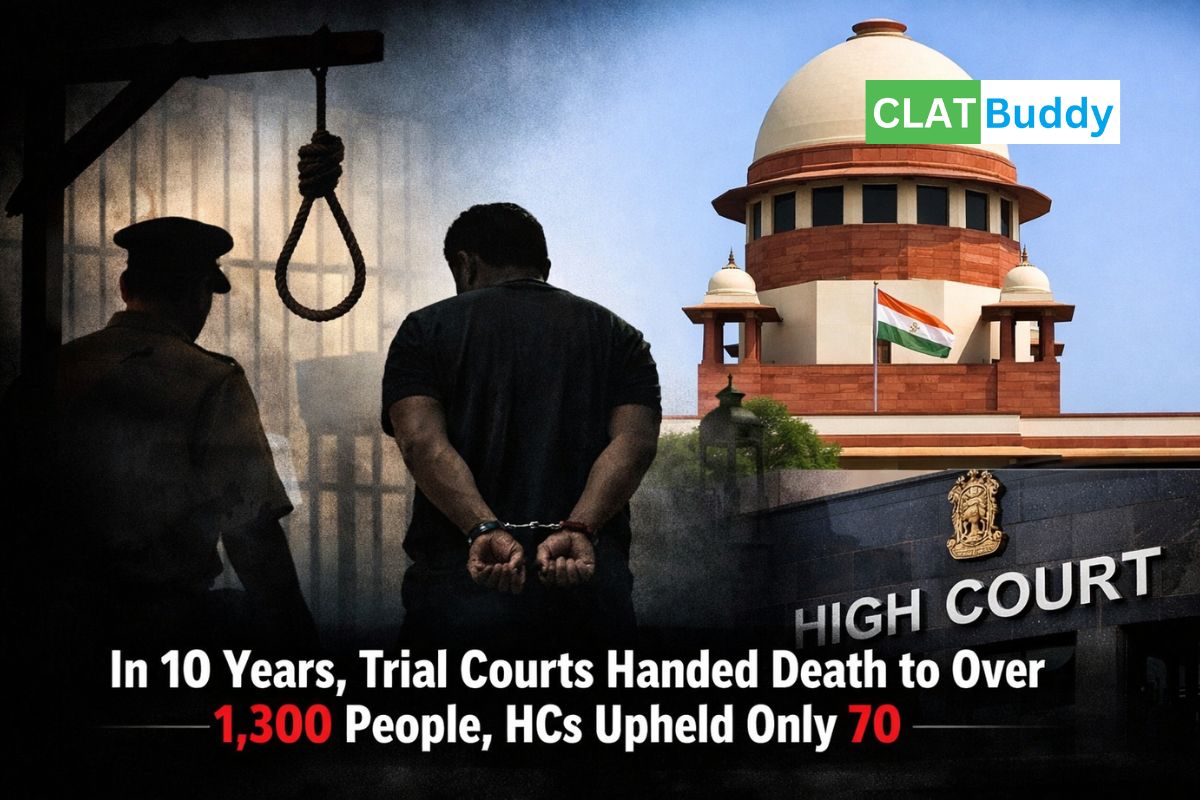
Over the last decade, trial courts across India have sentenced more than 1,300 people to death. Yet, when these cases reach the High Courts and the Supreme Court, only a tiny fraction of those sentences are ultimately upheld.
A new study by the NALSAR’s Square Circle Clinic tracking death penalty cases over ten years highlights a stark disconnect between sentencing at the trial stage and scrutiny by appellate courts, raising serious questions about due process, judicial consistency, and the future of capital punishment in India.
The study reveals that while trial courts handed down death sentences to 1,310 individuals over ten years, High Courts confirmed only about 70 of those cases. The Supreme Court, which examined a subset of these confirmations, did not uphold a single death sentence in recent years. As a result, India currently has a large and growing death row population, even though very few death sentences actually pass the test of appeal.
In several instances, people sentenced to death were later fully acquitted by higher courts. In recent years, acquittals, commutations to life imprisonment, or remands for fresh consideration have become far more common than confirmations of the death penalty.
Appellate courts have increasingly emphasised that the death penalty can be imposed only after strict compliance with procedural safeguards. Sentencing is no longer treated as a formality following conviction but as a separate, constitutionally significant stage of the trial.
Higher courts have repeatedly stressed the need to consider the accused person’s mental health, background, conduct in prison, and scope for reform. Where trial courts fail to meaningfully engage with these factors, death sentences are likely to be set aside.
The data suggests that many trial courts continue to impose death sentences without following these safeguards in letter and spirit. In a large number of cases, sentencing hearings were conducted hastily—sometimes on the same day as conviction—leaving little room for mitigation evidence to be collected or examined.
Over the past few years, the Supreme Court has laid down detailed guidelines requiring trial courts to call for reports such as psychological evaluations, probation officer assessments, and prison conduct records before imposing the death penalty. These directions were meant to ensure that sentencing decisions are informed, individualised, and fair.
More recently, the Court has gone a step further by holding that a proper sentencing hearing is part of the fundamental right to a fair trial. Where these guidelines are ignored, higher courts have been willing to reopen the sentencing stage altogether, even for prisoners who had already exhausted their appeals.
This shift explains why confirmations of death sentences have dropped sharply, while acquittals and commutations have increased.
The report cautions against treating the high reversal rate as a series of isolated mistakes. Instead, it points to a systemic issue at the trial court level, where sentencing practices often fail to keep pace with evolving constitutional standards.
At the same time, there is a growing contradiction between the judiciary and the legislature. While courts have become more cautious about affirming death sentences, Parliament and state legislatures have expanded the scope of offences that carry the death penalty. This has led to more people being sentenced to death at the trial stage, even as fewer sentences ultimately survive appeal.
Another significant trend highlighted by the study is the increasing use of life sentences that effectively rule out remission for decades or even for the remainder of a person’s natural life. Appellate courts have often used such sentences as alternatives to the death penalty.
However, the report flags this as an under-regulated area of law. These sentences, while avoiding execution, can remove any realistic hope of release and raise their own constitutional and human rights concerns.
The findings underline a deep inconsistency in how the most severe punishment under Indian law is imposed and reviewed. A system in which hundreds of people are sentenced to death, but only a handful of sentences are upheld, places enormous psychological, legal, and social costs on accused persons, their families, and the justice system itself.
More broadly, the data strengthens the argument that errors in capital sentencing are not rare exceptions but recurring features. As higher courts continue to insist on stricter safeguards and fairer sentencing processes, the future of the death penalty in India appears increasingly uncertain, even as death row numbers continue to rise.