
The issue of hate speech in India has once again come into focus after the Gauhati High Court issued notice to Assam Chief Minister Himanta Biswa Sarma on February 26, 2026 over alleged communal remarks.
The petitions initially reached the Supreme Court of India, but a Bench led by Chief Justice of India Surya Kant declined to entertain them directly and asked the petitioners to approach the Gauhati High Court. The Court observed that during election periods, the judiciary often becomes a “political battleground.”
Around the same time, another Supreme Court Bench indicated that hate speech petitions pending since 2021 may be closed, while clarifying that parties remain free to approach High Courts or other legal remedies.
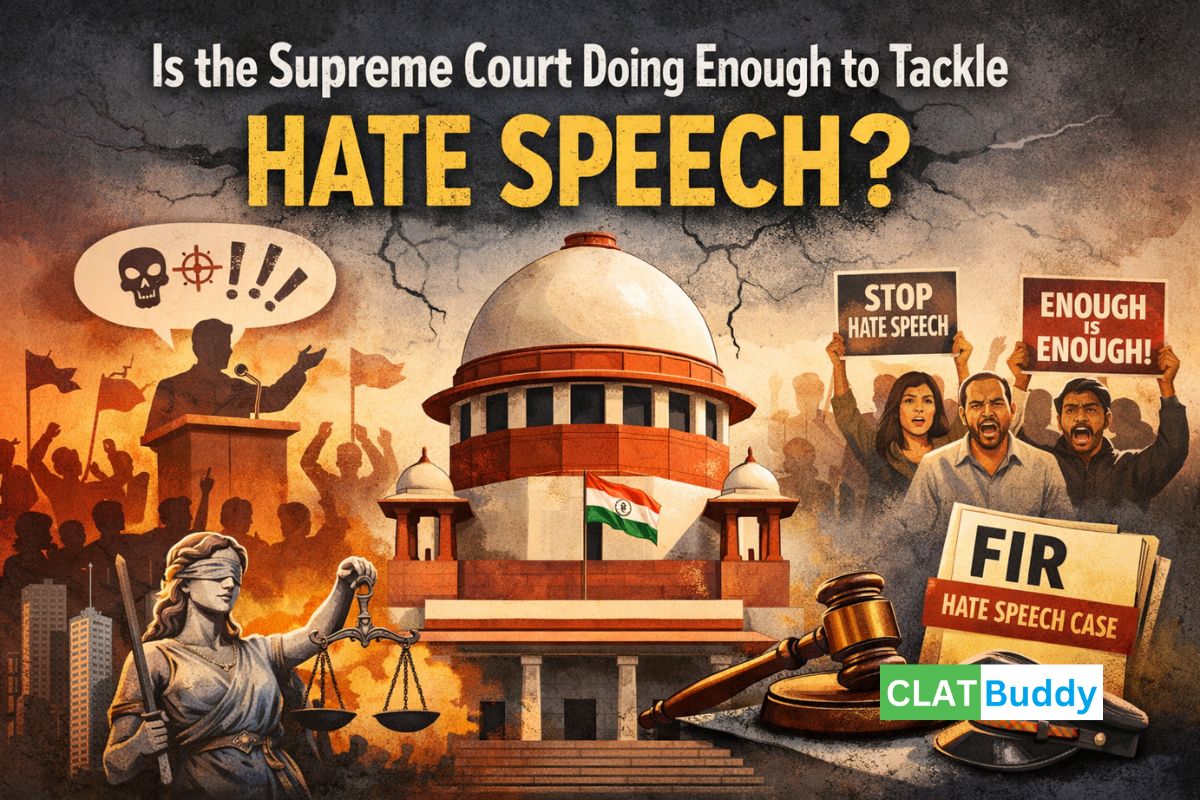
These developments have triggered a broader constitutional question: Is the Supreme Court doing enough to tackle hate speech in India?
Legal experts Shahrukh Alam and Haris Beeran recently debated this issue, highlighting the complexities surrounding hate speech laws, enforcement challenges, and the role of the judiciary.
One of the major challenges in addressing hate speech lies in defining it clearly in legal terms.
According to Shahrukh Alam, hate speech is not always a direct call to violence. More often, it appears as prejudicial or discriminatory discourse that targets particular communities and reinforces existing social hierarchies. Such speech can marginalise vulnerable groups and deepen social divisions even when it does not explicitly incite violence.
This makes criminalisation difficult. Not every offensive or divisive statement can be punished under criminal law. The threshold for criminal liability must be high, otherwise free speech could be unnecessarily restricted.
Another complication arises from power dynamics. Hate speech frequently originates from dominant political or social groups and is directed at communities that are already marginalised. In such situations, the harm is not merely the words spoken but the social context in which those words operate.
Hate speech therefore becomes not only a legal issue but also a democratic concern, because it may silence or exclude vulnerable communities from public discourse.
Rajya Sabha MP and advocate Haris Beeran emphasises another challenge: the ambiguity of hate speech.
Hate speech often appears in the form of “dog whistles.” These are statements designed to appear neutral or ambiguous while sending a discriminatory message to a specific audience.
Because such statements are not explicit calls for violence, speakers often claim plausible deniability. This makes it difficult for authorities to determine whether the speech actually violates criminal law.
In practice, courts must therefore evaluate not only the words used but also how the speech is perceived by the public and its potential impact on targeted communities.
This ambiguity complicates enforcement and creates uncertainty in applying existing legal provisions.
Some legal scholars argue that hate speech should not be treated merely as a criminal offence but as a constitutional tort.
A constitutional tort arises when state action or inaction violates constitutional rights, making the state liable for damages or compensation.
According to Shahrukh Alam, the state often fails to respond effectively to hate speech even when it leads to violence or social unrest. When authorities repeatedly fail to act, victims are left without adequate remedies.
Recognising hate speech as a constitutional tort could allow courts to:
This approach shifts the focus from simply punishing individuals to ensuring institutional accountability.
Haris Beeran similarly argues that the increasing prevalence of hate speech is closely linked to political rhetoric during elections. When communal or divisive language is used by prominent political leaders, it often encourages similar behaviour among supporters and lower-level officials.
Without a strong institutional response from bodies such as the police or the Election Commission, hate speech can become normalised in public discourse.
The Supreme Court has issued several important directives in the past to address hate speech and related crimes.
In Tehseen Poonawalla v Union of India (2018), the Supreme Court dealt with incidents of mob lynching and issued comprehensive guidelines to curb hate crimes.
The Court directed states to:
These guidelines were intended to create a preventive framework rather than simply reacting after violence occurs.
In 2023, the Supreme Court went a step further and directed state governments to register FIRs suo motu in cases of hate speech, even if no formal complaint is filed.
This direction was meant to address the problem of police inaction, which often occurs due to political pressure or administrative hesitation.
Despite these judicial directives, many observers argue that implementation remains weak.
Haris Beeran points out that violations of the Court’s guidelines continue to occur frequently. Hate speech cases often go unreported, and authorities rarely take action unless significant public pressure is generated.
One possible solution, according to Beeran, is for the Supreme Court to initiate contempt proceedings against officials who fail to implement its directions.
The Court also possesses wide powers under Article 142 of the Constitution, which allow it to pass orders necessary to ensure “complete justice.” These powers could theoretically be used to strengthen enforcement mechanisms.
However, critics argue that the Court has sometimes been reluctant to exercise these powers aggressively.
The recent decision involving Assam Chief Minister Himanta Biswa Sarma illustrates the Court’s cautious approach.
Instead of directly hearing the case, the Supreme Court asked the petitioners to approach the Gauhati High Court, noting that the judiciary should avoid becoming a forum for political disputes during election periods.
This reflects the Court’s broader concern about judicial overreach in politically sensitive matters.
However, some experts believe that such decisions risk weakening the Court’s role as a constitutional guardian against hate speech.
The Law Commission of India has previously recommended introducing specific provisions on hate speech, arguing that existing laws may not be sufficient.
Currently, hate speech in India is addressed through several legal provisions, including:
However, Haris Beeran argues that the problem is not the absence of laws but the lack of effective enforcement.
Even when legal provisions exist, institutions such as the Election Commission often fail to act decisively against political leaders who use divisive language.
A recent legislative attempt to address hate speech is the Karnataka Hate Speech and Hate Crimes (Prevention) Bill, 2025.
Some experts view this Bill as a potential model for national legislation.
However, Shahrukh Alam raises concerns about its design. According to her, the Bill focuses heavily on injury, offence, or public disorder, framing hate speech primarily as a law-and-order issue.
This approach may fail to capture the structural discrimination and social exclusion that hate speech often produces.
Additionally, overly broad definitions could lead to arbitrary enforcement, which might threaten legitimate free speech.
Haris Beeran believes that the Bill’s effectiveness can only be assessed after actual implementation, and any conceptual gaps can be corrected through amendments.
Even strong laws may not fully address the problem of hate speech.
Shahrukh Alam argues that the issue is deeply rooted in social attitudes and political culture. Laws can punish extreme cases, but they cannot eliminate the broader narratives and stereotypes that fuel hate speech.
Addressing the problem therefore requires societal change, including:
Without such changes, legal measures alone may have limited impact.
The debate ultimately raises a broader constitutional question: What role should the Supreme Court play in addressing hate speech?
On one hand, the Court has the authority and responsibility to protect fundamental rights, including the right to equality and dignity.
On the other hand, the judiciary must also respect freedom of speech and democratic debate, which are protected under Article 19 of the Constitution.
Balancing these competing principles is one of the most difficult challenges in constitutional law.
Hate speech remains one of the most complex legal and political issues in India today. While the Supreme Court has issued important guidelines and directives over the years, implementation gaps continue to undermine their effectiveness.
The debate over whether the Court is doing enough reflects deeper concerns about institutional accountability, political culture, and the limits of legal regulation.
Ultimately, tackling hate speech requires a combination of strong judicial oversight, effective law enforcement, clear legislation, and broader social commitment to equality and democratic values. Without such a comprehensive approach, hate speech may continue to challenge India’s constitutional promise of justice and fraternity.