
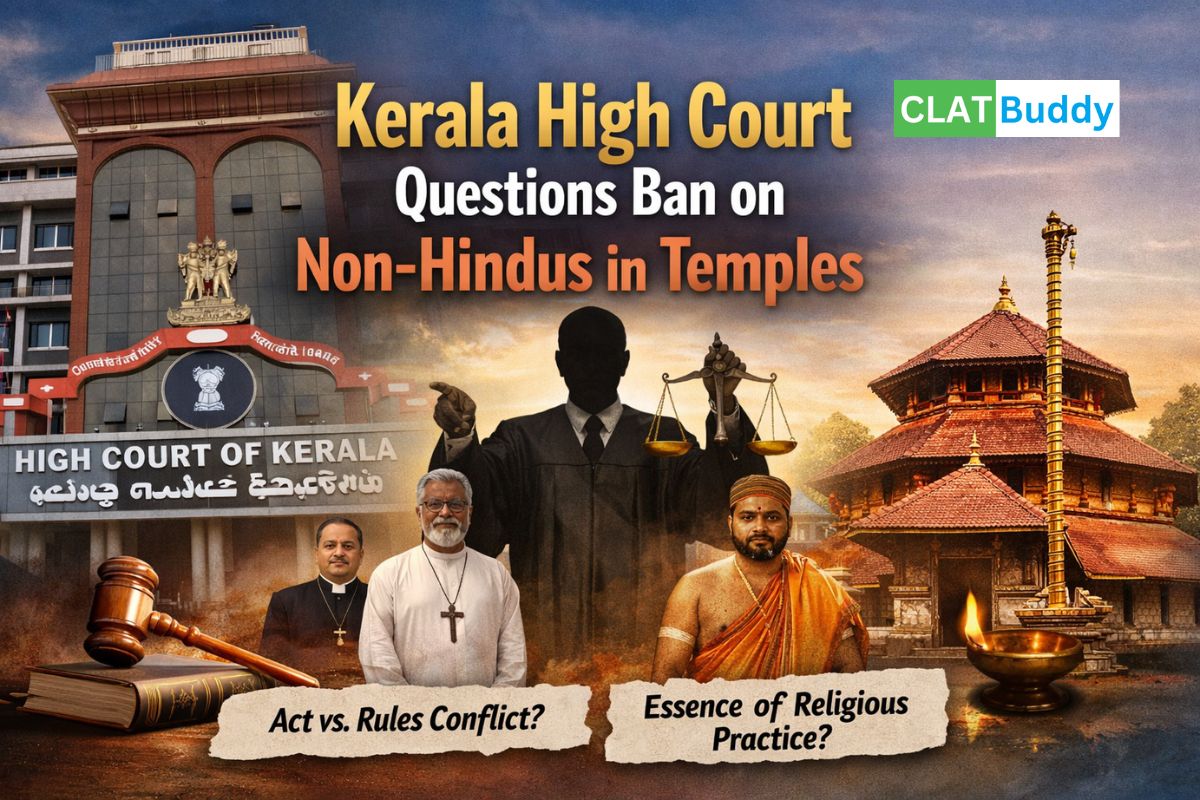
The Kerala High Court has raised important questions about the legality and constitutional validity of a rule that restricts the entry of non-Hindus into Hindu temples in the state. While dismissing a plea challenging the entry of Christian priests into a temple, the court asked the Kerala government to reconsider whether such a restriction should continue to exist at all.
The case arose from an incident in 2023 when two Christian priests entered the Sree Parthasarathy Temple, which is managed by the Travancore Devaswom Board. Their entry was reportedly on invitation and with the permission of the temple’s tantri (chief priest).
A devotee challenged this entry, arguing that it violated Rule 3(a) of the Kerala Hindu Places of Public Worship (Authorisation of Entry) Rules, which explicitly bars non-Hindus from entering temples.
The Division Bench pointed out a crucial inconsistency. While Rule 3(a) restricts the entry of non-Hindus, the parent statute—the Kerala Hindu Places of Public Worship (Authorisation of Entry) Act, 1965—contains no such prohibition.
The court reiterated a settled legal principle: subordinate legislation, such as rules, cannot go beyond or contradict the parent Act. If there is a conflict, the Act must prevail.
In strong remarks, the High Court noted that law is not static and must evolve with societal change. It cautioned that statutes and rules should not become tools to create or deepen religious or social divisions.
The Bench observed that as society becomes more inclusive, legal provisions must be interpreted in a way that promotes constitutional values such as equality, fraternity, and social harmony.
An important point raised by the amicus curiae was that while restricting non-Hindus from entering temples may be considered a religious practice, it does not qualify as an essential religious practice. The court appeared to agree, noting that the core of Hindu religion would not be altered merely by allowing or disallowing the entry of non-Hindus.
The High Court dismissed the plea against the temple authorities, holding that the entry of the priests—being with permission—could not be termed unlawful. However, it went a step further by urging the state government to examine whether Rule 3(a) should be retained, amended, or modified.
The court suggested that any such reconsideration should be done after consulting stakeholders such as Devaswom Boards, tantris, religious scholars, and other relevant groups.