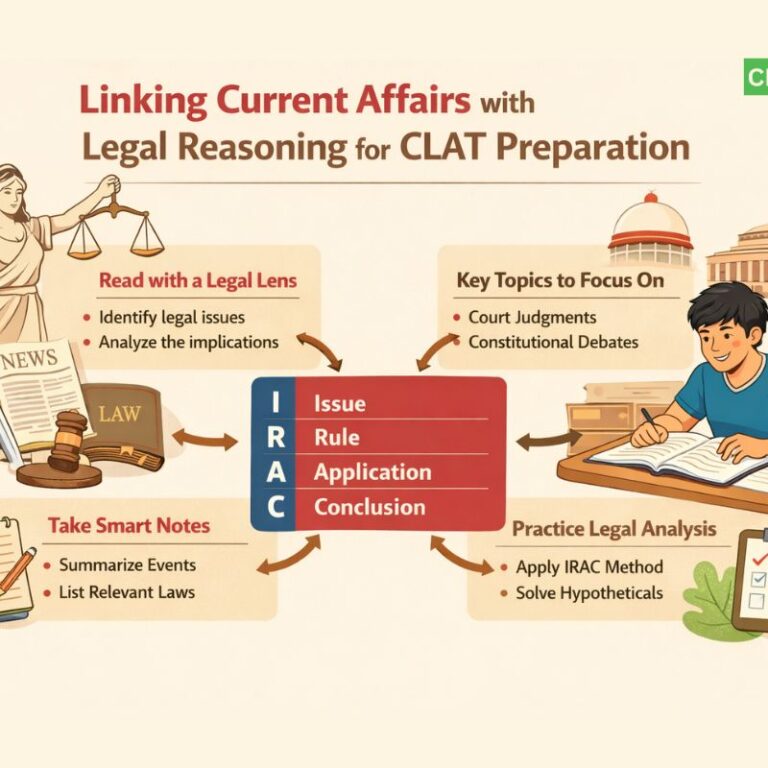


If you are preparing for CLAT or any other law entrance exam, you must have heard these two terms again and again: legal knowledge and legal reasoning. Many students confuse them or assume they are the same. This confusion often leads to poor preparation strategy and unnecessary stress.
Here is the truth. Understanding the difference between legal knowledge and legal reasoning can completely change how you prepare for CLAT. It can help you focus on the right skills, avoid common mistakes, and improve your score significantly.
Legal knowledge refers to your awareness and understanding of basic legal facts, concepts, terms, and principles. It is about knowing what the law is and how certain legal ideas are defined.
In simple words, legal knowledge is what you learn from textbooks, notes, newspapers, and current affairs related to law.
This includes knowing:
Legal knowledge builds your foundation. Without it, legal reasoning becomes difficult because you will not understand the language or concepts used in legal passages.
However, for CLAT, legal knowledge alone is not enough.
Legal reasoning is the ability to apply legal principles to given facts and arrive at a logical conclusion. It tests how you think, not how much you remember.
In the CLAT exam, you are usually given a passage. This passage contains a legal principle and a factual situation. Your task is to understand the principle, analyse the facts, and answer questions based on logical application.
Legal reasoning focuses on:
So, legal reasoning is about thinking like a lawyer, not memorising like a student.
At first glance, legal knowledge and legal reasoning may seem connected, and they are. But they are not the same.
Legal knowledge is about information. Legal reasoning is about application.
To make this clearer, think of it this way. Legal knowledge is knowing the rules of a game. Legal reasoning is using those rules to decide what happens in a new situation.
Here are some key differences explained simply.
One of the biggest mistakes CLAT aspirants make is spending too much time memorising laws and too little time practising legal reasoning.
CLAT is designed to test whether you can think logically and read carefully. The exam does not expect you to be a law student already. That is why most legal principles needed for answering questions are given within the passage itself.
The examiners want to see:
This is why legal reasoning carries much more weight in CLAT compared to pure legal knowledge.
No, that would be a misunderstanding.
Legal knowledge still plays an important supporting role.
If you have basic legal knowledge:
However, you should remember that legal knowledge is a tool, not the final goal. It supports legal reasoning but does not replace it.
Think of legal knowledge as the fuel and legal reasoning as the engine. Fuel alone cannot take you anywhere unless the engine is working.
To prepare smartly, you must understand how these skills are tested in the exam.
In CLAT legal reasoning questions:
This clearly shows that legal reasoning is the main focus.
Legal knowledge may appear indirectly when:
But direct questions testing memorised law are rare.
Many students struggle in legal reasoning not because they lack intelligence, but because of wrong preparation approach.
Some common mistakes include:
You must always remember that in CLAT, the passage is your law. Even if it contradicts what you already know, you must follow the principle mentioned in the passage.
Improving legal reasoning is possible if you practise in the right way.
Many aspirants worry whether they need to study constitutional law or criminal law in detail.
For CLAT, deep study of law subjects is not required. You do not need to remember sections or case names.
What you need instead is:
Studying law subjects at a basic level can help you feel comfortable, but your main focus should always remain on legal reasoning practice.
A smart CLAT preparation strategy balances both, but prioritises legal reasoning.
You can do this by:
Do not spend hours memorising legal facts. Instead, invest time in practising how to think through legal problems.
The right mindset can make a huge difference.
Always remember:
If you approach legal reasoning with curiosity instead of fear, it will slowly become your strongest section.
Legal knowledge and legal reasoning are connected but not identical. Legal knowledge helps you understand the language of law. Legal reasoning helps you use that language to solve problems.
For CLAT, legal reasoning is the real game changer. If you master it, you give yourself a strong advantage over thousands of aspirants.
Focus on understanding, analysing, and applying. Do not just memorise.
If you prepare with the right strategy and mindset, legal reasoning will stop being confusing and start feeling logical.
And once that happens, CLAT becomes far less intimidating.