
If you are preparing for CLAT or any other law entrance exam, you have probably experienced this. You read a Logical Reasoning passage, feel confident about an answer, and then the results show it was wrong. You go back and think, “But it made sense!”
Here is the truth. In CLAT Logical Reasoning, many wrong answers are not random. They are intentionally designed traps. The exam does not just test whether you can read English. It tests whether you can think clearly, avoid assumptions, and stick strictly to the information given.
In this article, I will guide you through the most common logical reasoning traps in CLAT, how they are framed, and how you can train yourself to avoid them. If you master this, your accuracy in CLAT Logical Reasoning and Legal Reasoning will improve significantly.
CLAT is not a memory based exam. It is a test of aptitude, analytical ability, and reading comprehension. When thousands of students score well in school exams, the paper setters need a way to distinguish between:
That is where logical reasoning traps in CLAT come in.
The Consortium designs questions that look easy at first glance but contain subtle shifts in language, scope, or assumptions. If you are careless, emotional, or overconfident, you will choose the “almost correct” answer.
This is especially true in:
Understanding these traps is part of smart CLAT preparation strategy.
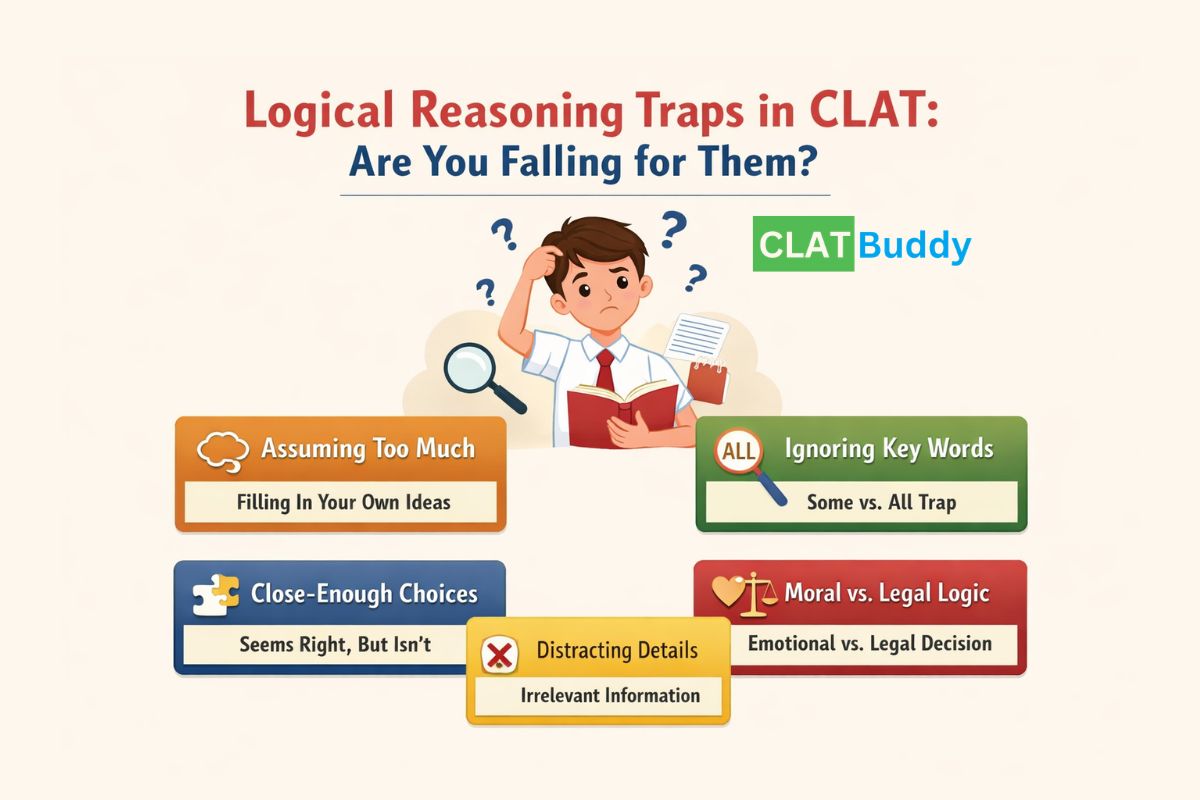
Let us break down the most frequent traps that appear in CLAT previous year papers and mock tests.
This is the most dangerous trap in CLAT.
The passage says something limited. Your brain adds extra meaning.
For example, imagine the passage says:
“Most universities prefer online application systems.”
A trap option might say:
“Universities believe offline applications are inefficient.”
But did the passage say that? No. It only mentioned preference, not reasons.
When you prepare for CLAT Logical Reasoning, always ask yourself:
CLAT tests reasoning based only on the given text, not your general knowledge.
Many students lose marks because they ignore qualifiers.
In Logical Reasoning for CLAT, small words completely change meaning.
If the passage says:
“Some judges support reform.”
And the option says:
“All judges support reform.”
That is a scope expansion trap.
Similarly, words like:
are very powerful in reasoning questions.
If you are serious about scoring high in CLAT Logical Reasoning, train yourself to underline such words while reading passages.
One of the most common CLAT exam tricks is the “close enough” answer.
These options:
But they slightly distort the meaning.
In CLAT Legal Reasoning and Logical Reasoning, an answer is correct only if it is fully supported by the passage. Even a small mismatch makes it wrong.
You must compare each word of the option with the relevant line in the passage. Do not rely on memory. Go back and verify.
This trap is very common in CLAT Legal Reasoning.
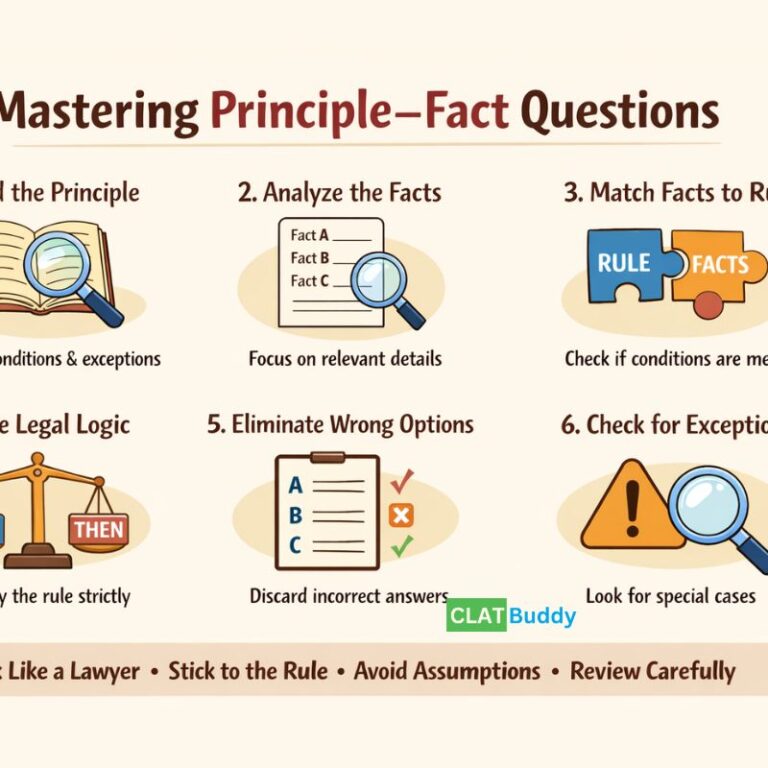
The principle is given in the passage. The facts are given. Your job is to apply the principle to the facts.
But many students choose the answer that feels morally right instead of legally correct.
For example:
But if the legal principle does not support that conclusion, it cannot be the correct answer.
In CLAT preparation, always remember:
The exam tests application of the given legal rule, not your personal sense of justice.
Some students preparing for CLAT believe that every question must be tricky. So they overanalyse simple questions and choose complicated answers.
Sometimes the correct answer is the simplest one that directly follows from the passage.
Do not try to show intelligence. Show discipline.
Let us understand the psychology behind these traps.
CLAT questions are designed keeping in mind that:
The paper setter predicts where students will likely assume something. Then they frame one option around that assumption.
For example:
This is why reading speed without reading accuracy can be dangerous in CLAT Logical Reasoning.
Now let us move to the most important part. What can you actually do during CLAT preparation to improve accuracy?
Yes, but intelligently.
You do not need to read slowly. You need to read actively.
While reading a Logical Reasoning passage for CLAT:
This builds clarity before you even look at the options.
This is a powerful technique for CLAT Logical Reasoning.
After reading the question, try to think of the answer in your own words. Then compare it with the options.
If you directly jump to the options, you are more likely to get influenced by trap wording.
Absolutely.
In most CLAT reasoning questions, two options can be eliminated quickly.
Ask these questions:
Often, the trap answers:
By eliminating these, your probability of choosing the correct answer increases.
If you are preparing for CLAT 2025 or CLAT 2026, previous year papers are gold.
They help you:
While solving previous year CLAT Logical Reasoning papers, analyse not just why the correct answer is right, but why the wrong ones are wrong. That is where real learning happens.
No.
Similar traps appear in:
But CLAT is especially known for passage based reasoning where subtle interpretation matters a lot.
If you build strong logical reasoning skills now, it will help you not only in law entrance exams but also in law school and even in courtroom argumentation later.
As your mentor, I want you to develop three habits.
Do not argue with the passage. Do not correct it. Do not improve it.
Your job is to understand and apply it.
Whenever you solve a Logical Reasoning question for CLAT, ask:
Is this directly stated?
Is this a valid inference?
Or is this my assumption?
This mental discipline is the difference between 15 marks and 22 marks in the Logical Reasoning section.
Many trap answers look attractive because you are anxious to move ahead.
Take a deep breath before marking the answer. Read it once more. Confirm it logically follows.
Accuracy first. Speed will automatically improve with practice.
If you are 16 to 18 years old and preparing seriously for CLAT, understand this clearly.
Logical reasoning traps in CLAT are not unfair. They are designed to reward disciplined thinkers.
The good news is this:
These traps are predictable.
Once you:
Your accuracy will increase steadily.
At CLATBuddy, the goal is not just to give you content but to train your thinking. Logical Reasoning for CLAT is not about intelligence. It is about control over your mind.
The next time you solve a mock test, do not just check your score. Analyse the traps you fell for.
That is how you grow.
If you want, in the next blog, we can break down actual sample Logical Reasoning questions and solve them step by step like we would in a mentoring session.