
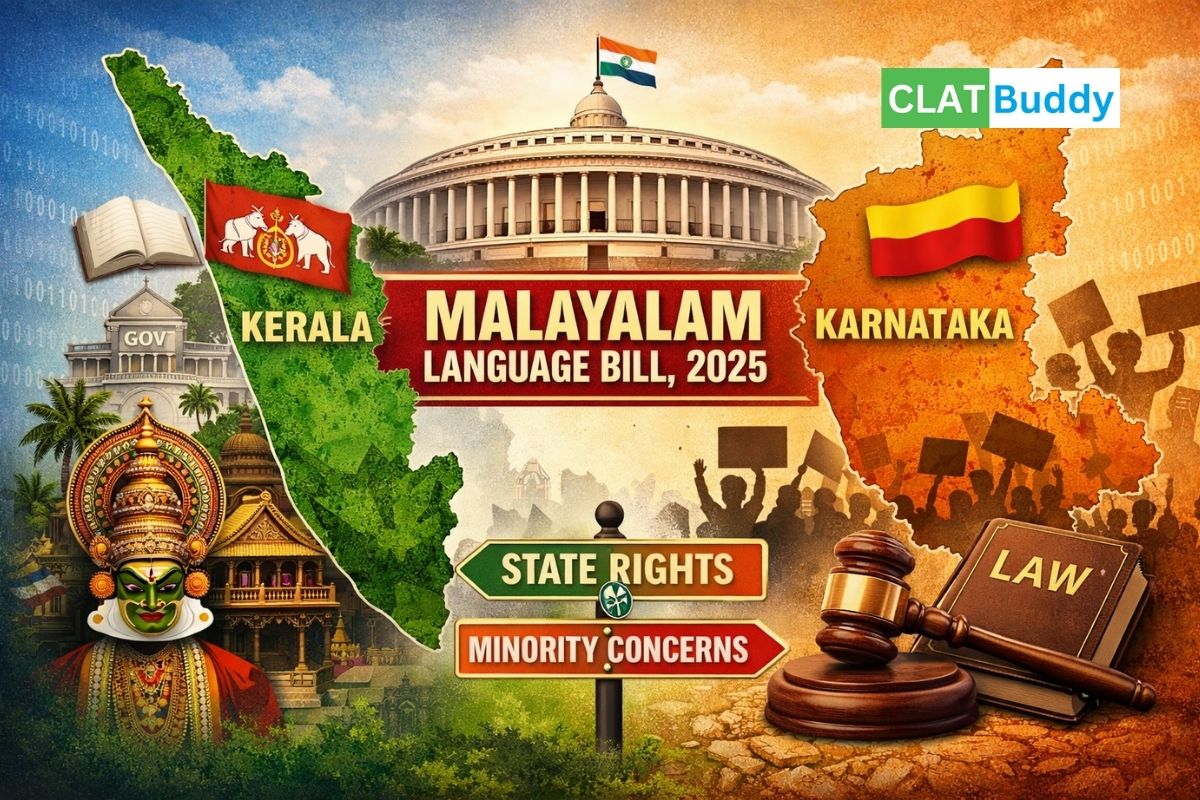
The passage of the Malayalam Language Bill, 2025 by the Kerala Legislative Assembly has brought language policy back to the centre of India’s federal debate. While Kerala describes the law as a step towards strengthening its linguistic identity, opposition from neighbouring Karnataka has raised constitutional and minority rights concerns, especially in border regions. The Bill therefore goes beyond language promotion and touches core issues of Centre–State relations.
The Bill seeks to formally declare Malayalam as the sole official language of the State of Kerala. At present, both Malayalam and English enjoy official language status. The proposed law mandates wider and more uniform use of Malayalam across government administration, education, judiciary, public communication, business, and digital platforms. However, it explicitly states that all its provisions will operate subject to the Constitution of India.
In the education sector, the Bill makes Malayalam the compulsory first language in all government and aided schools up to Class 10. At the same time, it allows linguistic minority students to study their mother tongue where such facilities exist, in line with the national education curriculum.
In the judiciary and legislature, all Bills and Ordinances are to be introduced in Malayalam. Court judgments and proceedings are to be translated into Malayalam in a phased manner, and important Central and State laws published in English will also be translated.
For administration, Malayalam will be used for official correspondence and public communication. Linguistic minorities are permitted to use their own languages for correspondence with government offices in designated areas. In the digital domain, the State’s Information Technology Department is tasked with developing open-source software and tools to enable the effective use of Malayalam in e-governance. Institutionally, the Bill proposes renaming the existing Official Language Department and setting up a dedicated Malayalam Language Development Directorate.
Kerala has a long history of promoting Malayalam in governance. A similar law passed in 2015 aimed at dissemination and enrichment of the language but was reserved for Presidential assent, which was ultimately withheld. That Bill faced objections over conflicts with the Official Language Act, 1963, concerns regarding linguistic minorities, the three-language formula, and the Right to Education Act.
According to the State government, the 2025 Bill was drafted after addressing these constitutional concerns. The government claims that minority protections have been strengthened and that the Bill aligns with national education policy and fundamental rights.
The strongest opposition has come from Karnataka, which has termed the Bill unconstitutional and detrimental to Kannada-speaking minorities in Kerala, particularly in the Kasaragod district. Karnataka argues that making Malayalam the compulsory first language in schools undermines the rights of Kannada-speaking students who currently study Kannada as their first language. There are also concerns that the Bill could weaken Kannada language and cultural identity in the border region.
A delegation from Karnataka’s Border Area Development Authority has urged the Kerala Governor to withhold assent to the Bill.
Kerala has rejected allegations of minority rights violations. It has pointed to explicit safeguards for linguistic minorities, including Kannada, Tamil, Tulu and Konkani speakers. The State maintains that minorities can use their own languages for official communication in relevant areas and that students may continue education in their preferred languages where available. Students from other States and foreign countries are exempted from Malayalam language examinations at higher levels.