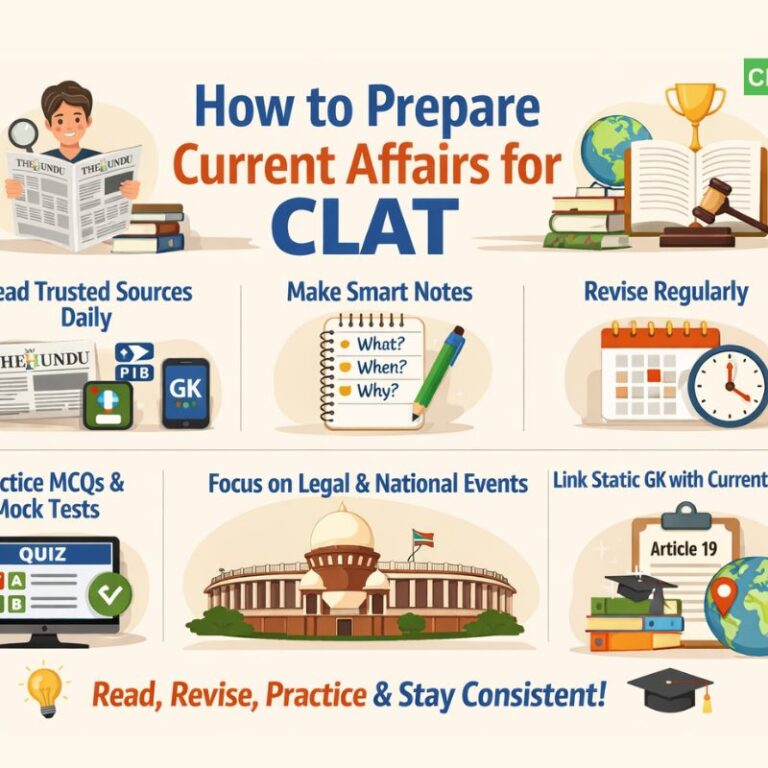


If you are preparing for CLAT or any other law entrance exam in India, one thing is clear. Current affairs can make or break your score. Every year, a significant portion of the CLAT paper is based on recent events. But here is the real challenge. It is not about reading everything. It is about reading the right things in the right way.
In this guide, I will walk you through a practical monthly current affairs preparation framework designed especially for CLAT aspirants aged 16 to 18. If you follow this consistently, you will not feel overwhelmed, and you will build strong legal awareness, comprehension skills, and analytical thinking.
This framework is based on what actually works for CLAT current affairs preparation in India.
Before we jump into the framework, let us understand why a monthly strategy works better than random daily reading.
CLAT current affairs questions are not direct one line GK questions. They are passage based. You are expected to read a paragraph about a recent event and answer questions on:
If you prepare current affairs month by month, you start noticing patterns. You connect news with static subjects like Indian Polity and Legal Reasoning. This is exactly what CLAT tests.
One of the biggest mistakes students make is using too many sources. You do not need five newspapers and ten apps.
Here is a simple and effective source strategy for CLAT 2026:
You can read:
Focus on:
You do not need to read celebrity gossip or sports news unless it is connected to policy or law.
Search terms students usually use include:
Using a reliable monthly compilation helps you revise everything in one place. It also ensures you did not miss important topics.
Occasionally refer to:
This builds credibility and accuracy in your preparation.
Now let me give you a step by step framework that you can follow every month.
You should spend 30 to 45 minutes daily on current affairs.
When reading a news article, ask yourself:
Use the 5W1H method:
Write short notes. Do not copy the entire article. Limit yourself to 4 to 6 bullet points.
Many students write long and messy notes. That is not helpful.
Instead, divide your notebook or digital notes into sections:
For each topic, write:
For example, if there is a Supreme Court judgment, note:
This will help you in CLAT legal reasoning and general knowledge sections.
You cannot wait until the end of the month to revise everything. Your brain forgets fast.
At the end of every week:
This improves retention and reading speed.
Students often search for:
Practising weekly ensures you are exam ready, not just information rich.
At the end of each month, you should do a proper revision cycle.
Go through the entire monthly current affairs PDF. Compare it with your notes. Add missing points.
This is where real CLAT preparation happens.
For example:
If there is news about a data protection law, revise:
If there is news about a new bill in Parliament, revise:
This integration improves your conceptual clarity.
Based on recent CLAT trends, you should focus on:
Students frequently search:
The answer is simple. Focus on law, constitution, governance, and global affairs.
Ideally, you should cover at least 12 months of current affairs before the exam. Some toppers even revise 18 months.
If you are in Class 11 or early Class 12, start now. Do not wait for the last six months.
If you are in Class 12 and targeting CLAT next year, create a monthly tracker:
This builds discipline and confidence.
CLAT current affairs questions are passage based. That means:
To improve reading speed:
Search terms like:
are common because students struggle with time management.
The solution is consistent reading and timed practice.
Let me warn you about some common mistakes.
Videos are helpful, but they cannot replace reading. CLAT tests comprehension, not just memory.
If you only memorise facts without understanding legal principles, you will struggle in passage based questions.
Without revision, your preparation becomes weak. Monthly revision is non negotiable.
Reading too many sources creates confusion. Stick to limited and reliable material.
Here is a simple structure you can follow:
Daily newspaper reading and note making
Weekend revision and MCQs
Continue reading
Add static linkage
Focus on Supreme Court judgments and legal developments
Solve passage based questions
Full monthly revision
Solve 50 to 100 current affairs questions
Update summary notes
This systematic approach keeps you ahead of most students.
When you build strong current affairs knowledge:
CLAT is not just an exam. It is your entry into the legal profession. Being aware of what is happening in India and the world is part of becoming a responsible law student.
If you are serious about cracking CLAT 2026 or any other law entrance exam in India, treat current affairs as a daily habit, not a last minute task.
Do not panic if you miss a few days. Get back on track. Focus on:
Remember, CLAT current affairs preparation is not about reading everything. It is about reading intelligently.
Start this monthly current affairs preparation framework today. Six months from now, you will thank yourself.
And whenever you feel confused or overwhelmed, remind yourself why you started. You are preparing to enter one of the most respected professions in the country.
Stay consistent. Stay curious. Stay disciplined.