

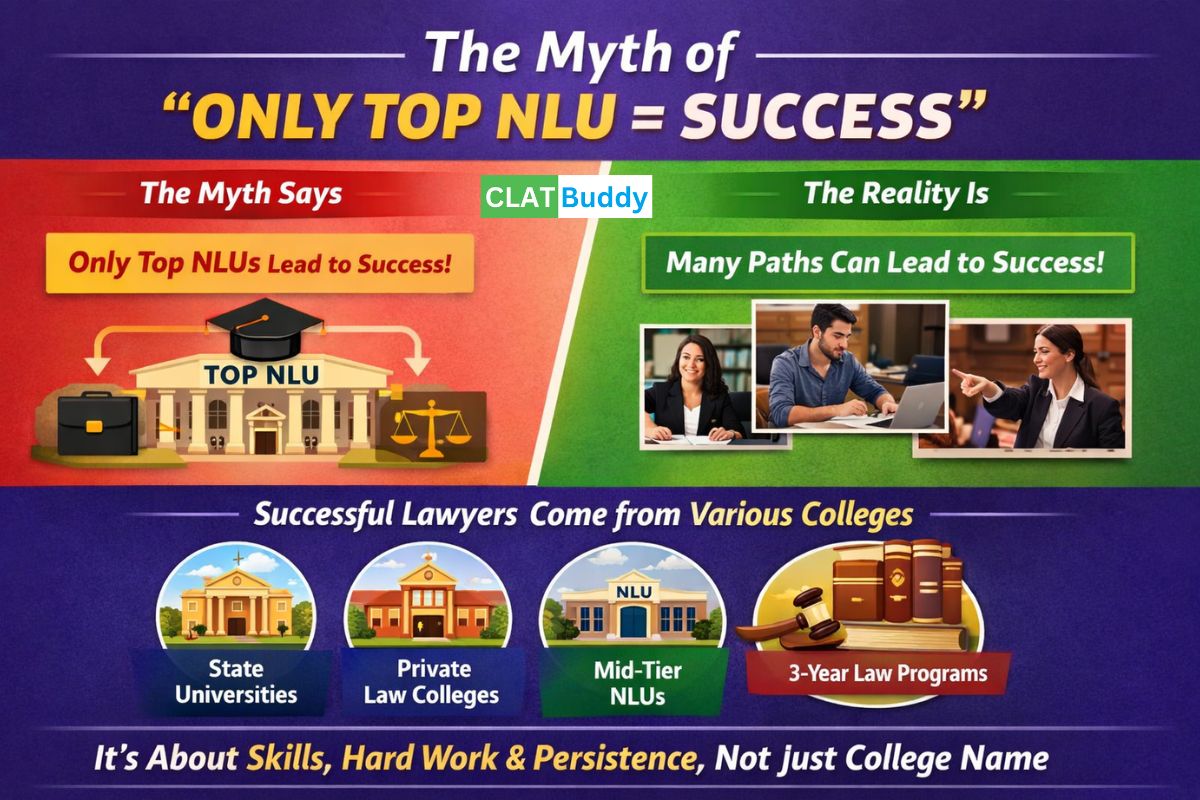
If you are preparing for CLAT or other law entrance exams, you have probably heard this statement many times
If I do not get into a top NLU, my career is finished.”
This belief creates fear, pressure, and self doubt at a very young age. When you are just 16 to 18 years old, this kind of thinking can make the entire preparation journey stressful and unhealthy.
The truth is simple. This belief is a myth.
Law is a long career. One exam or one college does not decide everything. This article will help you understand where this myth comes from, why it is misleading, and what actually matters for success in law.
This belief has been built over many years.
Top National Law Universities were the first institutions to introduce modern legal education in India. Many early graduates from these colleges joined big law firms, international organisations, and senior litigation chambers. Over time, these success stories were repeated again and again.
Coaching institutes, social media pages, and peer discussions started focusing only on a few colleges. Slowly, a message spread
Top NLU equals success
Anything else equals failure
When you hear the same thing repeatedly, it starts feeling true. But repetition does not make something accurate.
Yes, they do. It is important to be honest about this.
Top NLUs usually provide
These advantages can help you get early internships and confidence. However, these are starting advantages, not lifetime guarantees.
A college can open the first door, but it cannot build your entire career for you.
Absolutely not.
Every year, thousands of students graduate from
Many of them go on to become successful lawyers, judges, academics, policy professionals, and legal entrepreneurs.
Success in law depends on what you do after entering college, not just where you enter.
Success in law looks different for different people.
For some, success means joining a top corporate law firm.
For others, it means building a strong litigation practice.
For many, it means clearing judicial services or working in policy, academia, or NGOs.
No single college can prepare you perfectly for all these paths.
Your success depends on
None of these skills are limited to top NLUs.
CLAT is an entrance exam. It tests your speed, comprehension, and exam strategy on one particular day.
CLAT does not test
Many brilliant lawyers were average entrance exam performers. Many toppers also struggled later because law requires sustained effort.
Your CLAT rank reflects your performance on one day, not your worth or future capability.
If you join a non top NLU or a private college, your journey may look slightly different, but it is not inferior.
You may need to
This process actually builds independence and resilience, which are very important in the legal profession.
Drafting, legal research, case analysis, and writing are skills that matter in every legal career. These skills improve with practice, not college brand.
Clear speaking and writing can set you apart in interviews, moots, internships, and later in courtrooms or offices.
Doing internships with learning in mind is more valuable than collecting certificates. One good internship can teach more than five random ones.
Talking to seniors, alumni, professors, and professionals helps you understand the real world of law. Guidance often matters more than grades.
Yes, many do.
Law firms look for
If you build these qualities, your college name becomes less important over time.
Initial entry may be harder, but once you prove your ability, performance matters far more than background.
Litigation and judiciary are even less dependent on college names.
In litigation, what matters is
In judiciary preparation, what matters is
Judges and senior advocates come from all kinds of colleges across India.
Instead of worrying only about getting into a top NLU, focus on what is in your control.
Focus on
Your growth matters more than your starting point.
Not at all.
Aiming high is good. Working hard for CLAT is important. Wanting a top NLU is completely valid.
The problem starts when you believe that life ends if you do not get one.
Law is not a sprint. It is a marathon.
If you get a top NLU, stay humble and work hard.
If you do not, stay confident and work harder.
Both paths can lead to success if you stay focused and disciplined.
The belief that “only top NLU equals success” is not just incorrect, it is harmful.
Your legal career will be shaped by
Not by one exam or one college.
Where you start matters far less than how you grow.