

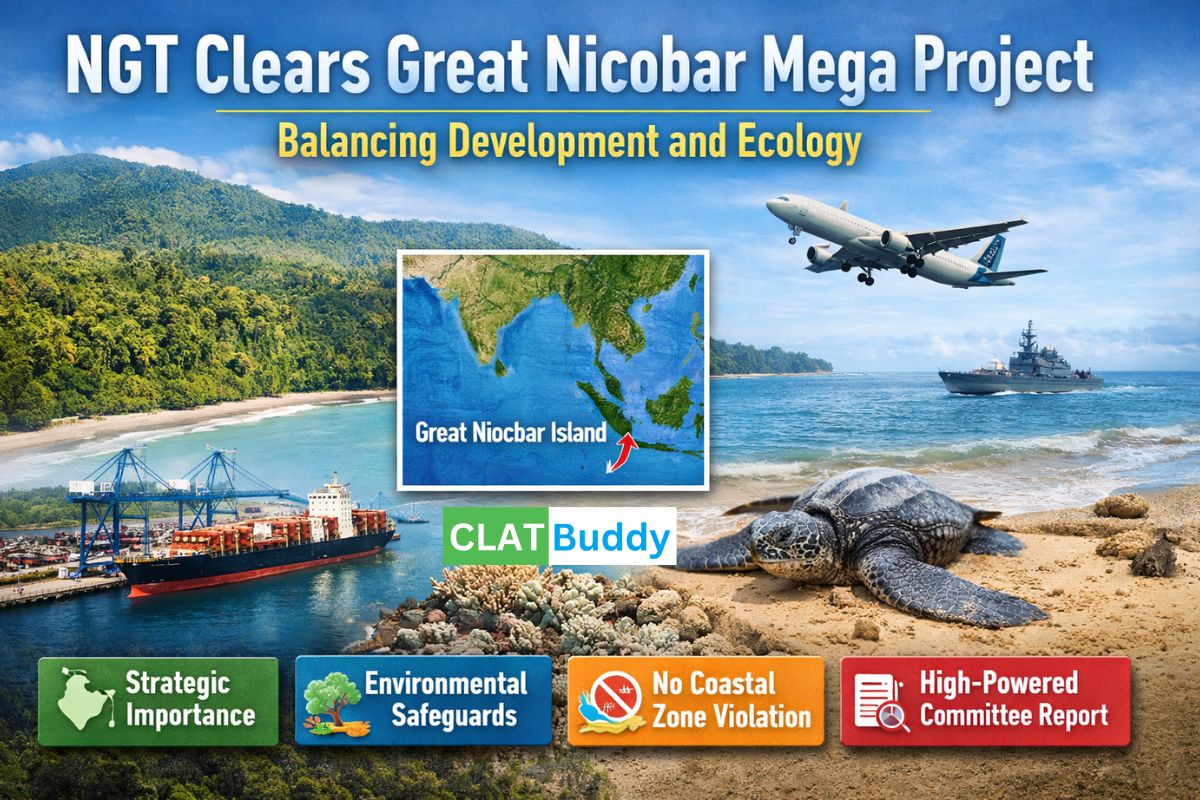
In a significant ruling, the National Green Tribunal (NGT) has upheld the environmental clearance granted to the Rs 80,000-crore Great Nicobar mega infrastructure project. Calling the project “strategic” in nature, the Tribunal said it found no “good ground” to interfere, noting that “adequate safeguards” had been built into the environmental clearance.
The decision is likely to serve as an important reference point for future large-scale infrastructure projects in ecologically sensitive areas.
The project is proposed on Great Nicobar Island, the southernmost island of India in the Bay of Bengal. Spread over nearly 166 sq km, it includes:
To execute this, around 130 sq km of forest land will be diverted and nearly one million trees are expected to be felled.
The scale of the project and its ecological footprint have triggered intense debate since its environmental clearance was granted in 2022.
Petitions were filed before the NGT alleging:
Environmental activist Ashish Kothari was among those who moved the Tribunal, arguing that portions of the project fell within prohibited coastal regulation zones.
There were also concerns from sections of the Nicobarese community about displacement from ancestral lands, especially in light of the devastation caused by the 2004 tsunami.
A six-member special bench of the NGT, headed by Justice Prakash Shrivastava, examined whether the environmental clearance granted to the project was legally and procedurally sound.
The Tribunal framed the issue as requiring a “balanced approach” — weighing ecological protection against strategic national interest.
The Tribunal held that it did not find any sufficient legal basis to cancel or suspend the environmental clearance. It observed that:
The NGT specifically noted the “strategic importance” of the project. Given Great Nicobar’s location near key international shipping routes, the transshipment port and military-civil aviation infrastructure are viewed as significant from a national security and trade perspective.
The Tribunal made it clear that strategic considerations cannot be ignored while evaluating such projects.
A major question was whether parts of the project fell within prohibited zones under the Island Coastal Regulation Zone (ICRZ) Notification, 2019.
The NGT relied on the report of a High-Powered Committee headed by former Environment Secretary Leena Nandan. It concluded that no part of the project fell within prohibited ICRZ areas.
Although the full HPC report was not made public due to confidentiality and strategic concerns, the Tribunal relied on findings placed on record by the Centre through an affidavit.
One of the most serious concerns raised was potential damage to coral reefs.
The NGT referred to past submissions of the Zoological Survey of India and concluded:
The Tribunal directed the Environment Ministry to ensure protection of coral reefs along the coastal stretch.
The Tribunal pointed to specific mitigation measures included in the environmental clearance:
It also directed that:
Importantly, the NGT emphasised that the government is legally bound to comply with every condition in the environmental clearance.
This ruling could become a benchmark for future projects in ecologically sensitive regions.
The key takeaway from the judgment is the emphasis on a “balanced approach.” The Tribunal recognised that:
This signals that courts may not lightly interfere with clearances granted to projects of strategic national importance, provided procedural compliance and mitigation measures are demonstrated.
With the NGT disposing of the batch of petitions, the project is cleared to move forward from the environmental litigation standpoint.
However, compliance monitoring will be crucial. The Tribunal has clearly stated that:
Future challenges, if any, may arise based on implementation failures rather than the validity of the original clearance.
The Great Nicobar project sits at the intersection of three major questions:
The NGT has taken a clear position — that with adequate safeguards and oversight, such projects can proceed.
Whether this balance holds in practice will depend on how rigorously environmental conditions are enforced on the ground.
The NGT has upheld the environmental clearance for the Great Nicobar mega project, citing:
The order reinforces a judicial trend that prioritises procedural compliance and mitigation mechanisms while acknowledging national infrastructure imperatives.
As construction advances, the real test will lie not in the courtroom, but in ecological compliance and ground-level monitoring.