

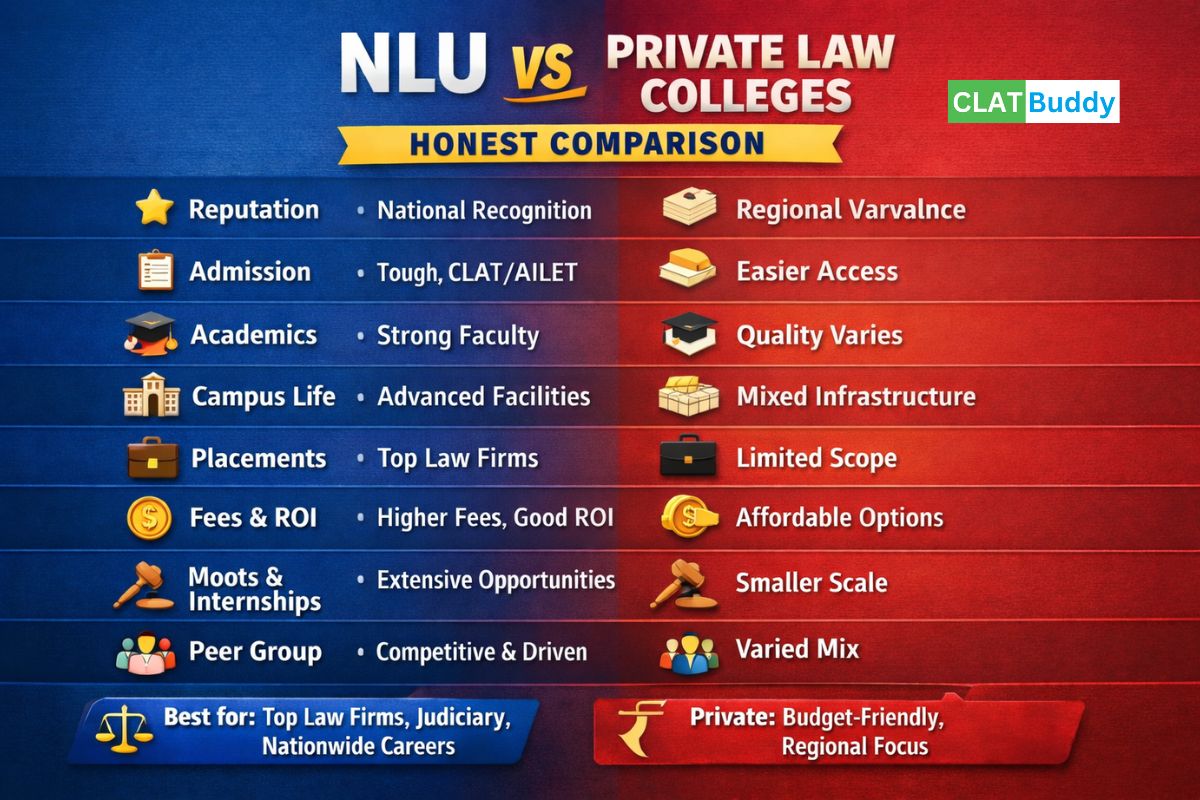
Choosing a law college is one of the biggest decisions you will make after Class 12. If you are preparing for CLAT, you have probably heard people say that NLUs are the best and private law colleges are risky. At the same time, you may also know seniors who are doing very well from private colleges.
So what is the real picture?
This guide gives you an honest, practical comparison between National Law Universities (NLUs) and private law colleges in India. The aim is not to glorify one option but to help you understand which choice makes sense for you, based on your goals, rank expectations, and learning style.
Before comparing, it is important to be clear about what these terms actually mean.
NLUs are public law universities set up by State Governments. Most of them offer a five-year integrated BA LLB, BBA LLB, or similar programmes. Admission is mainly through CLAT, and in one case, through a separate exam.
Private law colleges are law institutions run by private trusts or universities. Some of them are very old and reputed, while others are relatively new. Admission is usually through their own entrance tests, merit lists, or management quotas.
Both options can lead to successful legal careers, but the experience and opportunities can differ.
Brand value matters more than many students realise, especially in the early years of a legal career.
NLUs enjoy strong national recognition. When a law firm, corporate office, or internship organisation sees the name of an NLU on your CV, it immediately understands the level of competition you cleared to get there. This often helps you get shortlisted faster for internships, moots, and placements.
Private law colleges usually have limited brand recall outside certain regions. Some well-known private colleges do have a strong reputation, but many others are recognised only locally. This does not mean you cannot succeed, but you may need to work harder to prove your competence.
Brand value does not replace hard work, but it can give you a head start.
This is one of the biggest differences.
Getting into an NLU is extremely competitive. CLAT is taken by thousands of students across India, and seats are limited. Even a small mistake can push your rank down significantly. The pressure and competition are real.
Private law colleges usually have a much easier admission process. Many accept students based on board marks, internal tests, or shorter entrance exams. Some also offer direct admission options.
If you enjoy competition and structured preparation, the NLU route suits you. If you want flexibility or have backup options in mind, private colleges provide that space.
In most cases, yes, but with some important points to remember.
NLUs generally follow a rigorous academic structure. The curriculum is updated more regularly, and there is strong focus on reading, case analysis, research papers, and class discussions. Many professors are actively involved in legal research and policy work.
Private law colleges vary a lot in academic quality. Some have excellent faculty and teaching culture, while others struggle with frequent faculty changes and limited academic depth. It depends heavily on the specific institution.
In an NLU, academic pressure is higher, but it pushes you to think like a lawyer early on. In private colleges, you may need to self-motivate more to reach the same level.
Campus life shapes your personality as much as academics do.
Most NLUs have fully residential campuses. You live, study, debate, and grow with students from different states and backgrounds. This exposure helps you develop communication skills, confidence, and maturity.
Private law colleges may or may not be residential. Campus culture depends on the college location, student mix, and management support. Some private universities offer excellent infrastructure, while others are more basic.
If you want intense peer learning and constant interaction, NLUs usually provide a richer environment.
Placements are one of the main reasons students aim for NLUs.
Top NLUs have strong placement cells with regular visits from leading law firms, corporate houses, and consulting companies. Even mid-tier NLUs usually ensure decent internship pipelines and career guidance.
In private law colleges, placement outcomes vary widely. A few reputed private institutions do place students well, but many colleges offer limited support. In such cases, students rely heavily on self-applied internships and personal networks.
If corporate law or top-tier placements are your goal, NLUs offer more structured support. However, motivated students from private colleges can also build strong careers with consistent effort.
Law education is expensive, so this question matters a lot.
NLUs generally have higher fees compared to government colleges but lower than many private universities. Scholarships and fee waivers are available in some cases. Given the placement outcomes, the return on investment can be reasonable.
Private law colleges show a wide range in fees. Some are affordable, while others are extremely expensive. The return on investment depends on how well the college supports placements and internships.
You should always compare total fees with realistic career outcomes before deciding.
Yes, in most cases.
NLUs have active moot court societies, research centres, and student-run committees. Participation in national and international moots is common, and seniors often guide juniors closely.
Private law colleges may conduct moots and seminars, but the scale and frequency can be lower. Exposure depends on how proactive the college administration and students are.
If you enjoy competitive activities and learning outside the classroom, NLUs offer more built-in opportunities.
Your peer group influences your mindset, habits, and ambitions.
In NLUs, students are usually highly competitive and driven. Discussions about internships, cases, and careers are common. This environment pushes you to stay focused and ambitious.
Private law colleges have mixed peer groups. Some students are very motivated, while others may be less focused. This does not mean learning is impossible, but you must choose your circle carefully.
A strong peer group can motivate you on days when you feel lost or tired.
Yes, absolutely.
An NLU is not the only path to success in law. Many successful lawyers, judges, and corporate professionals come from private colleges. What matters is how you use the five years of law school.
From a private college, you need to be proactive about internships, moots, reading, and skill-building. You may not get automatic exposure, but you can create opportunities through consistent effort.
The law rewards skill, discipline, and reputation over time, not just the name of your college.
The choice depends on your situation and goals.
If you are confident about securing a good CLAT rank and want national exposure, intense academics, and structured placements, NLUs are a strong choice.
If you want flexibility, affordability, or have a specific private college with good reputation in mind, a private law college can also work well.
What matters most is how seriously you treat your legal education, wherever you study.
Do not choose a college only based on fear or social pressure. Understand your strengths, financial situation, and career goals. Use CLAT as an opportunity to aim high, but always keep realistic and informed backup options.
Law is a long journey. The right college helps, but your consistency, curiosity, and discipline matter even more.