
The Parliament has passed the Transgender Persons (Protection of Rights) Amendment Bill, 2026, with the Rajya Sabha approving it on March 25, 2026, a day after it was cleared by the Lok Sabha. The Bill has triggered significant debate across political parties, civil society, and the transgender community, raising concerns about its impact on rights, dignity, and recognition.
The government has presented the Bill as a measure to bring administrative clarity and stronger protection mechanisms for transgender persons.
Union Minister for Social Justice and Empowerment, Virendra Kumar, stated that the law aims to:
The government has also highlighted that transgender welfare boards have already been established in more than 30 States, and the amendment is intended to support and streamline these efforts.
According to the official stance, the Bill is not just a legal reform but an attempt to address long-standing social exclusion and discrimination faced by transgender persons in India.
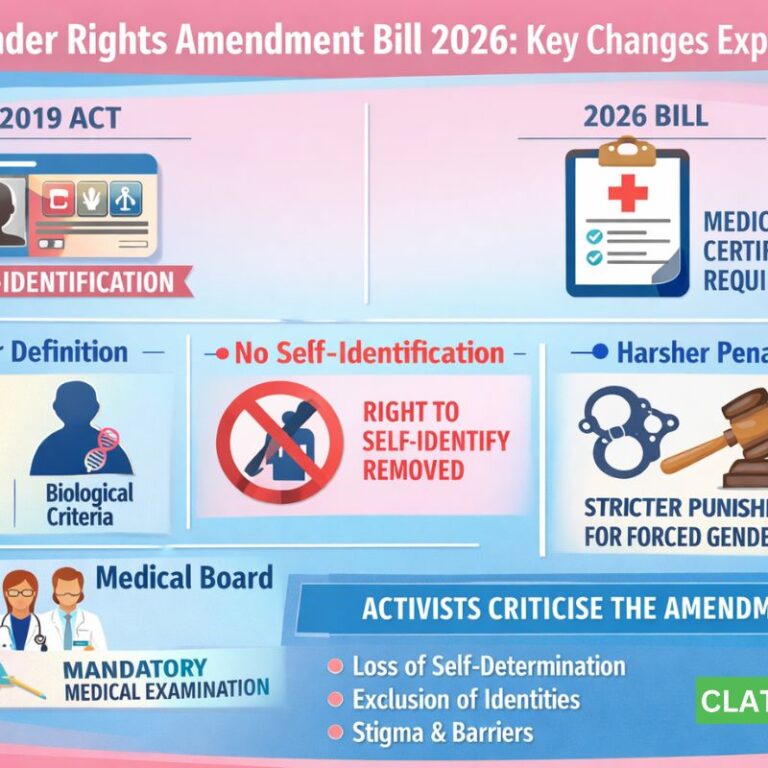
One of the most debated aspects of the Bill is the change in the process of gender recognition.
Opposition leaders have argued that the amendment:
DMK MP Tiruchi Siva strongly criticised this provision, stating that it takes away a fundamental right and imposes an external validation process on personal identity.
The concern is that such a requirement may go against the idea that gender identity is a matter of personal autonomy and dignity.
Several opposition members had demanded that the Bill be referred to a select committee for deeper examination before being passed.
Their key arguments included:
Despite these demands, the Bill was passed without being sent for further scrutiny.
Trinamool Congress MP Saket Gokhale highlighted the gap between law and reality:
This indicates that a large section of the community remains outside the formal recognition system.
The MP also pointed to alarming mental health statistics:
These figures were cited to underline the social discrimination and exclusion faced by the community.
Critics have argued that instead of reducing discrimination, the amendment could:
There were also political remarks suggesting that the policy direction reflects global trends, particularly referencing developments in the United States.
CPI(M) MP John Brittas described the Bill as restrictive and exclusionary.
A key point raised was that a Supreme Court-appointed committee had reportedly advised the government to reconsider or withdraw the Bill.
The concern was that:
This has added another layer to the debate, questioning the consultative nature of the law-making process.
The controversy around the Bill reflects a broader legal and social debate:
The core issue lies in balancing state regulation with individual autonomy.
The amendment is significant because it directly affects:
For many, the law will determine how accessible and respectful the recognition process becomes in practice.
Even though the Bill has been passed by Parliament, the debate is far from over.
Possible developments include:
The implementation of the law will ultimately determine whether it strengthens protections or creates new barriers.
The Transgender Amendment Bill, 2026 has opened up an important national conversation on identity, dignity, and rights. While the government views it as a step towards inclusion and clarity, critics argue that it risks undermining hard-won rights, especially the principle of self-identification.
The real impact of the law will depend not just on its text, but on how sensitively and effectively it is implemented in practice.