
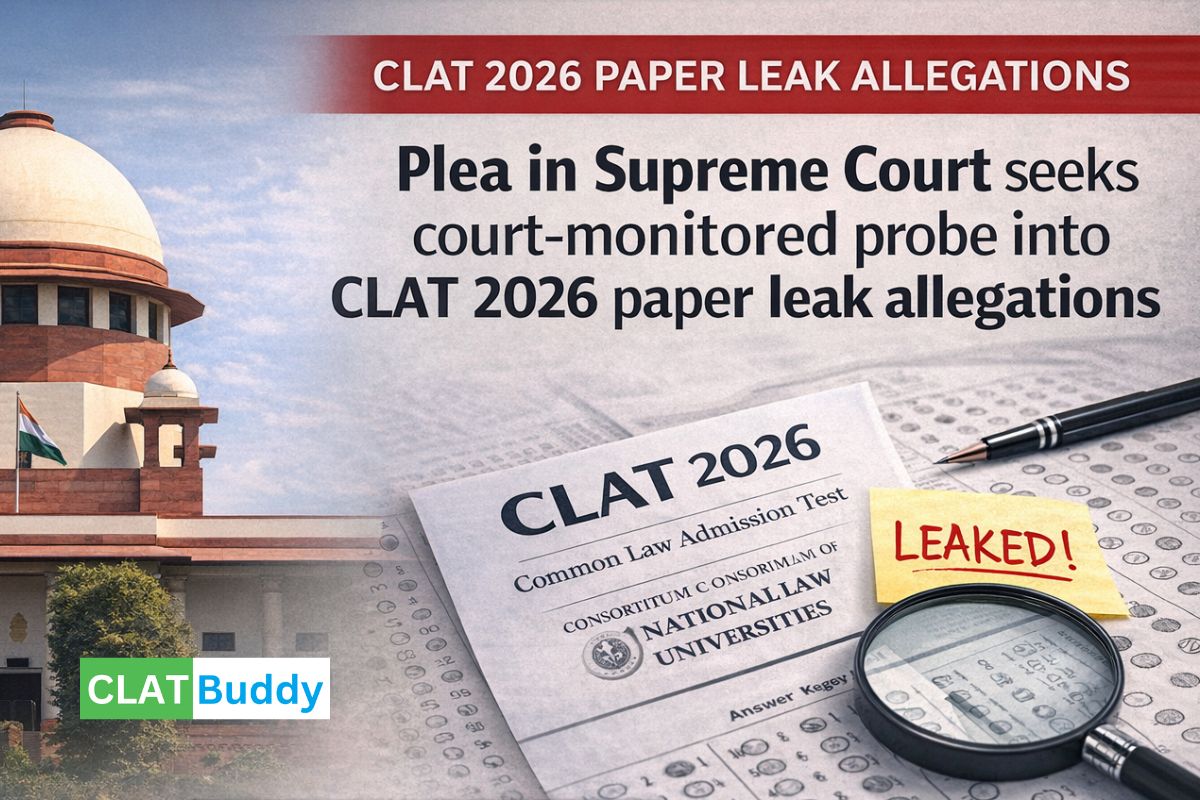
A petition has been filed before the Supreme Court of India seeking a court-monitored and time-bound investigation into allegations that the Common Law Admission Test 2026 (CLAT 2026) question paper was leaked before the examination. The plea raises serious concerns about the integrity of one of India’s most important entrance exams for law students.
CLAT is a national-level entrance examination conducted for admission to undergraduate and postgraduate law programmes in National Law Universities (NLUs) and several other institutions. Every year, tens of thousands of students appear for CLAT, and the exam largely determines access to premier legal education in the country.
CLAT 2026 was conducted on 7 December 2025, between 2 PM and 4 PM, across 156 centres in 25 States and 4 Union Territories. Around 92,000 candidates appeared for the examination, competing for nearly 5,000 seats.
Given its scale and importance, any allegation of paper leakage directly affects public confidence in the fairness of the process.
The petition has been filed by a group of law aspirants belonging to Scheduled Caste (SC), Other Backward Classes (OBC), and Economically Weaker Sections (EWS). They have approached the Supreme Court alleging that the CLAT 2026 question paper and answer key were illegally accessed and circulated on social media platforms even before the exam began.
The case has been filed as Lalit Pratap Singh & Ors. v. Consortium of National Law Universities.
According to the petition:
The petitioners argue that these factors strongly suggest that the paper was leaked before the examination.
The plea states that the alleged leak has irreparably compromised the sanctity of the examination and destroyed the level playing field that is essential for any competitive exam. According to the petitioners:
Counselling for CLAT 2026 is scheduled to begin on 7 January 2026, making the issue extremely urgent.
CLAT is organised by the Consortium of National Law Universities, a body comprising National Law Universities across India.
After concerns were raised, the Consortium reportedly set up a grievance redressal portal headed by former Supreme Court judge Justice MR Shah. However, the petition points out that:
The plea argues that this silence has further weakened public trust in the examination process.
The petitioners have requested the Supreme Court to:
The plea emphasises that examinations like CLAT carry a constitutional obligation of fairness, transparency, and integrity, as they determine entry into the legal profession.
The petition highlights that access to legal education affects not only individual careers but also the future of the justice system. When an entrance exam is allegedly compromised:
For candidates from marginalised backgrounds, such breaches can have a disproportionate impact.
As of now, the Supreme Court has not passed final orders on the plea. The matter is at the stage where the Court is being urged to intervene urgently, considering that counselling and seat allotment are about to begin.
The CLAT 2026 paper leak allegations raise serious questions about the fairness and credibility of one of India’s most important entrance examinations. The petition before the Supreme Court seeks not only accountability but also restoration of trust in the system. The Court’s response to this plea will be closely watched by law aspirants, universities, and the wider legal community, as it may set important standards for transparency and integrity in national-level examinations.