

If you are preparing for CLAT or any other law entrance exam, you already know that Legal Reasoning can make or break your score. Many students lose marks not because they do not understand the law, but because they do not know how to apply a principle to given facts properly.
Principle–fact questions in CLAT test your ability to think like a lawyer. They check whether you can read a legal rule, understand it, and apply it logically to a situation. In this detailed guide, you will learn a clear principle–fact question solving framework that you can start using immediately in your CLAT preparation.
This article will help you with legal reasoning for CLAT, CLAT legal aptitude strategy, how to solve principle fact questions, and tips to improve your CLAT legal section score.
In CLAT Legal Reasoning, you are usually given:
Your task is to apply the given principle strictly to the facts and choose the most logical conclusion.
These questions are also called principle and fact questions in CLAT, legal reasoning questions, or legal aptitude questions. They do not test whether you know the actual law of India. They test whether you can think logically and apply a rule correctly.
For example, a principle might say that a contract with a minor is void. The facts might tell you that a 17 year old entered into an agreement. Your job is not to debate the fairness of the rule. Your job is to apply it as it is.
This is where most students go wrong. They either use outside legal knowledge or they apply personal logic instead of the given rule.
Many CLAT aspirants struggle with these questions for three main reasons.
First, they read the facts emotionally instead of logically. If the facts look unfair, they try to adjust the outcome.
Second, they ignore small words in the principle such as only, unless, intentionally, or knowingly. These words often decide the answer.
Third, they bring in outside knowledge. In CLAT Legal Reasoning, you must assume that the given principle is absolutely correct, even if it is different from real Indian law.
If you master this mindset, your accuracy in legal reasoning will improve significantly.
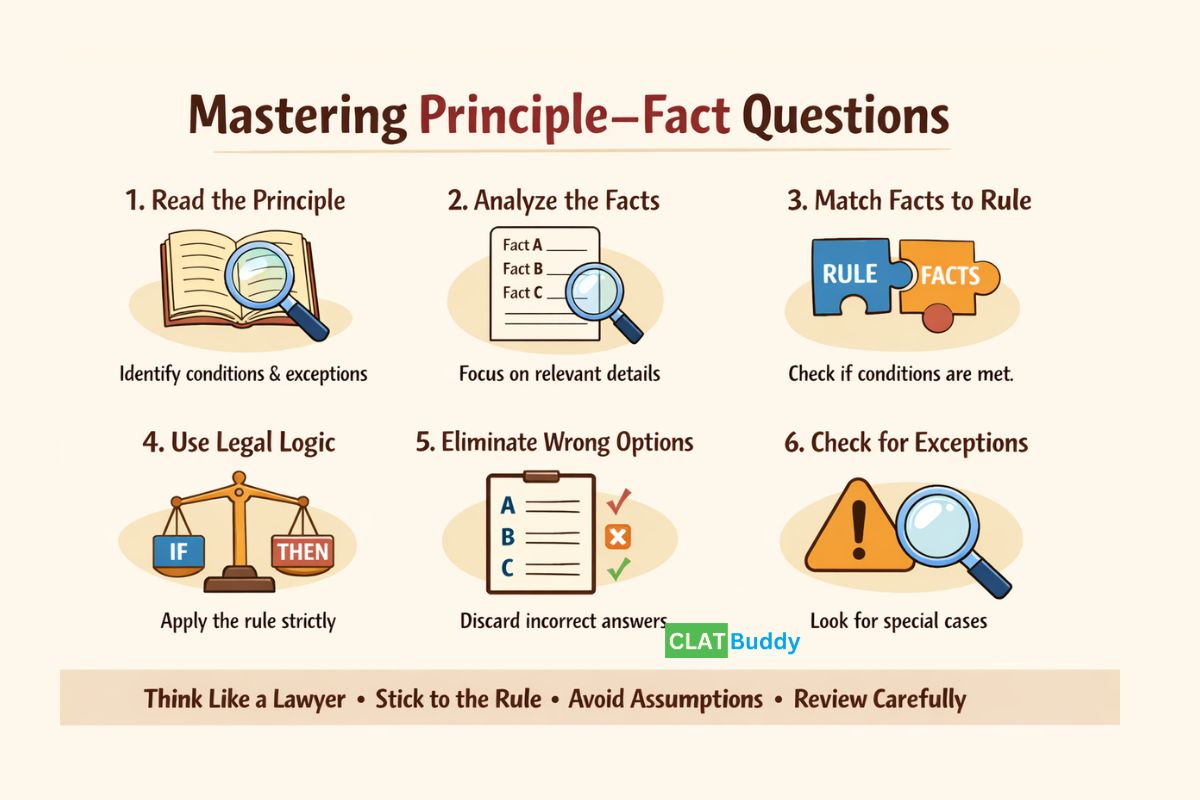
Before you even look at the facts, focus on the principle. This is the most important part of the question.
When you read the principle, ask yourself:
Let us break this into a simple structure.
Most principles have certain requirements. For example, a principle may say that a person is guilty if they intentionally cause harm to another person.
Here, the conditions are:
If even one condition is missing, the principle may not apply.
Some principles include words like unless, except, provided that, or however. These signal exceptions.
In CLAT legal reasoning questions, exceptions are very important. A small factual detail can activate an exception and completely change the answer.
When you prepare for CLAT Legal section, train your mind to circle or mentally note such words.
After understanding the principle, move to the facts. Do not rush.
You should:
Many students make the mistake of reading the facts first. Instead, read the principle first. Then read the facts with the principle in mind.
For example, if the principle talks about intention, check whether the facts show intention or negligence. Do not assume intention unless it is clearly mentioned.
This approach will improve your CLAT legal reasoning strategy and reduce confusion in tricky questions.
This is where you actually solve the question.
You can use a simplified IRAC method in your mind:
You do not have to write this in the exam, but you should think this way.
Ask yourself, what is the main question? Is it about liability, validity, guilt, or rights?
Go back to the principle. Break it into conditions again.
Take one condition at a time and check if the facts satisfy it.
If the principle says intentional harm, check:
If both are satisfied, the rule applies.
If one is missing, the rule may not apply.
Once you match all conditions, the answer should become clear.
This systematic approach is one of the best CLAT preparation tips for legal reasoning.
CLAT is a multiple choice exam. Even if you are slightly unsure, elimination can help you reach the correct answer.
Here is how you can eliminate wrong options in principle fact questions.
First, remove options that contradict the principle. If the principle clearly says something, an option that goes against it cannot be correct.
Second, remove options that add new facts. In CLAT legal aptitude questions, you cannot assume anything beyond what is given.
Third, remove options that use extreme language unless the principle itself uses extreme words like always or never.
This elimination technique increases your accuracy and saves time during the exam.
As a mentor guiding you for CLAT and other law entrance exams, let me highlight the most common mistakes.
Even if you know real Indian law, ignore it. The question is testing logical application, not memory.
Words like knowingly, voluntarily, reasonable, or good faith are very important. Many CLAT legal reasoning questions are built around these words.
You might feel that a person in the facts deserves sympathy. But your answer must be based only on the principle.
Sometimes students think the question is very tricky and look for hidden meanings. Stick to the text. Do not imagine facts that are not written.
Avoiding these mistakes will significantly improve your CLAT legal section score.
Practice is essential for mastering legal reasoning for CLAT.
Here is how you should practice.
First, solve previous year CLAT legal reasoning questions. This will help you understand the pattern.
Second, after solving a question, review why the correct answer is correct and why the other options are wrong.
Third, create a small notebook where you write down tricky principles and how they were applied.
Fourth, time yourself. Legal reasoning in CLAT is passage based and time management is crucial.
Regular practice with analysis will make principle and fact questions feel easier over time.
When you follow a structured principle–fact question solving framework, three things improve.
First, your accuracy increases because you are applying logic step by step.
Second, your confidence improves. You stop guessing and start reasoning.
Third, your speed improves because your mind gets trained to break down principles quickly.
In competitive exams like CLAT, AILET, and other law entrance exams in India, consistency and logical clarity are more important than rote learning.
Legal reasoning is not about knowing law. It is about thinking like a law student.
You are not just preparing for an entrance exam. You are training your mind to think logically, critically, and analytically. Principle–fact questions are the foundation of legal education.
Every time you solve such a question, follow this simple checklist:
If the answer to all these is yes, you are on the right path.
Keep practicing legal reasoning questions for CLAT regularly. Over time, you will notice that what once seemed confusing becomes straightforward.
Stay consistent, stay disciplined, and trust the process. With the right strategy and mindset, you can master principle–fact questions and boost your CLAT Legal Reasoning score significantly.
If you would like, the next step can be a practice set of CLAT principle fact questions with detailed solutions so you can apply this framework immediately.