
If you are preparing for CLAT and feel nervous about the Quantitative Techniques section because you are not from a math background, you are not alone. Many CLAT aspirants from humanities and arts streams feel the same way. The good news is this section is not about advanced mathematics. It is about basic arithmetic, logical thinking, and data interpretation.
In this guide, I will walk you through a practical quantitative techniques strategy for non math students. Think of this as a mentor talking directly to you and helping you build confidence step by step.
Before building a strategy, you need clarity.
In the CLAT exam pattern, the Quantitative Techniques section usually includes sets based on:
You are not expected to solve trigonometry or advanced algebra. Most questions are based on Class 8 to 10 level mathematics. The focus is on understanding data and applying simple concepts logically.
If you prepare smartly, this section can actually become a scoring area.
Let us address the real issue.
Most non math students struggle because:
Here is the truth. In CLAT preparation, consistency matters more than background. Students who practice regularly outperform those who rely only on past academic strengths.
The Quantitative Techniques section rewards clarity, practice, and time management. Not your stream.
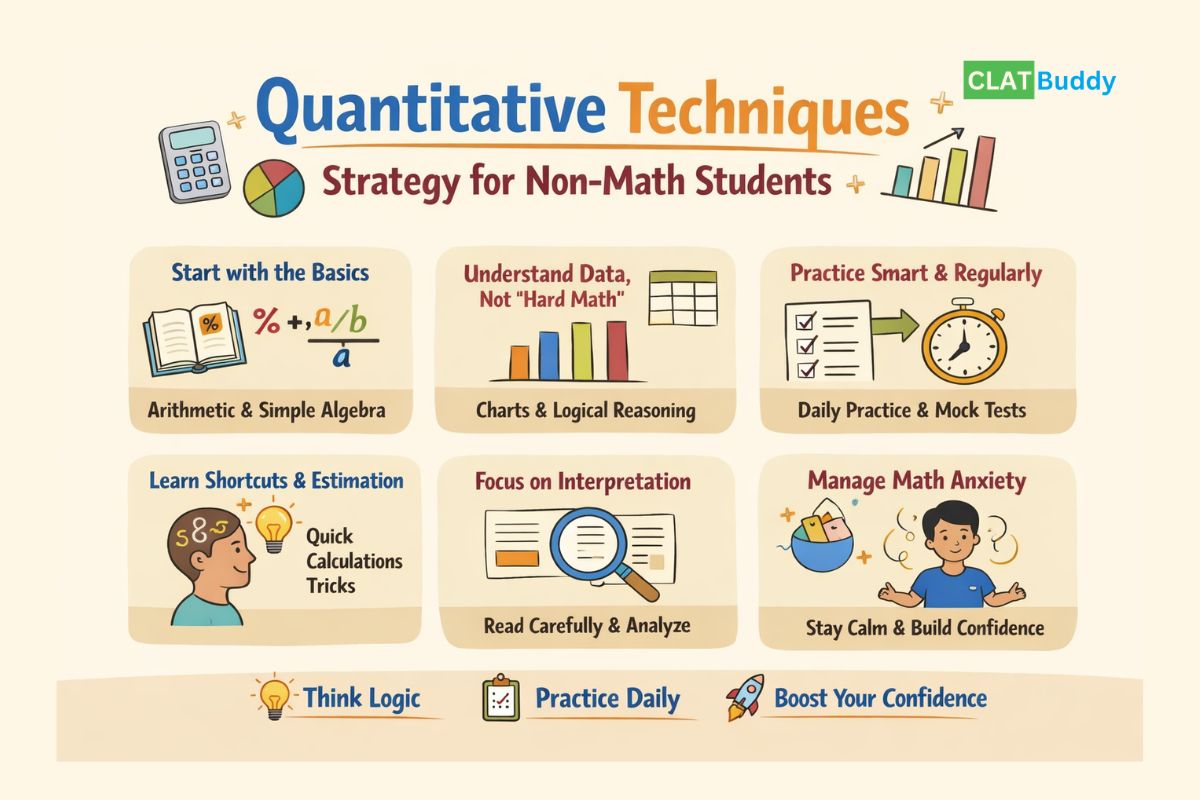
When you start your CLAT quantitative preparation, do not jump directly into mock tests. Build your foundation first.
You must master:
These topics form the backbone of most quantitative aptitude for law entrance exams.
Spend at least two weeks revising these basics from NCERT or a good CLAT preparation book. Do not rush this stage. Strong basics reduce fear.
Data interpretation for CLAT is a major part of the Quantitative Techniques section. Most questions are based on:
Before looking at the data, read the question carefully. Understand what is being asked. This prevents unnecessary calculations.
Do not look at the entire graph at once. Focus only on the values relevant to the question.
In many CLAT questions, options are far apart. You can use estimation techniques instead of exact calculations. This saves time.
Practice at least 3 to 4 data interpretation sets daily. Within one month, you will notice significant improvement.
Speed is important in the CLAT exam because you have limited time for 120 questions.
Here is how you can improve your calculation speed.
Spend 15 minutes daily on:
This improves your numerical confidence.
Create a small notebook for:
Revise it weekly. Repetition builds retention.
Once your basics are clear, start solving timed quantitative aptitude mock tests. Initially, give yourself more time. Gradually reduce it to match actual CLAT exam timing.
If you consider yourself very weak in maths, follow this structured plan.
Focus only on understanding concepts. Do not worry about speed.
Daily routine:
Start solving mixed arithmetic problems and basic data interpretation sets.
Now integrate Quantitative Techniques with other CLAT sections.
Consistency matters more than long study hours.
Many students lose marks due to simple errors.
Math anxiety is real. But you can control it.
First, stop labeling yourself as bad at maths. That mindset blocks improvement.
Second, track your progress. Maintain a notebook where you record:
When you see improvement on paper, your confidence increases.
Third, practice regularly. Exposure reduces fear. The more you solve quantitative aptitude questions, the less intimidating they feel.
Exam day strategy is different from preparation strategy.
Quickly scan the Quantitative Techniques section. Identify easier sets based on simple percentages or straightforward data interpretation.
In CLAT, accuracy matters more than attempts. Attempt only those questions you are confident about.
If you can eliminate two options logically, you can consider taking a calculated risk.
Remember, CLAT preparation is about smart strategy, not blind attempts.
For effective quantitative techniques preparation:
Quality matters more than quantity. Always analyze your mistakes.
Yes, absolutely.
Many students from non math backgrounds initially fear this section but later score very high because:
If you prepare strategically, Quantitative Techniques can become a scoring advantage in CLAT and other law entrance exams like AILET and SLAT.
| Day | Focus Area | What You Should Do |
| Monday | Core Arithmetic Revision | Revise percentages, ratios, averages, profit and loss, interest. Solve practice questions from one topic. |
| Tuesday | Core Arithmetic Practice | Continue arithmetic practice. Solve mixed questions and focus on improving accuracy. |
| Wednesday | Data Interpretation | Solve 2 to 3 data interpretation sets based on tables, bar graphs, and pie charts. Focus on understanding data clearly. |
| Thursday | Mixed Practice | Attempt mixed arithmetic and data interpretation problems. Work on time management. |
| Friday | Sectional Mock Test | Attempt one full Quantitative Techniques sectional mock under timed conditions. |
| Saturday | Analysis and Concept Revision | Analyze mistakes from the mock test. Identify weak areas and revise those specific concepts. |
| Sunday | Light Revision and Mental Math | Practice quick calculations, tables, squares, percentage conversions. Revise formulas briefly. |
You do not need to be a math genius to crack the Quantitative Techniques section in CLAT.
You need:
Remember, CLAT quantitative aptitude is about logic and application, not complicated formulas.
If you start today and stay consistent, this section can shift from your biggest fear to your silent strength.
Stay disciplined. Stay patient. And most importantly, believe that you can improve.
Your CLAT journey is not about where you started. It is about how consistently you move forward.