
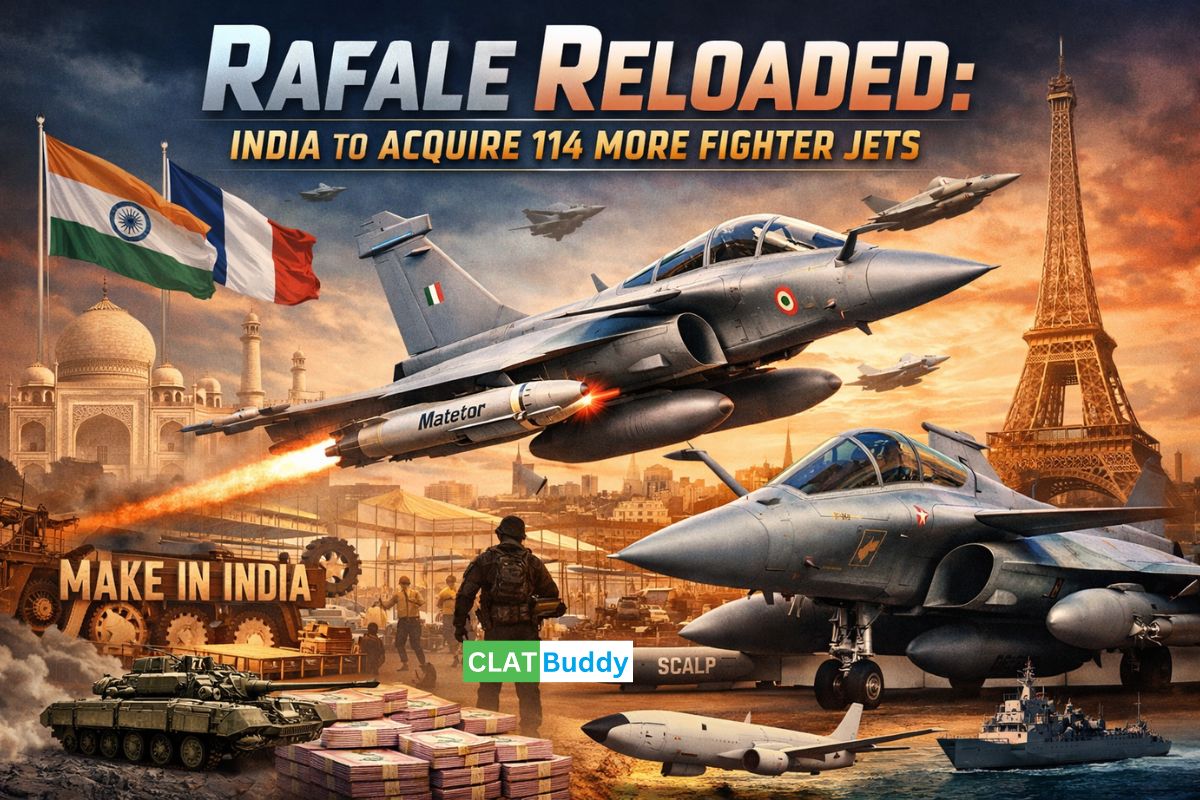
In one of the largest defence procurement moves in recent years, India has cleared a ₹3.25 lakh crore proposal to acquire 114 additional Rafale fighter jets, significantly strengthening the Indian Air Force’s combat capability amid evolving security challenges.
The approval marks a major milestone in India’s long-term military modernisation strategy and reinforces defence cooperation with France.
The proposal was cleared by the Defence Acquisition Council (DAC), chaired by Defence Minister Rajnath Singh. The Council granted Acceptance of Necessity (AoN), which formally allows the programme to move into detailed technical, financial and contractual negotiations.
The clearance is part of a broader defence push, with total approvals touching approximately ₹3.60 lakh crore across the three armed services.
Under the approved framework:
Once completed, India’s total Rafale fleet will rise to 176 aircraft, including:
The aircraft are manufactured by French aerospace major Dassault Aviation.
The Indian Air Force currently operates around 30 squadrons, significantly below its sanctioned strength of 42 squadrons. With ongoing security challenges along both western and northern borders, strengthening air power has become a strategic necessity.
The additional Rafales are expected to enhance operational readiness in the near to medium term.
A major portion of the aircraft will be built domestically under the “Make in India” initiative. The local manufacturing component is expected to involve Indian private sector firms in collaboration with Dassault Aviation.
This move aims to:
The Rafale has emerged as a central pillar of India’s air combat capability. Already operational with the IAF, it is considered a highly versatile multi-role fighter.
Key features include:
Notably, the aircraft is equipped with:
These capabilities give the IAF significant long-range precision strike power.
India’s fifth-generation Advanced Medium Combat Aircraft (AMCA) remains under development. Meanwhile, the indigenous HAL Tejas MkIA production line is still scaling up.
In this context, additional Rafales are seen as a crucial interim reinforcement until indigenous platforms mature and enter full-scale operational service.
With AoN granted, the programme now enters the detailed negotiation phase, which will cover:
Officials indicate that final contractual contours will emerge over the coming months before formal signing.
Alongside the Rafale clearance, the DAC also approved several high-value proposals:
Together, these approvals reflect a comprehensive modernisation effort across land, air and maritime domains.
The Rafale expansion further cements India–France strategic ties. Defence cooperation between New Delhi and Paris has steadily deepened in recent years, extending beyond aircraft procurement to maritime security, space cooperation and joint exercises.
The latest clearance signals continuity in this partnership and reinforces France’s position as a key defence supplier to India.
The ₹3.25 lakh crore Rafale decision is not just a procurement exercise. It represents:
As negotiations progress, the deal is expected to shape India’s air power trajectory for the next two decades.
India’s defence modernisation drive has entered a decisive phase, and Rafale is once again at its centre.