
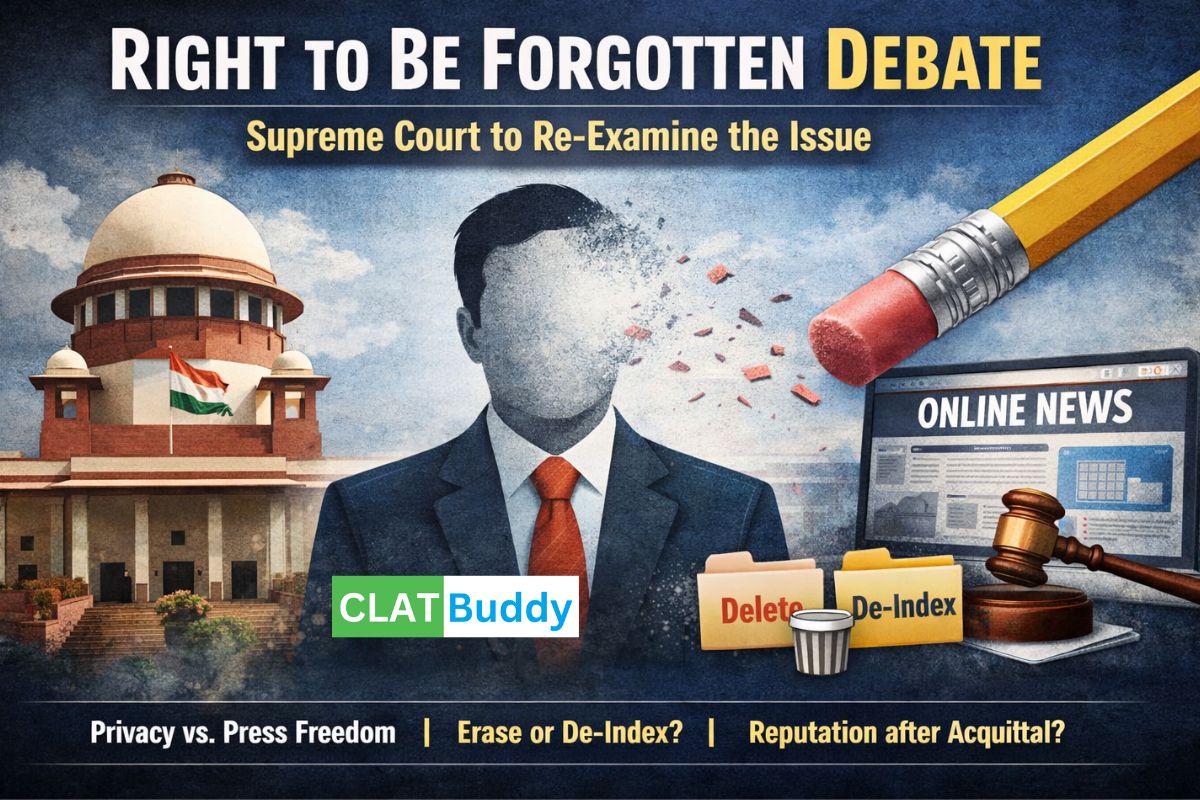
The Supreme Court has agreed to examine an important question at the intersection of digital privacy, reputation, and press freedom — whether the right to be forgotten can be used to seek the removal or de-indexing of accurate online news reports after an accused person has been discharged from a criminal case.
The issue arose after the Court issued notice on a plea filed by IE Online Media Services Private Limited, challenging a December 2025 judgment of the Delhi High Court that directed the removal of certain news URLs from the internet. The Supreme Court has stayed that order and clarified that it will not operate as a precedent while the matter is examined in detail.
The dispute originates from a defamation suit filed by a banker who had earlier been named in news reports related to a money-laundering investigation. The reports were published between 2020 and 2024 and were based on official press releases of the Enforcement Directorate and court proceedings.
In 2024, the banker was discharged by a trial court. Following this, he approached the courts seeking removal and de-indexing of these earlier reports, arguing that their continued availability online was harming his reputation despite his exoneration.
A trial court at Patiala House granted an interim injunction in November 2025 directing the removal of the URLs. This order was later upheld by the Delhi High Court.
The Delhi High Court held that while the media enjoys the right to free expression, this right is not absolute. It observed that an individual’s right to dignity and reputation, traceable to Article 21 of the Constitution, must also be protected.
The Court noted that the perpetual digital availability of past reports can result in enduring reputational harm, especially where an individual has been discharged or cleared. On this basis, it upheld the direction to remove the URLs from public access.
A Bench of Justices B V Nagarathna and Ujjal Bhuyan stayed the High Court’s ruling and issued notice on the publisher’s plea.
The petitioner argued that the High Court order sets a dangerous precedent, allowing anyone named in a past news report to invoke the right to be forgotten regardless of whether the reporting was accurate and based on public records.
Senior Advocate Arvind Datar, appearing for the publisher, submitted that truthful reporting based on public documents does not become defamatory merely because subsequent events — such as a discharge — take place later.
The right to be forgotten (RTBF) is understood as a person’s right to restrict or remove personal data that is no longer necessary, relevant, or accurate. In India, it is derived from the right to privacy, which the Supreme Court recognised as a fundamental right under Article 21 in Puttaswamy v Union of India.
However, Indian law does not yet provide a clear statutory framework defining the scope, limits, or enforceability of the RTBF, particularly when it conflicts with freedom of speech and the public’s right to information.
The case raises a core constitutional conflict:
The publisher has argued that allowing deletion of truthful reports would amount to rewriting history, conceal matters of public record, and create a chilling effect on investigative journalism.
On the other hand, individuals argue that indefinite online availability of such reports can cause permanent reputational damage, even after legal vindication.
The Supreme Court has listed the matter for further hearing on March 16. Its eventual ruling is expected to clarify:
The decision is likely to have far-reaching consequences for media houses, search engines, digital platforms, and individuals alike.