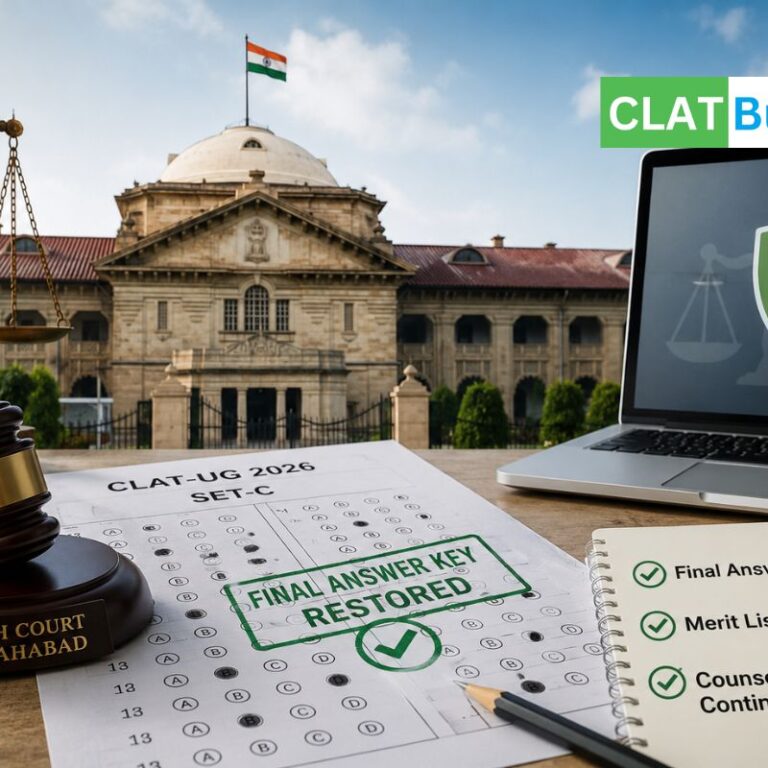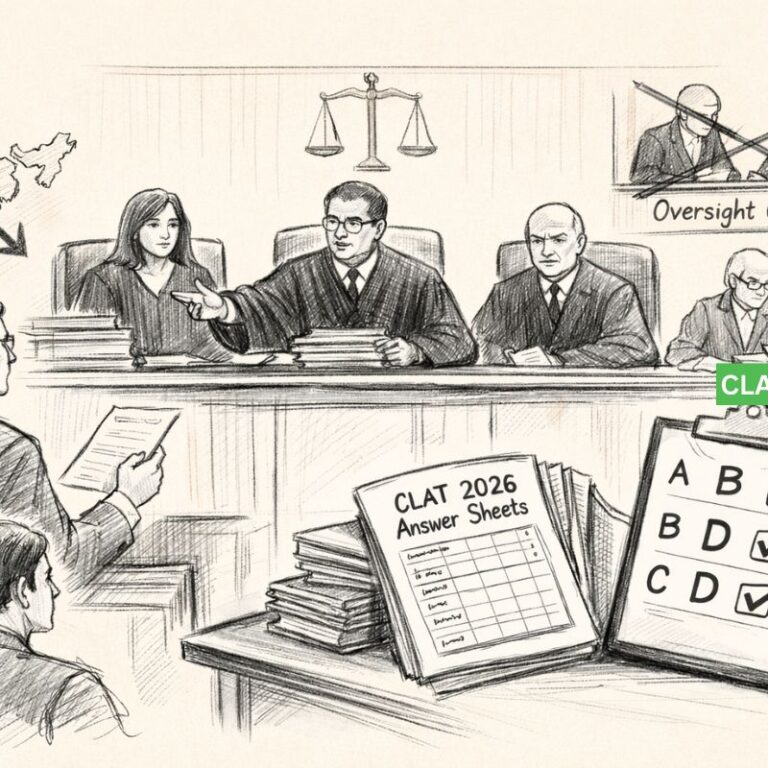



The Supreme Court on Wednesday expressed its inclination to consolidate petitions challenging the Common Law Admission Test (CLAT) 2025 that are currently pending before seven different high courts. A bench headed by Chief Justice of India (CJI) Sanjiv Khanna issued notice to the petitioners in these cases and scheduled the matter for hearing in the first week of February 2025.
The Consortium of National Law Universities (NLUs) had filed a plea seeking the transfer of petitions pending in the high courts of Punjab & Haryana, Delhi, Karnataka, Madhya Pradesh, Bombay, Jharkhand, and Rajasthan. These petitions involve various grievances regarding the CLAT 2025 examination, including discrepancies in the answer key and other procedural issues.
The consortium argued that having cases spread across multiple high courts could lead to conflicting orders, potentially delaying the admission process for undergraduate and postgraduate law courses.
The bench, which also included Justice P.V. Sanjay Kumar, noted the necessity of consolidating these matters for efficiency and consistency in judicial outcomes. Initially, the Court favoured transferring all cases to the Punjab & Haryana High Court, where the first petition was filed. However, this was later reconsidered following objections:
The bench ultimately refrained from finalising a transfer venue but emphasised that transferring the cases would expedite resolution and ensure uniformity.
The Supreme Court clarified that its notice does not bar ongoing proceedings in the respective high courts.
“Notwithstanding our order, the petitioners before the high courts can complete their pleadings,” the bench stated.
The consortium highlighted the risks of contradictory judgments if the petitions remain scattered across different courts. Such inconsistencies could disrupt the admission process for law courses across the country.
“In the interest of efficiency, it is expedient to transfer the matters for an early resolution of the dispute in question,” the bench observed.
The Supreme Court will hear arguments on the matter in the first week of February 2025. The decision will determine whether all cases will be consolidated under one high court or remain dispersed across multiple jurisdictions.