
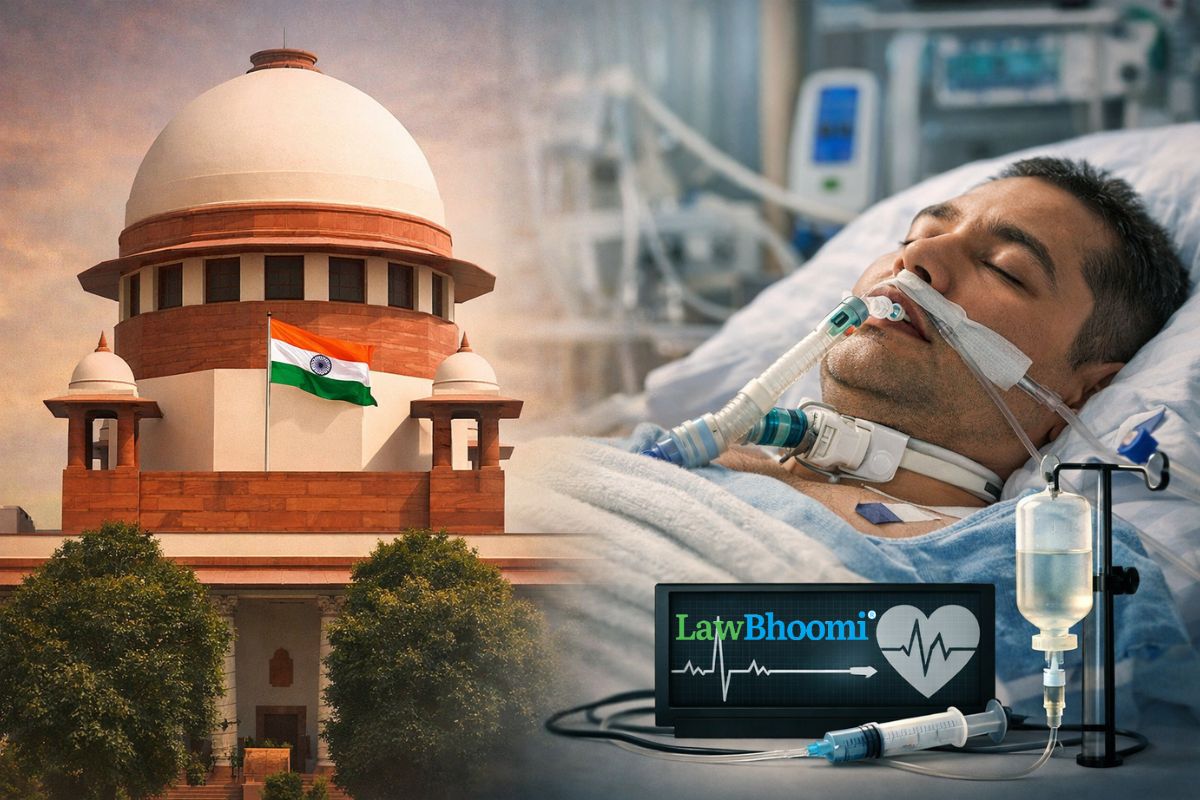
In a significant development concerning end-of-life care and the right to die with dignity, the Supreme Court of India has permitted passive euthanasia in a case involving a man who had been in a persistent vegetative state for more than thirteen years. The decision marks the first time that the Supreme Court has judicially applied the framework laid down in its landmark 2018 judgment on passive euthanasia. [Harish Rana v. Union of India]
The case involved Harish Rana, a 32-year-old man who suffered a severe brain injury after falling from the fourth floor of his paying guest accommodation many years ago. The accident left him in a persistent vegetative state (PVS) with 100% quadriplegia. Medical reports showed that his condition had not improved during the past thirteen years. He survived only through clinically administered nutrition, which was delivered through surgically installed feeding tubes.
The bench comprising Justice JB Pardiwala and Justice KV Viswanathan examined the medical evidence and the circumstances of the case. The Court noted that the patient had no reasonable prospect of recovery and that continuing treatment merely prolonged biological existence without offering any therapeutic benefit.
The patient’s father had approached the Court seeking permission to withdraw life-sustaining treatment. Medical experts evaluated the case through the constitution of Primary and Secondary Medical Boards, as required under the guidelines laid down by the Supreme Court in earlier judgments. Both boards concluded that the patient’s chances of recovery were extremely remote and that continuation of treatment was not in his best interest.
The Court recognised that clinically administered nutrition is a form of medical treatment, and therefore it can be withdrawn when medical boards unanimously conclude that continuing such treatment serves no purpose.
Accordingly, the Supreme Court in Harish Rana v. Union of India permitted the withdrawal of life support and issued several directions. It ordered that the patient be shifted to the palliative care centre at the All India Institute of Medical Sciences (AIIMS) so that the withdrawal of life support could be carried out under proper medical supervision. The Court also emphasised that the process must be conducted in a dignified and carefully planned manner.
In addition, the Court directed High Courts across the country to ensure that Judicial Magistrates receive intimations from hospitals whenever medical boards decide to withdraw or withhold life support in accordance with the established guidelines. The Union Government was also asked to ensure that district authorities maintain panels of medical practitioners for such medical boards.