
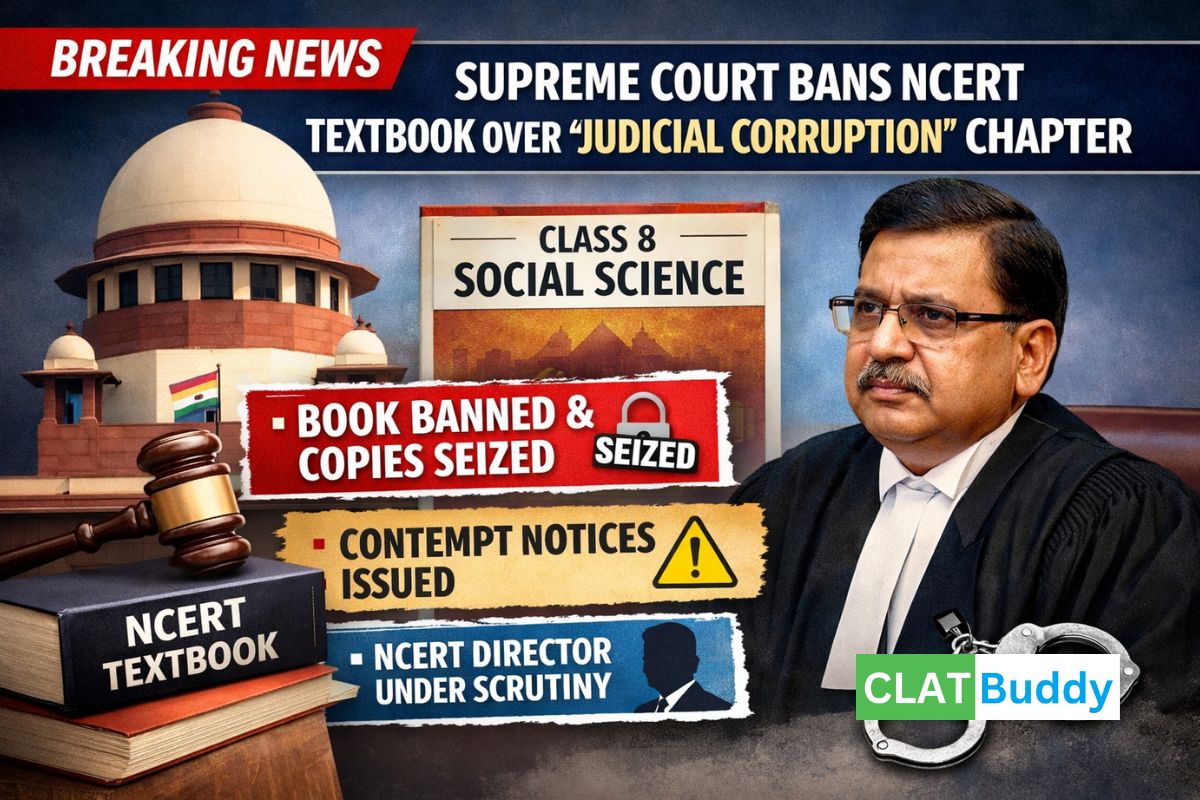
In a dramatic development, the Supreme Court on Thursday imposed a complete ban on a newly published Class 8 Social Science textbook by the National Council of Educational Research and Training (NCERT) after it carried references to “corruption in judiciary” and case backlogs as systemic challenges.
The Bench led by Chief Justice of India Surya Kant, along with Justices Joymalya Bagchi and Vipul M. Pancholi, took suo motu cognisance of the issue and issued show-cause notices to the Secretary, Department of School Education, Ministry of Education, and the Director of NCERT. The Court asked them to explain why proceedings under the Contempt of Courts Act, or any other law, should not be initiated.
The Court observed prima facie that the publication may amount to criminal contempt if it is found to be a deliberate attempt to scandalise the judiciary.
Complete Ban, Seizure and Takedown Ordered
The Court passed stringent directions, ordering:
The Bench directed NCERT, in coordination with Union and State Education Departments, to ensure that all copies — whether in storage, retail outlets, or schools — are seized and removed from public access. Compliance reports are to be filed within two weeks.
The Court made it the personal responsibility of the NCERT Director and the principals of schools where the book had reached to seal and secure all copies and confirm compliance. It further warned that any attempt to circulate the content through altered titles or electronic means would be treated as wilful defiance of the Court’s order.
The Bench noted that the chapter referred to complaints received against judges in a manner that allegedly created an impression that no action had been taken. It also observed that comments attributed to former Chief Justice of India B.R. Gavai were presented out of context, potentially suggesting that he had acknowledged corruption within the judiciary.
The Court took serious exception to a letter written by the NCERT Director to the Secretary General of the Supreme Court defending the contents of the book. The Bench described the reply as “contemptuous and reckless”.
According to the Court, the material appeared to be a “calculated move to undermine the institutional authority and demean the dignity of the institution.” The Bench remarked that such content, if left unchecked, could erode public confidence in the judiciary, particularly among impressionable young students.
However, the Court clarified that it did not intend to stifle legitimate criticism or prevent scrutiny of public institutions, including the judiciary. It emphasised that constructive criticism remains permissible, but what is under scrutiny is whether the content crossed the line into scandalising the institution.
The NCERT Director has been directed to furnish the names and credentials of all individuals involved in drafting the chapter. The original minutes of meetings where the chapter was deliberated and finalised must also be produced before the Court on the next date of hearing.
During the hearing, Solicitor General Tushar Mehta informed the Court that NCERT had withdrawn the chapter and expressed regret. He stated that only 32 copies had reached the market and assured the Court that they would be retrieved.
However, the CJI observed that the press release issued by NCERT did not contain “a single word of apology.” He also pointed out that when the Court initially sought clarification, the NCERT had defended the chapter rather than expressing regret.
When the Solicitor General stated that those responsible would no longer be associated with NCERT or the Ministry, the CJI remarked that such action was of “very little consequence,” adding that “judiciary is bleeding today.”
The Court described the episode as potentially a “deep-rooted, well-orchestrated conspiracy” to malign the judiciary and insisted on fixing accountability. “Heads must roll,” the CJI said, making it clear that the proceedings would not be closed lightly.
Senior Advocate Kapil Sibal informed the Court that soft copies of the chapter were being widely circulated on social media. Justice Bagchi observed that directions must be issued to ensure prompt takedown of online versions.
The matter also saw appearances by Senior Advocate Vikas Singh, President of the Supreme Court Bar Association, and Senior Advocate Manan Kumar Mishra, Chairperson of the Bar Council of India, who supported the Court’s intervention.
The controversy erupted after media reports on February 24 highlighted that a new Class 8 NCERT Social Science textbook listed “corruption in judiciary” and judicial backlogs as major challenges. Senior Advocates Kapil Sibal and Dr. A.M. Singhvi orally mentioned the issue before the CJI-led Bench, expressing concern that the chapter scandalised the entire judiciary.
The CJI remarked at the time that several judges were perturbed and that the development appeared to be a “calculated measure.” He stated unequivocally that the integrity of the institution would not be allowed to be tainted.
Following judicial remarks, NCERT issued a statement acknowledging that the content was “inappropriate” and described it as an “error of judgment.” It stated that the chapter would be rewritten in consultation with appropriate authorities before the academic session 2026–27.
Despite this withdrawal, the Court proceeded with suo motu action, citing the need to examine whether the publication was a bona fide error or a deliberate attempt to undermine public confidence in the judiciary.