
What Has Happened?
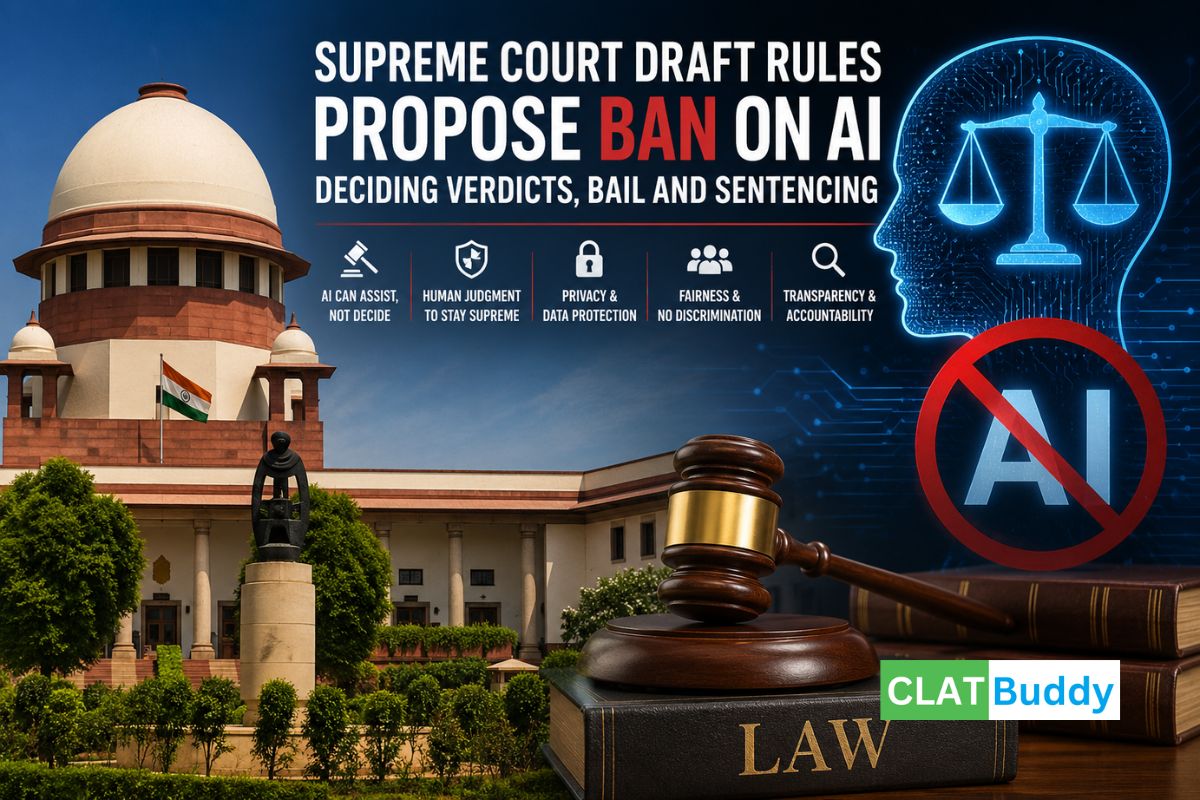
The Supreme Court has released a draft framework titled “Regulations for Use of Artificial Intelligence (AI) in Courts, 2026”, proposing strict safeguards on the use of AI in the Indian judiciary.
The draft makes it clear that AI can assist courts in administrative and research-related functions, but it cannot replace judges or influence judicial decision-making. The Supreme Court AI Committee has invited suggestions from stakeholders and the public until June 20, 2026, before finalising the regulations.
Key Principle: Human Judges Must Remain in Control
The draft regulations state that AI systems must remain strictly subservient to human judgment and judicial authority.
According to the proposal:
- AI can only function in an assistive capacity.
- Judicial officers will retain exclusive authority to decide questions of law, facts and justice.
- AI systems cannot replace or compromise independent judicial decision-making.
- Final responsibility for every judicial decision will remain with human judges.
Uses of AI Permitted in Courts
The draft allows AI to be used for several administrative and support functions, including:
- Case management and tracking.
- Preparation of cause lists.
- Scheduling of hearings.
- Transcription of court proceedings.
- Translation of judgments and court records.
- Legal research assistance.
- Record management and document organisation.
- Case filing assistance and defect scrutiny.
- Judicial resource allocation.
- AI-powered chatbots to help litigants understand procedures.
- Accessibility support for persons with disabilities and language barriers.
- Anonymisation of court records.
Activities AI Cannot Perform
The draft proposes a complete prohibition on AI being used to make or influence judicial decisions.
Ready to Take a Legal Reasoning Sectional Test?
Move beyond concepts and practise with sectional tests designed to help you build speed, accuracy and exam confidence.
Take the Next Step →AI systems cannot be used for:
- Adjudication of disputes.
- Sentencing decisions.
- Determining bail eligibility.
- Assessing flight risk.
- Predicting repeat offences (recidivism).
- Evaluating the credibility of parties or witnesses.
- Risk scoring of litigants.
- Any process that directly affects personal liberty or legal rights without human oversight.
Any AI-generated output relating to judicial outcomes would be treated only as advisory and would require independent evaluation by a judge.
Restrictions on AI Training and Data Usage
The draft also seeks to protect privacy and prevent misuse of personal information.
It proposes that:
- Personal data cannot be used to train, test or refine AI systems without prior approval from the appropriate authority.
- AI systems must comply with the Digital Personal Data Protection Act, 2023.
- Training data should be accurate, representative and lawfully obtained.
- Efforts must be made to minimise discriminatory bias in AI systems.
Safeguards Against Bias and Discrimination
The proposed regulations require AI systems used in courts to promote fairness and equality.
The draft states that AI systems must not:
- Perpetuate or amplify bias.
- Discriminate on grounds such as caste, religion, sex, gender, disability, language or economic status.
- Adversely affect vulnerable or marginalised communities.
Special protection is proposed for:
- Women.
- Children.
- Persons with disabilities.
- Minority communities.
- Economically and socially disadvantaged groups.
Ban on Opaque or Unexplainable AI
The draft proposes that courts should not use:
- Undisclosed AI systems.
- Opaque algorithms.
- Unexplainable AI models.
This restriction applies particularly where the AI system could materially affect a person’s rights or personal liberty.
The proposal aims to ensure transparency and accountability in all AI-assisted judicial processes.
Restrictions on Surveillance
The draft also seeks to prevent excessive monitoring within the judicial system.
AI systems cannot be used for:
- Continuous surveillance of judges.
- Monitoring advocates.
- Tracking litigants.
- Surveillance of individuals connected with court processes.
Such monitoring would only be allowed where specifically authorised by law.
Proposal for a National AI Regulatory Body
To oversee AI adoption in courts, the draft recommends the creation of a permanent apex body at the Supreme Court level.
The proposed body would:
- Regulate AI use in the judiciary.
- Develop standards and policies.
- Monitor implementation.
- Promote responsible innovation.
- Ensure compliance with ethical and legal safeguards.
The body would include judges, technology experts, cybersecurity specialists, finance professionals, legal practitioners and representatives from relevant government departments.
AI Committees in High Courts
The proposal also recommends the establishment of:
- A dedicated AI Committee at the Supreme Court.
- AI Committees in every High Court.
These committees would oversee AI implementation within their respective jurisdictions and ensure compliance with national standards.
Take Your Legal Reasoning Preparation Further.
Get recorded lessons, 3,000+ Legal Reasoning questions, Legal Current Affairs and regular new practice.
Get Complete Access →Calling all law aspirants!
Are you exhausted from constantly searching for study materials and question banks? Worry not!
With over 15,000 students already engaged, you definitely don't want to be left out.
Become a member of the most vibrant law aspirants community out there!
It’s FREE! Hurry!
Join our WhatsApp Groups (Click Here) and Telegram Channel (Click Here) today, and receive instant notifications.