
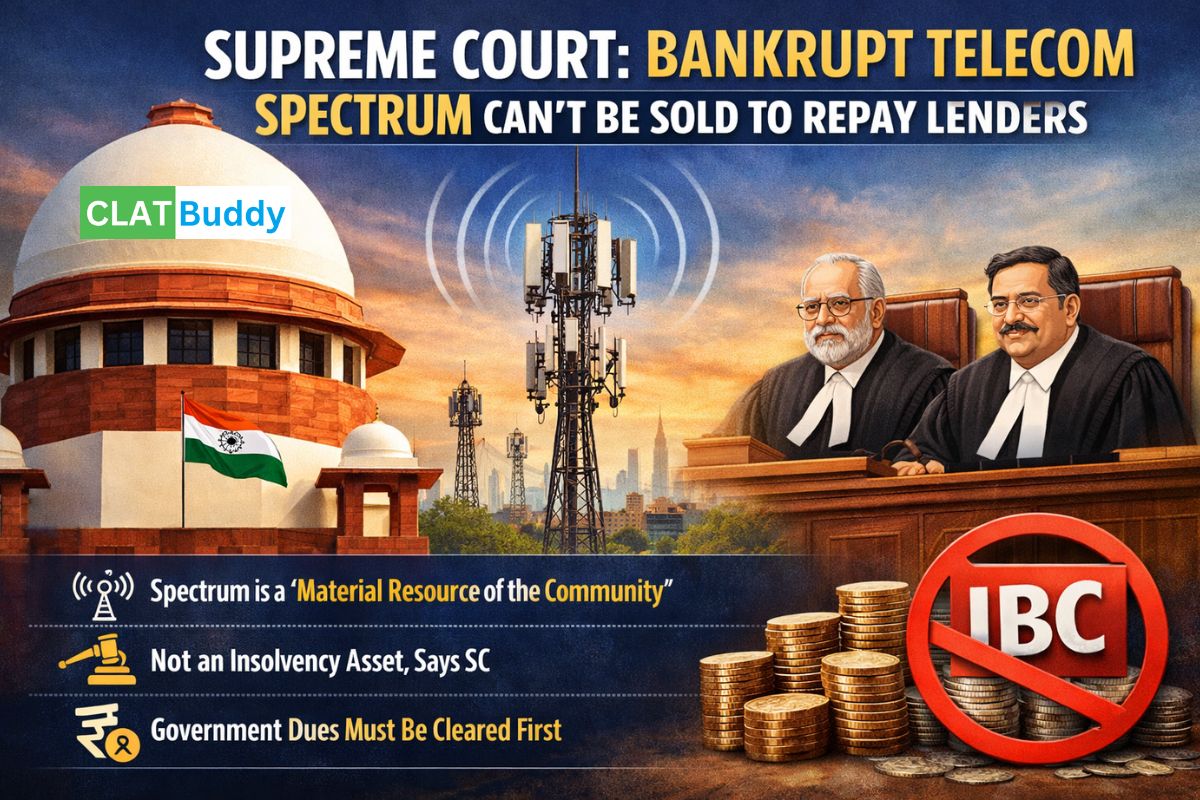
In a significant ruling that could reshape telecom insolvency resolutions, the Supreme Court of India has held that spectrum of bankrupt telecom operators cannot be sold under the Insolvency and Bankruptcy Code (IBC) to repay lenders.
The Court declared that telecom spectrum is a “material resource of the community” and cannot be treated as a tradable commercial asset.
A Bench of the Supreme Court of India comprising Justice P.S. Narasimha and Justice Atul Chandurkar ruled that:
The Court categorically held that even if spectrum usage rights are shown as “intangible assets” in company balance sheets, they do not amount to ownership.
“As naturally as water knows the slope, the IBC cannot be the guiding principle for restructuring the ownership and control of spectrum,” the Bench observed.
Telecom spectrum refers to radio frequencies used by mobile networks to transmit voice and data. The government allocates these frequencies through auctions for fixed periods, subject to licensing conditions.
The Court emphasized that:
Because of this, the IBC — which applies to assets owned by a company — cannot override telecom laws governing allocation, control and recovery of dues.
The ruling arose from insolvency proceedings involving:
Both companies entered insolvency between 2018 and 2019 with massive unpaid dues.
Under Aircel’s resolution plan approved in 2020:
Lenders argued that spectrum should be treated as a monetizable intangible asset. The government disagreed.
The central issue was:
Can spectrum usage rights be treated as assets under the IBC and sold under a resolution plan?
The National Company Law Appellate Tribunal (NCLAT) in 2021 had held that spectrum could be transferred only after clearing all outstanding government dues.
Lenders and telecom operators challenged this before the Supreme Court.
The Supreme Court has now:
The Court held that spectrum allocated to telecom service providers:
The judgment stated:
“Dues payable to the Licensor… must be cleared prior to spectrum trading.”
This means spectrum cannot be transferred unless government liabilities, including statutory dues such as AGR, are fully settled.
The Court made it clear that the IBC:
For banks, spectrum was seen as key collateral. This ruling:
Legal experts say this changes the risk assessment of telecom lending significantly.
Experts noted that the IBC cannot be used to bypass statutory dues like Adjusted Gross Revenue (AGR).
Ankita Singh, founder of Sarvaank Associates, observed that the ruling removes the possibility of using insolvency as a “clean slate” mechanism to avoid government liabilities.
Mukesh Chand, senior counsel at Economic Laws Practice, noted that telecom insolvencies cannot be resolved in isolation.
According to him:
must act as joint stakeholders.
The Court’s approach reinforces that spectrum allocation is tied to public interest and regulatory continuity.
The Court described spectrum as a “material resource of the community.” This phrase is rooted in constitutional principles governing distribution of resources for the common good.
The Bench stated that:
In effect, the Court has reaffirmed that natural resources cannot be treated purely as commercial commodities.
The ruling:
Going forward, resolution plans in telecom insolvencies will likely focus on:
Pure asset liquidation involving spectrum now appears legally untenable.
The Supreme Court’s ruling firmly establishes that telecom spectrum is a public resource held in trust by the government and cannot be used as a private asset to repay lenders in insolvency.
The judgment may reshape the telecom lending landscape and reinforces a broader constitutional doctrine: natural resources must serve the common good, even in commercial disputes.
This decision is likely to have long-term implications for telecom financing, insolvency law, and public resource governance in India.