
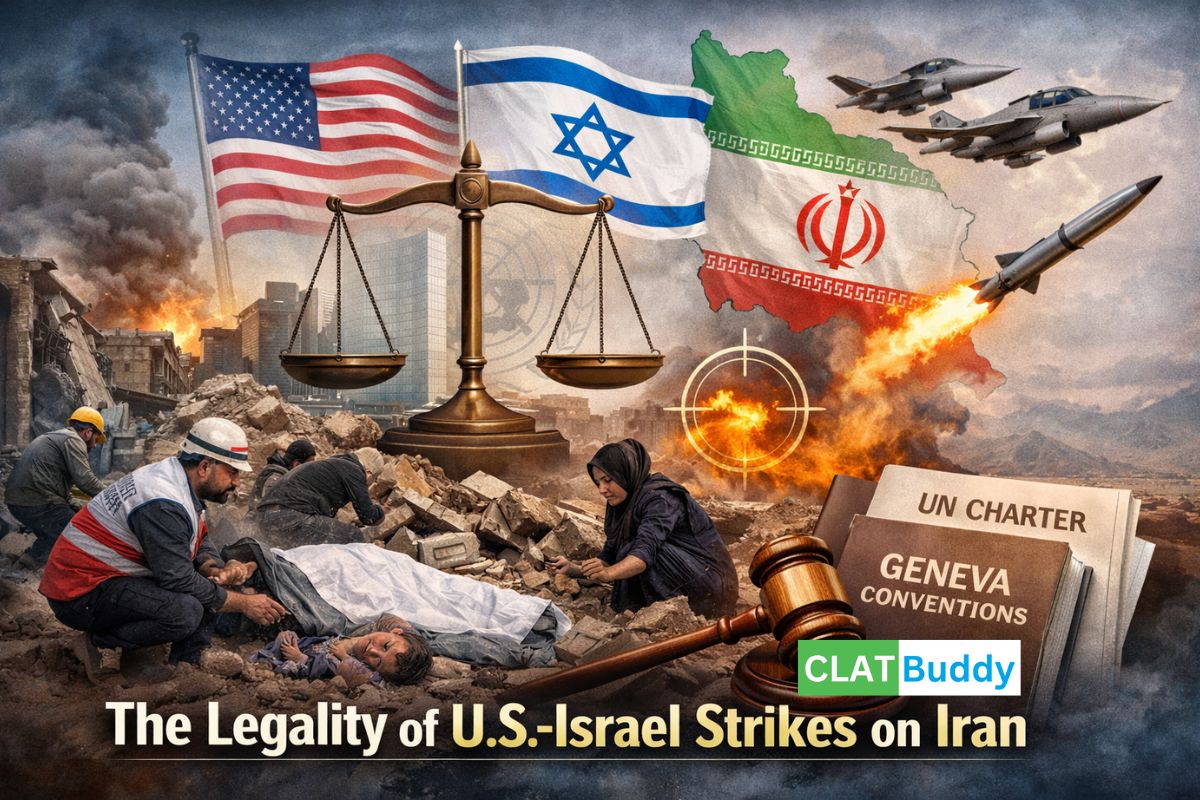
Recent coordinated military strikes by the United States and Israel on targets in Iran have raised serious questions about the legality of the operation under international law. The controversy intensified after reports emerged that a missile strike hit a girls’ primary school in the southern Iranian city of Minab, killing around 150 people and injuring nearly 100 others. Many of the victims were reportedly schoolchildren.
The incident has drawn global condemnation, including from UNESCO, which described the attack as a grave violation of International Humanitarian Law (IHL), commonly referred to as the “laws of war”. The episode has triggered a wider debate about whether the strikes themselves were lawful and whether the manner in which they were conducted violated international legal principles.
This article explains the legal framework governing the use of force between states and how the strikes may be evaluated under international law.
The legality of military action between countries is primarily governed by the United Nations Charter, adopted in 1945 after the devastation of the Second World War. The Charter was designed to prevent future global conflicts and maintain international peace and security.
Article 2(4) of the UN Charter establishes a fundamental rule:
States must refrain from the threat or use of force against the territorial integrity or political independence of another state.
This provision effectively prohibits unilateral military action by one state against another. The use of force is permitted only in two limited circumstances:
In the case of the U.S.-Israel strikes on Iran, no authorisation appears to have been issued by the UN Security Council. Therefore, the legality of the operation depends largely on whether it can be justified as an act of self-defence.
Article 51 of the UN Charter allows states to use force in self-defence if an armed attack occurs against them. This right exists until the UN Security Council takes measures to restore international peace and security.
For the use of force to qualify as lawful self-defence, certain conditions must generally be satisfied:
Reports indicate that Iran had not recently launched an armed attack against either the United States or Israel. In the absence of such an attack, invoking Article 51 becomes legally difficult.
As a result, the justification offered for the strikes has largely relied on the theory of “anticipatory self-defence”.
Anticipatory self-defence refers to the use of force to prevent an imminent attack before it actually occurs. Some states argue that international law permits such pre-emptive action when a threat is immediate and unavoidable.
However, this doctrine remains highly controversial in international law. Many legal scholars maintain that Article 51 permits self-defence only after an armed attack has taken place, not before.
Even those who accept the concept of anticipatory self-defence generally insist on strict conditions. These conditions typically include:
In the present case, questions arise regarding whether these conditions were satisfied. Reports indicate that earlier U.S. strikes in June 2025 had already significantly weakened Iran’s nuclear capabilities. At the time, U.S. leadership publicly stated that Iran’s nuclear programme had been “obliterated”.
Since then, no publicly available evidence has demonstrated that Iran had revived the programme or was preparing an imminent attack against either the United States or Israel.
If such evidence does not exist, the argument for anticipatory self-defence becomes considerably weaker under international law.
Another possible justification sometimes cited in international conflicts is humanitarian intervention or regime change. However, these grounds do not have a clear basis under the UN Charter.
International law generally does not recognise unilateral military intervention to change the government of another state. Similarly, intervention to protect a foreign population from its own government is controversial unless authorised by the UN Security Council.
Without such authorisation, these justifications are unlikely to provide a lawful basis for the use of force.
Even if the legality of starting the conflict remains disputed, the conduct of hostilities is governed by a separate body of law known as International Humanitarian Law (IHL).
IHL regulates how wars are fought. Its objective is to limit human suffering during armed conflict.
The modern framework of IHL is largely derived from the Geneva Conventions of 1949 and subsequent treaties. These rules protect civilians, prisoners of war, and the wounded while restricting certain methods of warfare.
Importantly, IHL applies regardless of whether the war itself was lawful. Even if the use of force is legally justified, violations of IHL can still occur during the conduct of military operations.
International law therefore distinguishes between:
IHL is built around several core principles that regulate military operations. The four most important principles are:
Each of these principles plays a role in assessing whether the Minab school strike violated international law.
The principle of distinction requires parties in a conflict to distinguish between:
Attacks may only be directed against military objectives. Civilian objects such as schools, hospitals, places of worship, and residential buildings must not be targeted.
If there is doubt about whether a structure is a military objective, it must be treated as civilian.
Reports indicate that the missile strike hit a girls’ primary school in Minab. Schools are clearly recognised as civilian objects under international law. Attacks intentionally directed against such buildings would constitute serious violations of IHL.
Additional protections also arise from international treaties concerning children.
The Convention on the Rights of the Child reinforces the protection of children during armed conflict. Article 38 requires states to take all feasible measures to ensure the protection and care of children affected by war.
Furthermore, the Rome Statute of the International Criminal Court (ICC) identifies certain acts as war crimes, including:
However, an important legal qualification exists. Civilian objects may lose their protected status if they are used for military purposes.
For example, a school being used as:
could legally become a military objective.
At present, there is no publicly available evidence indicating that the school in Minab was being used for such purposes.
Another possibility is that the school was not intentionally targeted but was damaged as collateral damage during an attack on a nearby military installation.
Some reports suggest that the intended target may have been a facility belonging to Iran’s Islamic Revolutionary Guard Corps (IRGC).
International humanitarian law recognises that civilian harm may sometimes occur during attacks on legitimate military targets. However, such incidental damage must satisfy strict legal conditions.
Under the principle of proportionality, attacks are unlawful if the expected civilian harm is excessive in relation to the concrete and direct military advantage anticipated.
In simpler terms, commanders must weigh the military benefit of the strike against the risk to civilians.
If a strike on a military facility is likely to cause large-scale civilian casualties, the attack may be considered disproportionate and therefore illegal.
In the Minab incident, reports of around 150 deaths, many of them children, raise serious questions about whether the expected military advantage justified the foreseeable civilian harm.
The principle of precaution requires military forces to take all feasible steps to minimise harm to civilians.
These precautions may include:
Failure to take such precautions may result in a violation of international humanitarian law.
Critics often argue that international law has little practical relevance because states frequently violate it during conflicts. However, this view overlooks the broader role international law plays in global governance.
International law does not operate like domestic criminal law with a central enforcement authority. Instead, it functions through norms, diplomacy, and international accountability.
Despite occasional violations, the majority of international interactions—from aviation and trade to environmental agreements—continue to operate within legal frameworks.
Even when violations occur, international law performs an important role by requiring states to justify their actions before the international community.
Legal scrutiny helps identify violations, mobilise diplomatic pressure, and potentially trigger international investigations or sanctions.
The strikes on Iran illustrate the continuing tension between geopolitical strategy and international legal norms.
If the use of force cannot be convincingly justified under self-defence or Security Council authorisation, the operation risks being viewed as inconsistent with the UN Charter.
At the same time, the alleged strike on a school raises urgent concerns under international humanitarian law regarding civilian protection, proportionality, and precaution.
Investigations by international organisations, human rights bodies, or potential war crimes tribunals may ultimately determine whether legal violations occurred.
The controversy surrounding the U.S.-Israel strikes on Iran highlights two central questions in international law. The first concerns the legality of initiating the use of force under the UN Charter. The second concerns the legality of how that force was used under International Humanitarian Law.
While the doctrine of self-defence remains the primary justification offered by states in such circumstances, its application is tightly constrained by legal requirements. Similarly, even lawful military operations must comply with strict humanitarian principles designed to protect civilians.
When civilian structures such as schools become sites of destruction, the legal and moral scrutiny intensifies. Beyond questions of legality, such incidents underline the enduring purpose of international law: to restrain the violence of war and protect those who are most vulnerable in times of conflict.