
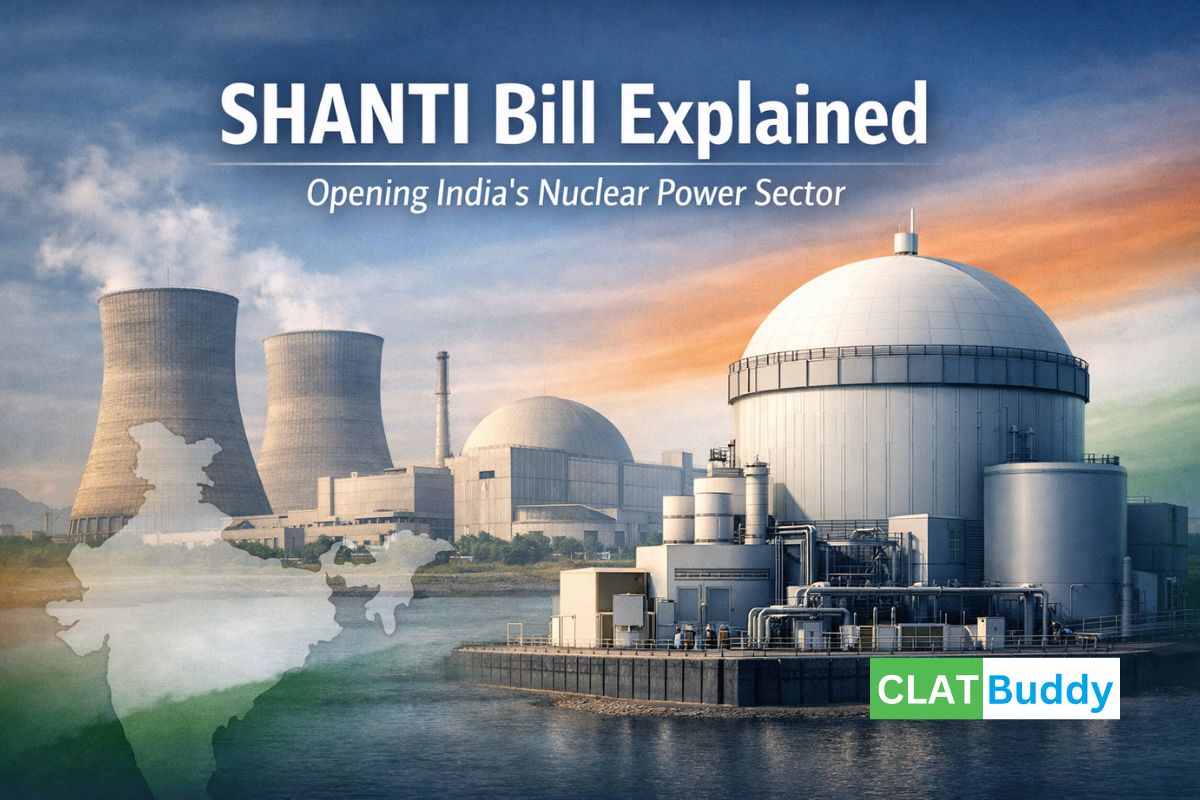
The SHANTI Bill Explained 

Parliament has passed the Sustainable Harnessing and Advancement of Nuclear Energy in India (SHANTI) Bill, marking a major shift in India’s nuclear power policy. For the first time since independence, India’s nuclear power sector is being opened—partly—to private and foreign participation. The move has generated strong support from the government and sharp criticism from the Opposition. Understanding what the Bill changes, and why it matters, is important because nuclear energy affects national security, public safety, electricity supply, and long-term development.

Background: Why This Bill Was Needed

India’s nuclear power sector has been almost entirely controlled by the government since 1956. Two main laws shaped this structure:

  • Atomic Energy Act, 1962 – kept nuclear power under strict State control
  • Civil Liability for Nuclear Damage Act, 2010 – imposed strict liability on operators and allowed suppliers to be sued

Because of these laws, private Indian companies and foreign firms stayed away from India’s nuclear sector. At the same time, India’s electricity demand has grown rapidly. Coal still supplies a large part of power, while renewable energy like solar and wind cannot always provide uninterrupted electricity due to weather and storage limitations.

To address these challenges, the government announced a Nuclear Energy Mission, allocating ₹20,000 crore for advanced reactors and Small Modular Reactors (SMRs). The SHANTI Bill is the legal foundation for this mission.

What Is the SHANTI Bill?

The SHANTI Bill is a comprehensive law that changes how nuclear power projects can be developed in India.

Key Change

The biggest change is that private Indian companies can now own, build, and operate nuclear power plants, something that was earlier allowed only for government-owned entities.

Ownership Structure

  • Up to 49% private participation is allowed
  • At least 51% government control is mandatory
  • Sensitive areas like nuclear fuel, waste management, safety systems, and licensing remain fully under government control

This structure is meant to attract private investment while ensuring national security and safety.

End of NPCIL Monopoly

Until now, nuclear power plants were operated only by the Nuclear Power Corporation of India Limited (NPCIL). The SHANTI Bill ends this monopoly.

Under the new system:

  • Private companies and joint ventures can operate nuclear plants
  • Private players can participate in fuel fabrication, equipment manufacturing, operations, and research
  • The model is based on public–private partnership, with government oversight at every critical stage

Focus on Advanced Nuclear Technology

The Bill encourages the use of:

  • Small Modular Reactors (SMRs) – smaller, safer, and quicker to build
  • Indigenous reactor designs
  • Advanced pressurised water reactors

These technologies support India’s clean energy transition and long-term energy security.

Role of the Nuclear Regulator (AERB)

The Atomic Energy Regulatory Board (AERB), which earlier functioned under executive control, has now been given statutory status. This means:

  • It is accountable to Parliament
  • It regulates nuclear safety, radiation protection, and emergency preparedness
  • It issues licences and safety standards
  • It conducts inspections to prevent radiation hazards

With more private players entering the sector, AERB’s role becomes even more critical. However, critics argue that concentrating too much power in one regulator may reduce checks and balances.

Safeguards Under the Bill

The Bill includes several safeguards to maintain control and safety:

  • No explicit permission for foreign direct investment
  • Mandatory authorisation from the regulator for every stage—from construction to waste disposal
  • Government control over:
    • Spent fuel reprocessing
    • High-level radioactive waste
    • Heavy water production
    • Uranium enrichment and isotope separation

A nuclear liability fund will also be created to provide compensation in case of nuclear accidents.

What Has Changed in Nuclear Liability?

This is one of the most controversial parts of the Bill.

Liability Caps Introduced

The Bill fixes clear liability limits:

  • ₹3,000 crore for large plants (3,600 MW)
  • ₹1,500 crore for medium plants (1,500–3,600 MW)
  • ₹100 crore for Small Modular Reactors (150 MW)

Penalties for severe violations are capped at ₹1 crore.

Government Takes Over Beyond the Cap

If damages exceed the operator’s liability, the Union government will bear the remaining cost, supported by the nuclear liability fund.

Major Change

Earlier, operators could sue suppliers for faulty equipment or defective design. The SHANTI Bill removes supplier liability completely, making nuclear projects more attractive for foreign and private companies.

Government’s Justification

The government argues that the Bill is essential for:

  • Energy security – ensuring uninterrupted electricity supply
  • Reducing coal dependence
  • Meeting climate commitments, including net-zero emissions by 2070
  • Stable baseload power, unlike solar and wind
  • Reviving stalled nuclear cooperation with countries like the U.S., France, and Japan
  • Reducing over-dependence on Russia

According to the government, nuclear power is clean, reliable, and necessary for India’s economic growth.

Why Nuclear Energy Is Important for India

India faces several energy challenges:

  • Renewable energy depends on weather and geography
  • Energy storage remains expensive
  • Electricity demand is rising with urbanisation and industrial growth

Nuclear power provides continuous, affordable baseload electricity with very low carbon emissions. For a growing economy, this stability is crucial.

India’s Existing Nuclear Programme

India already has a strong indigenous nuclear programme:

  • 25 reactors across 7 power plants
  • 21 pressurised heavy water reactors
  • 4 light water reactors

India has developed expertise in:

  • Reactor design and operation
  • Spent fuel reprocessing
  • Nuclear waste handling
  • Fast breeder reactors for thorium utilisation

This makes India largely self-reliant in nuclear technology.

Why the Opposition Is Opposing the Bill

The Opposition has raised serious concerns:

Accountability and Safety

  • Private companies earn profits, but the State bears accident liability
  • Supplier liability has been completely removed
  • The liability cap is considered too low compared to actual damage costs

Examples like Chernobyl and Fukushima are cited, where damages ran into trillions. Fukushima’s actual damages were many times higher than the proposed liability cap.

Transparency and RTI Concerns

  • A provision in the Bill overrides parts of the RTI Act, 2005
  • Nuclear plant data, safety reports, and operational details may become “restricted”
  • This limits public scrutiny and accountability

Workers’ Rights

  • Nuclear workers are removed from general labour safety laws
  • Occupational safety rules are diluted
  • Trade unions have strongly opposed this change

Lack of Public Participation

The Bill does not mandate:

  • Public hearings
  • Environmental impact assessment disclosures
  • Community consent
  • Regular public safety reporting
  • Parliamentary oversight mechanisms

Pro-Profit Bias

The Opposition argues that:

  • The Bill favours private and corporate interests
  • Public safety and environmental risks are underestimated
  • India’s thorium-based indigenous technology is sidelined
  • Other countries, like France, keep nuclear power fully under State control

Conclusion

The SHANTI Bill represents one of the most significant policy shifts in India’s energy sector. It promises investment, technology, and cleaner power but also raises serious questions about safety, accountability, transparency, and public trust.

Whether the Bill strengthens India’s energy future or creates long-term risks will depend entirely on how strictly it is implemented, regulated, and monitored in the years ahead.



Calling all law aspirants!

Are you exhausted from constantly searching for study materials and question banks? Worry not!

With over 15,000 students already engaged, you definitely don't want to be left out.

Become a member of the most vibrant law aspirants community out there!

It’s FREE! Hurry!

Join our WhatsApp Groups (Click Here) and Telegram Channel (Click Here) today, and receive instant notifications.

CLAT Buddy
CLAT Buddy
CLATBuddy Popup Banner New