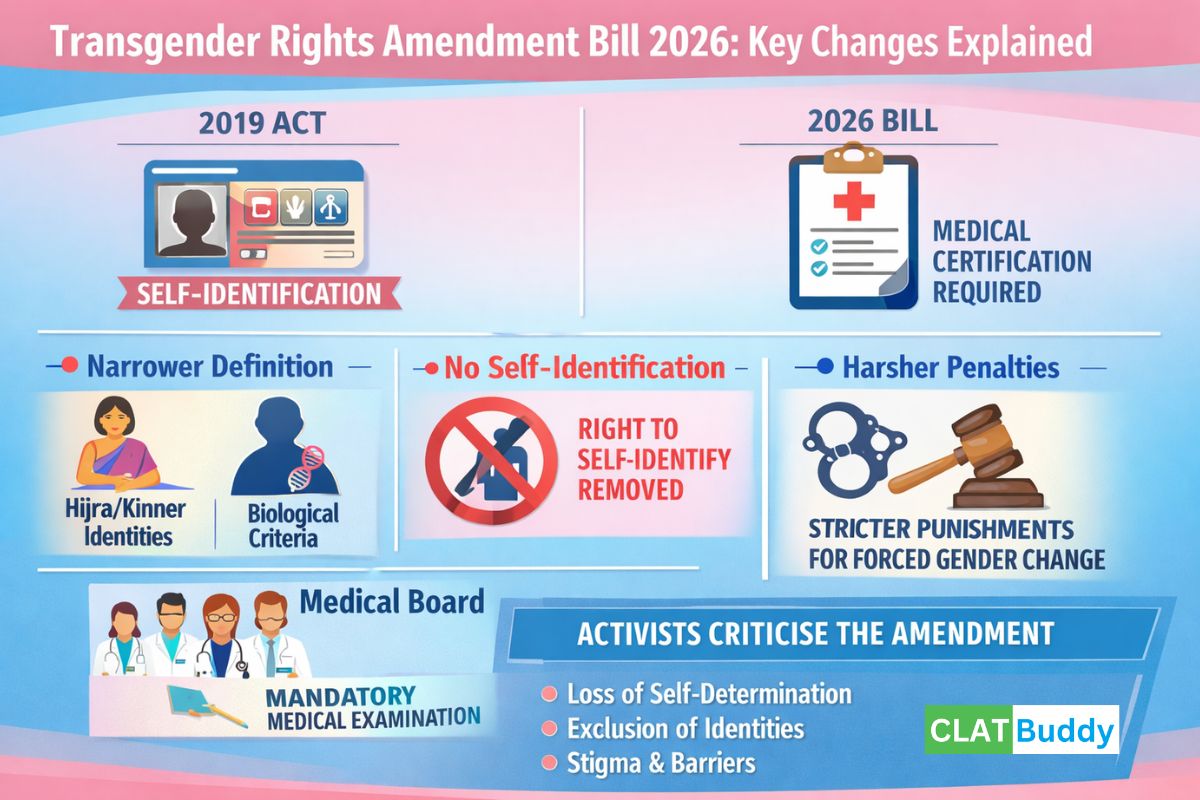
The Central Government has introduced the Transgender Persons (Protection of Rights) Amendment Bill, 2026 in Parliament, proposing significant changes to the existing 2019 law governing transgender rights in India. The Bill, presented by the Ministry of Social Justice and Empowerment, has triggered widespread debate, particularly over its departure from the principle of self-identification recognised by the Supreme Court.
Background: Existing Legal Position
The legal framework for transgender rights in India is rooted in the landmark NALSA v Union of India (2014) judgment, where the Supreme Court:
- Recognised transgender persons as the “third gender”
- Affirmed that fundamental rights apply equally
- Established the right to self-identification of gender
This judgment led to the enactment of the Transgender Persons (Protection of Rights) Act, 2019, which:
- Provided a broad definition of transgender persons
- Allowed individuals to self-identify their gender without medical examination
- Introduced a system of identity certificates issued by District Magistrates
- Enabled access to welfare schemes through transgender identity cards
Key Changes Proposed in the 2026 Amendment
1. Narrower Definition of Transgender Persons
The Bill restricts the definition to:
- Persons belonging to socio-cultural communities such as hijra, kinner, aravani
- Individuals with specific biological or congenital variations
This replaces the broader, inclusive definition under the 2019 Act, which covered non-binary and gender-fluid identities.
2. Removal of Right to Self-Identification
- The Bill removes Section 4(2) of the 2019 Act
- Individuals will no longer be able to self-identify their gender
The government has stated that the earlier provision was “vague” and made identification of beneficiaries difficult.
3. Introduction of Medical Certification
A key structural change is the introduction of a Medical Board:
- Headed by a Chief or Deputy Chief Medical Officer
- Responsible for assessing applications for gender identity
The District Magistrate will issue identity certificates only after considering the Board’s recommendation.
4. New Category for Forced Gender Transformation
The Bill recognises persons who are:
- Forced into assuming a transgender identity through
- Mutilation
- Castration
- Surgical or hormonal procedures
This aims to address cases of coercion and exploitation.
5. Stricter Penal Provisions
The amendment expands punishments for offences against transgender persons:
- Forced gender transformation (adult):
- Minimum 10 years imprisonment, extendable to life
- Fine of at least ₹2 lakh
- Forced gender transformation (child):
- Life imprisonment
- Fine of at least ₹5 lakh
- Forced begging or servitude:
- 5–10 years imprisonment for adults
- 10–14 years imprisonment for children
Criticism and Concerns
The Bill has been criticised by transgender rights activists and organisations. Key concerns include:
- Loss of self-determination: Removal of the right to self-identify gender
- Medicalisation of identity: Requirement to prove identity through medical procedures
- Exclusion of identities: Non-binary and gender-fluid persons may not be recognised
- Practical barriers: Accessing medical boards may be difficult due to social stigma
Conclusion
The Transgender Rights Amendment Bill, 2026, marks a significant shift from the existing framework. While it strengthens provisions against exploitation, it moves away from a rights-based approach centred on dignity and autonomy. The proposed changes are likely to be closely examined for their alignment with constitutional principles laid down by the Supreme Court.
Calling all law aspirants!
Are you
exhausted from constantly searching for study materials and question banks?
Worry not!
With over
15,000 students already engaged, you definitely don't want to be left out.
Become a member of the most vibrant law aspirants community out there!
It’s
FREE! Hurry!
Join our
WhatsApp Groups (
Click Here) and
Telegram Channel (Click Here) today, and receive instant notifications.