
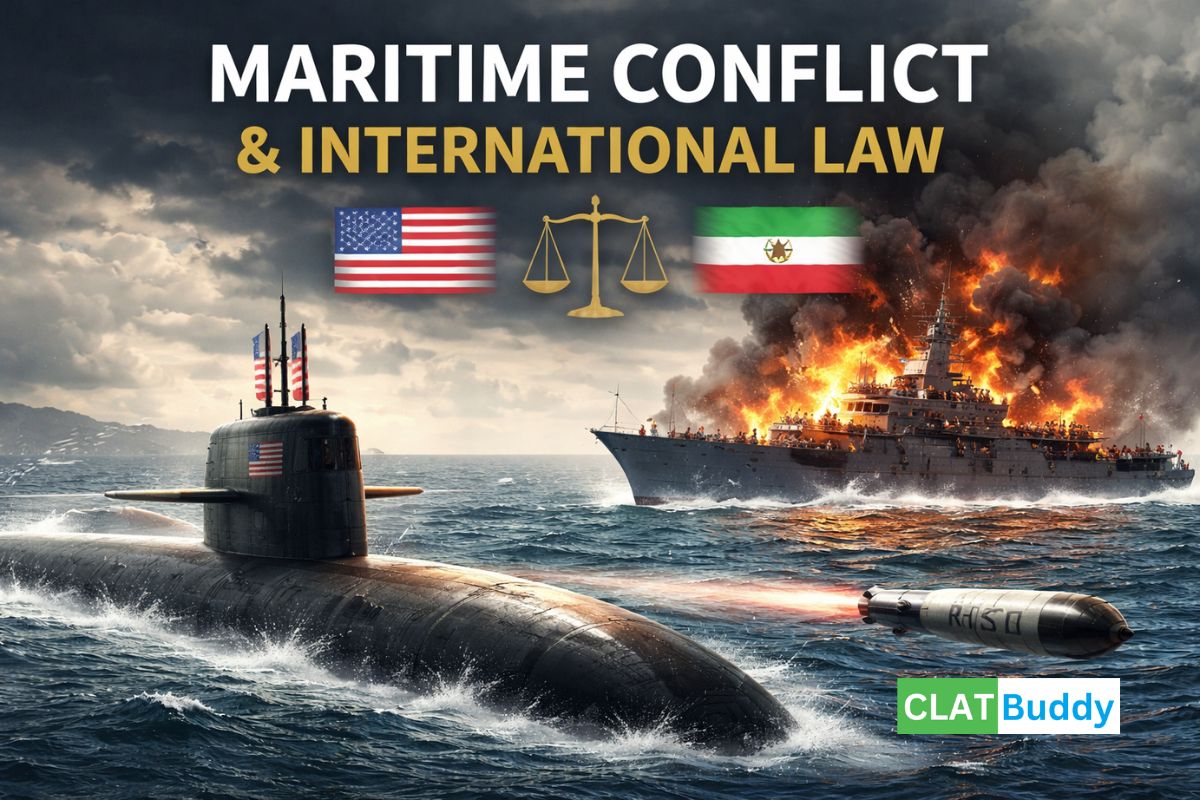
A recent naval incident in the Indian Ocean has triggered international debate on the legality of military action in international waters. On March 4, a United States submarine reportedly torpedoed the Iranian warship IRIS Dena near the coast of Sri Lanka, resulting in the deaths of at least 80 sailors. The attack occurred while the ship was returning from a multilateral naval exercise organised by the Indian Navy near Visakhapatnam.
The incident has widened the scope of the ongoing tensions involving the United States, Israel, and Iran, extending the theatre of conflict from West Asia into waters close to India. It has also sparked discussions among security experts about maritime law and the legal framework governing naval warfare.
According to reports, the Iranian frigate IRIS Dena was torpedoed by a US submarine outside Sri Lanka’s territorial waters. The vessel had recently participated in MILAN-2026, an international naval exercise hosted by the Indian Navy.
The sinking of the warship has raised concerns about security in the Indian Ocean region. Given India’s strategic interests and naval presence in these waters, the incident has drawn particular attention from defence analysts and policymakers.
Experts have pointed out that once a vessel enters international waters, the ability of nearby countries to intervene or protect the ship becomes extremely limited under international law.
The legal framework governing maritime activity is primarily derived from the United Nations Convention on the Law of the Sea (UNCLOS). This treaty regulates issues such as maritime boundaries, navigation rights, and resource use.
However, UNCLOS mainly deals with peacetime maritime governance. It does not provide detailed rules on the conduct of hostilities at sea.
Importantly, the United States is not a signatory to UNCLOS. Nevertheless, many of its principles are recognised as customary international law and are widely followed by states.
When armed conflict occurs at sea, another body of law comes into operation: the law of naval warfare. These rules exist alongside UNCLOS and govern military operations during maritime conflicts.
Under these principles, a warship belonging to a belligerent state may be considered a legitimate military target during an armed conflict, regardless of whether it is actively participating in combat at that moment.
Another key legal framework relevant to the incident is the United Nations Charter, particularly provisions relating to the use of force.
Article 2(4) of the Charter generally prohibits states from using force against the territorial integrity or political independence of another state. However, the Charter also recognises certain exceptions.
Article 51 of the UN Charter allows a state to exercise its right of individual or collective self-defence if it faces an armed attack.
If the United States considered the Iranian vessel to pose a threat linked to ongoing hostilities, it could potentially argue that the strike was justified under this provision.
Another possible legal justification for military action is authorisation from the United Nations Security Council under Chapter VII of the UN Charter.
Such authorisation allows member states to use force to maintain or restore international peace and security. However, obtaining this approval is often difficult because it requires a majority vote and no veto from any of the five permanent members of the Security Council.
The Iranian frigate had previously been placed under sanctions by the US Treasury Department in February 2023. The sanctions were imposed along with restrictions on executives of an Iranian drone manufacturing company called Paravar Pars.
According to the US government, Iran had been supplying unmanned aerial vehicles (UAVs) used by Russia in its military operations targeting infrastructure in Ukraine.
However, sanctions do not necessarily prevent a naval vessel from participating in international maritime exercises during peacetime. Such restrictions typically apply to financial transactions, trade, and commercial dealings rather than naval movements.
At the time of the attack, the warship was believed to have been equipped with standard defensive systems such as close-in weapon systems and area defence mechanisms.
The legality of the strike remains contested, with experts offering differing interpretations of international law.
Vice Admiral G Ashok Kumar (Retd), former Vice Chief of the Indian Navy and India’s first National Maritime Security Coordinator, stated that the maritime domain does not impose strict geographical limitations on war zones.
According to him, once hostilities begin, naval operations may extend beyond traditional conflict zones.
He also noted that the incident occurred within Sri Lanka’s Exclusive Economic Zone (EEZ), allowing Sri Lankan authorities to quickly initiate search and rescue operations.
However, other experts have questioned whether the strike was legally justified.
Rear Admiral Sudhir Pillai (Retd) argued that the use of force against a foreign warship on the high seas is generally presumed unlawful unless it is clearly justified as part of an ongoing armed conflict or an act of self-defence.
He observed that a military strike in such circumstances would need to satisfy the conditions laid down under Article 51 of the UN Charter.
A senior Indian Navy official also described the attack as a significant escalation in the broader geopolitical conflict involving the United States, Israel, and Iran.
According to the official, the Iranian vessel was reportedly on a peaceful passage when it was attacked, and it was not located in a recognised conflict zone at the time.
The incident has also highlighted the growing strategic importance of the Indian Ocean region. As major powers increasingly project naval strength in these waters, concerns over maritime security and freedom of navigation are likely to intensify.
For India, which maintains a strong naval presence in the region, the development underscores the complexities of managing security in a heavily contested maritime environment.
The fact that the warship had recently participated in a naval event hosted by the Indian Navy has added another dimension to the geopolitical implications of the episode.
The sinking of the Iranian warship IRIS Dena has raised complex legal and strategic questions about the rules governing warfare at sea. While international maritime law provides a framework for navigation and jurisdiction, the conduct of naval warfare is largely governed by separate legal principles.
Whether the attack can be justified under international law depends largely on factors such as the existence of armed conflict, the applicability of self-defence under the UN Charter, and the interpretation of the law of naval warfare.
As tensions continue to escalate in different parts of the world, incidents such as this highlight the continuing challenges of regulating military action in international waters and maintaining stability in strategically important maritime regions.